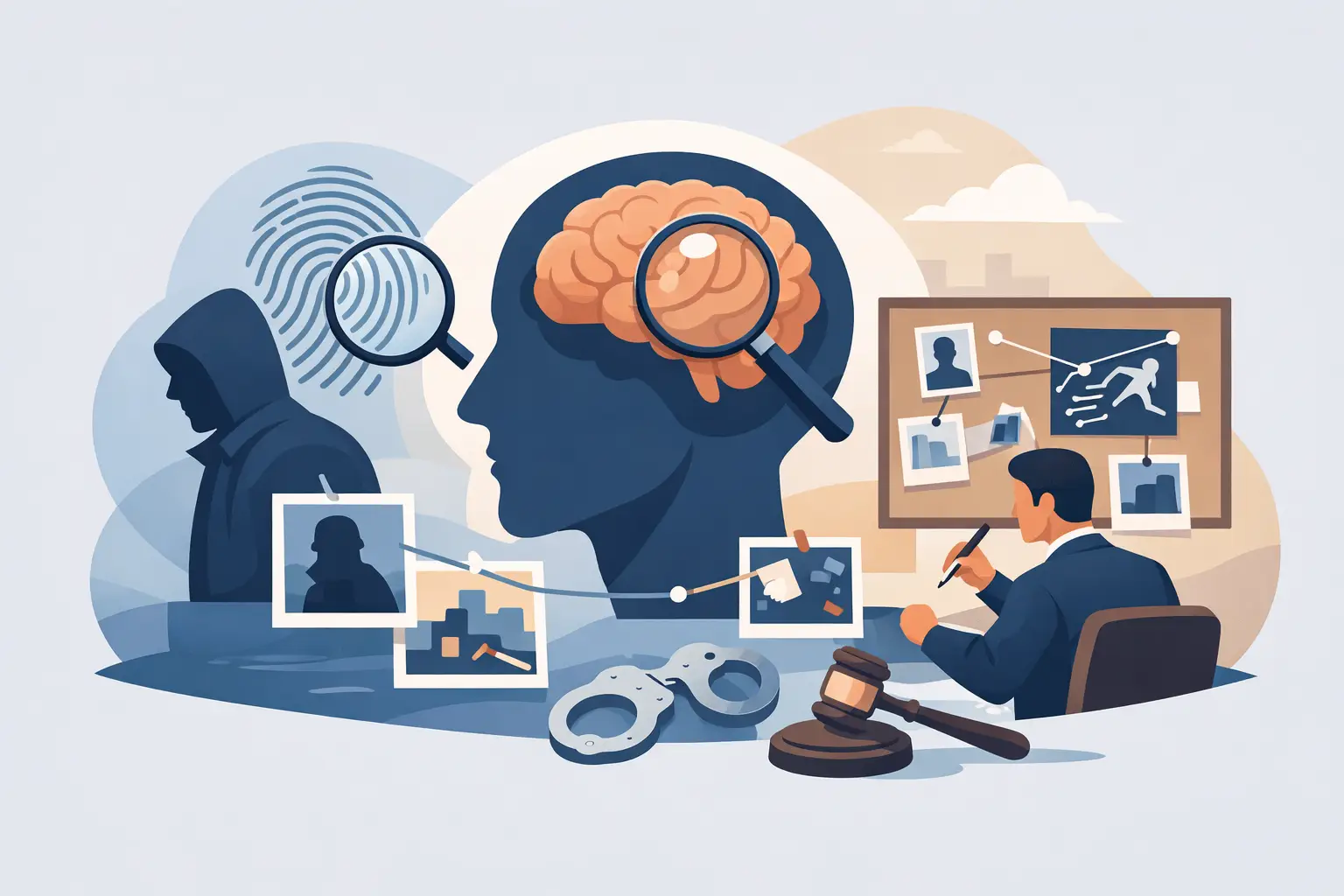
A common question among aspiring investigators, psychology graduates, and mid-career professionals is this: is criminal profiling forensic psychology? The short answer is no, not exactly. Criminal profiling and forensic psychology overlap in meaningful ways, but they are not interchangeable fields, and treating them as synonyms can create confusion about training, practice, and career paths.
That distinction matters more than it may seem. If you are choosing a graduate program, planning a transition into investigative work, or building expertise in behavioral science, the difference affects what you study, what credentials you may need, and the kinds of problems you will be prepared to solve.
Is criminal profiling forensic psychology, or a separate specialty?
Criminal profiling is best understood as a specialized applied practice that uses behavioral analysis to generate investigative insight. It examines crime scene behavior, victimology, offender patterns, and decision-making in order to develop hypotheses about an unknown offender. Those hypotheses may help investigators prioritize leads, assess risk, or identify patterns across cases.
Forensic psychology is broader and more formally defined. It applies psychological science to legal, criminal, and civil justice contexts. That can include competency evaluations, risk assessment, expert testimony, offender treatment, eyewitness issues, jury behavior, trauma assessment, and consultation within courts, corrections, and law enforcement settings.
So, is criminal profiling forensic psychology? In many cases, profiling draws on psychological principles, but it does not represent the whole of forensic psychology. In fact, some profiling work is shaped as much by criminology, investigative analysis, and behavioral pattern recognition as by clinical or forensic psychological training.
A useful way to think about it is this: forensic psychology is a field. Criminal profiling is a narrower activity that may sit beside it, intersect with it, or sometimes be informed by it.
Where the overlap is real
The confusion exists for a reason. Criminal profiling and forensic psychology both focus on human behavior in high-stakes settings. Both may ask why a person acted in a certain way, what patterns can be identified, and what behavioral evidence can tell us about intent, escalation, deception, or future risk.
A forensic psychologist may evaluate violence risk, analyze behavioral functioning, or interpret the psychological dimensions of criminal conduct. A profiler may assess modus operandi, signature behavior, offender fantasy, and interaction patterns between offender and victim. In both cases, the professional is using structured reasoning about behavior rather than relying on intuition alone.
The two areas also meet in multidisciplinary environments. Law enforcement agencies, correctional institutions, legal teams, and consulting settings often bring together professionals from psychology, criminology, intelligence, and investigation. In practice, behavioral expertise rarely lives in a single silo.
That said, overlap does not mean equivalence. A person can be highly trained in forensic psychology without ever conducting criminal profiles. Likewise, someone working in behavioral crime analysis may not be licensed as a psychologist or trained to perform forensic mental health evaluations.
The key differences in purpose and method
The clearest difference is purpose. Forensic psychology often serves legal and clinical functions. It may address questions such as whether a defendant is competent to stand trial, whether someone presents a measurable risk of reoffending, or how trauma affects memory and testimony.
Criminal profiling serves an investigative function. It is generally concerned with narrowing possibilities, identifying behavioral patterns, and supporting case strategy when the offender is unknown or not fully understood. It is less about diagnosing a person in the clinical sense and more about interpreting behavior within the context of a crime.
Method matters too. Forensic psychology typically relies on established psychological assessment tools, interview methods, diagnostic frameworks, research literature, and legal standards. Criminal profiling may use case linkage analysis, crime scene assessment, geographic and temporal patterns, victimology, and behavioral typologies. Some approaches are more evidence-based than others, which is one reason profiling continues to generate debate.
That debate is healthy. Popular culture often presents profiling as near-magical deduction. Serious professionals know it is far less dramatic and far more constrained. Profiling can offer useful hypotheses, but it is not a substitute for physical evidence, witness work, digital forensics, or rigorous investigative procedure.
Why the term creates confusion
Part of the problem is that “criminal profiling” is used loosely. In media, it can refer to everything from offender analysis to interrogation strategy to threat assessment. In academic and professional settings, those are related but distinct functions.
Another source of confusion is that psychology carries public authority. When a behavioral analysis sounds psychologically informed, people often assume it falls under forensic psychology. Sometimes that assumption is justified. Sometimes it is not.
For adult learners considering advanced study, this is where precision becomes valuable. If your interest is clinical assessment in legal settings, a forensic psychology pathway may be appropriate. If your interest is offender behavior, investigative analysis, threat assessment, or applied behavioral interpretation, you may need a program that integrates psychology with criminology, law enforcement practice, and analytical methods.
Is criminal profiling forensic psychology in academic training?
In education, the answer is often “partly, depending on the curriculum.” Some forensic psychology programs include coursework on offender behavior, violence, psychopathology, and criminal conduct that can support profiling-related knowledge. Others focus more heavily on assessment, treatment, ethics, and court-related practice.
By contrast, programs centered on criminal profiling or behavioral analysis tend to emphasize investigative applications. They may focus on homicide analysis, sexual offending patterns, victim selection, deception, threat assessment, and case interpretation. These subjects can be psychologically informed without being identical to graduate clinical training.
This is an important distinction for professionals who want career-relevant expertise rather than a broad label. A program title alone does not tell you enough. Course design, faculty background, methodological orientation, and applied outcomes matter more.
That is one reason specialized institutions such as Evidentia University appeal to working professionals seeking focused education in forensic and behavioral sciences. In niche fields, depth and practitioner relevance often matter more than general branding.
Career implications for students and professionals
If you are asking whether criminal profiling is forensic psychology, you may really be asking a career question. What kind of role do you want to hold, and what knowledge base will make you credible in that role?
If your goal is licensure as a psychologist, courtroom evaluations, or forensic mental health practice, you should follow the educational and regulatory path required for psychology in your jurisdiction. Criminal profiling alone will not substitute for that pathway.
If your goal is investigative behavioral analysis, intelligence support, interviewing strategy, threat management, or offender pattern analysis, a different educational blend may make more sense. You may need training in criminology, behavioral science, investigative reasoning, forensic methodology, and legal context rather than a purely clinical framework.
For some professionals, the strongest path is interdisciplinary. Law enforcement personnel may benefit from psychological literacy without becoming psychologists. Mental health professionals may deepen their impact by understanding investigative behavior and criminal decision-making. Security, compliance, and fraud professionals may use profiling-adjacent methods in threat and risk environments far beyond traditional violent crime.
This is where mature career planning becomes an advantage. The most effective specialists are often those who understand both the boundaries and the intersections of their field.
The evidence question
A serious discussion of profiling should also address evidence. Forensic psychology, while not free from controversy, is generally anchored in a more established research and professional framework. Criminal profiling includes methods that vary in empirical support.
Some behavioral analyses are highly structured and data-informed. Others rely too heavily on anecdotal experience or broad assumptions about offender types. That does not make profiling useless. It means it must be practiced with caution, methodological discipline, and humility.
Professionals in this space should be wary of overstating certainty. Behavioral evidence can guide inquiry, but it rarely speaks with one voice. Context matters. Culture matters. Offender behavior is adaptive, not fixed. What appears meaningful in one case may be misleading in another.
For graduate-level learners, this is exactly why advanced education matters. The goal is not to memorize profiles. It is to learn how to think critically about behavior, evidence, inference, and professional limits.
A better way to frame the question
Instead of asking only, “is criminal profiling forensic psychology,” a better question is: how do criminal profiling and forensic psychology intersect, and which kind of expertise do I want to build?
That framing is more useful because it moves the conversation from labels to competencies. It asks what problems you want to solve, what environments you want to work in, and what type of authority your future role will require.
In a field shaped by human complexity, legal consequence, and public safety, precision is not academic hair-splitting. It is professional responsibility. Criminal profiling can be informed by forensic psychology, but it is not simply another name for it. Understanding that difference is the first step toward choosing a path grounded in rigor, relevance, and real-world impact.
The strongest careers in behavioral and forensic sciences are rarely built on vague fascination. They are built on clear definitions, disciplined training, and the willingness to study human behavior with both ambition and restraint.