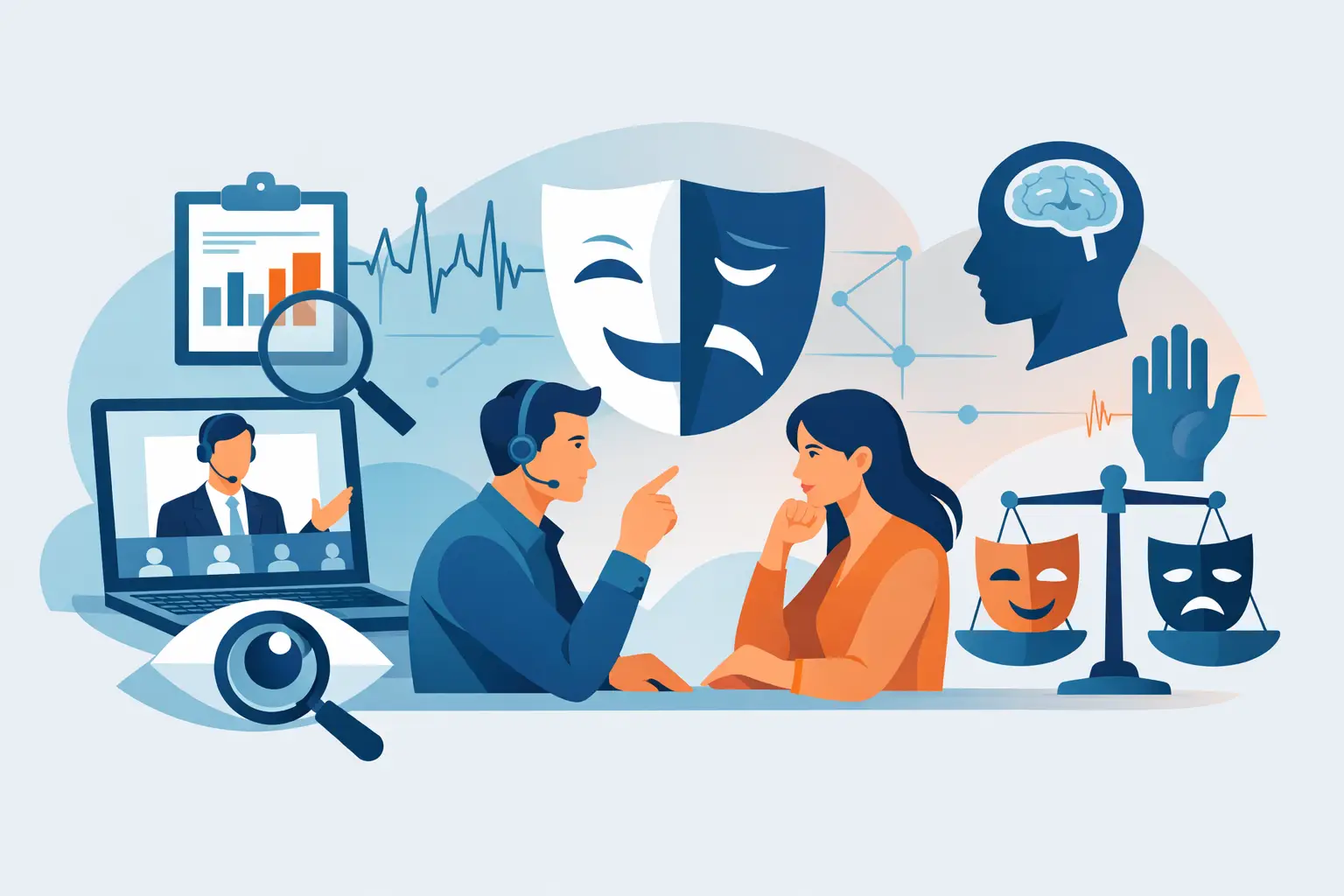
A statement that feels incomplete. A delayed answer to a simple question. A confident denial delivered with direct eye contact. These moments can raise concern, but they do not prove deception. Effective deception detection training online begins with that distinction: the professional task is not to spot a universal “liar’s tell.” It is to evaluate behavior, language, evidence, and context with disciplined skepticism.
For professionals in investigations, security, compliance, law enforcement, human resources, and behavioral research, that discipline matters. Decisions made after an interview can affect employment, safety, reputation, liberty, and organizational trust. Training in this field must therefore do more than make learners more alert to facial expressions. It must develop judgment that is scientifically informed, ethically grounded, and usable under pressure.
Why “Reading People” Is Not Enough
Popular culture has made deception detection look simpler than it is. A crossed arm, a fidget, an averted gaze, or a change in vocal tone is often treated as a reliable sign that someone is lying. Research does not support that certainty. People show stress, fear, cultural deference, neurodivergent communication patterns, fatigue, trauma responses, and ordinary discomfort for many reasons. None of these behaviors alone can diagnose deception.
This is the first professional advantage of serious study. Rather than asking, “What does this gesture mean?” trained practitioners ask better questions: What is this person’s normal communication style? What changed, when did it change, and what was being discussed? Does the account remain coherent when explored through open-ended questions? Is there independent evidence that confirms or challenges the statement?
The strongest approach treats behavioral observation as one source of information, not a verdict. It also recognizes a difficult reality: people are often overconfident in their ability to judge truthfulness. Training should reduce that overconfidence, not replace it with a more sophisticated version of the same bias.
What High-Quality Deception Detection Training Online Includes
Online learning can be especially valuable for working professionals because it allows rigorous study without requiring a geographic relocation or a pause in career responsibilities. But format alone does not make a program credible. The quality lies in what learners are asked to understand, practice, question, and apply.
A foundation in behavioral science
A credible curriculum begins with the psychology of memory, emotion, cognition, communication, and decision-making. Deception is not a single behavior. It is a strategic act shaped by motive, risk, relationship dynamics, cultural expectations, and the person’s ability to manage information.
Learners should examine why honest people can appear evasive and why deceptive people can seem calm. They should also understand the limits of memory. A confident witness may be mistaken; an uncertain witness may still be accurate. This distinction is essential for anyone conducting interviews or assessing reports in a high-stakes setting.
Evidence-based verbal and nonverbal analysis
Nonverbal communication belongs in the curriculum, but it should be taught with restraint. A meaningful course considers clusters of behavior, changes from an observable baseline, and the relationship between verbal content and nonverbal presentation. It avoids simplistic claims that one movement, expression, or posture reveals hidden intent.
Verbal analysis is equally important. Learners can study narrative structure, sensory detail, temporal sequence, qualification, distancing language, and strategic omissions. Yet these features require context. A sparse account may reflect deception, but it may also result from anxiety, limited recall, language barriers, or uncertainty about what is relevant.
The goal is not to turn ambiguity into certainty. It is to identify areas that deserve careful follow-up.
Interviewing and information-gathering skills
The quality of an interview often determines the quality of the information obtained. Training should emphasize rapport, clear question design, active listening, appropriate pacing, and strategic use of open-ended prompts. Professionals need to know how to seek clarification without becoming accusatory or contaminating an account.
For example, asking someone to recount an event in their own words may reveal more useful information than immediately confronting them with perceived inconsistencies. Follow-up questions can then test detail, chronology, source knowledge, and alternative explanations. This approach serves both investigative rigor and procedural fairness.
Training should also address when confrontation is inappropriate. In workplace inquiries, internal investigations, victim interviews, and sensitive security matters, a premature accusation can damage trust, distort recall, escalate risk, and expose an organization to legal or ethical consequences.
Ethics, bias, and professional accountability
The ability to influence another person through questioning carries responsibility. A serious program addresses confirmation bias, cultural bias, tunnel vision, false confessions, coercive practices, and the misuse of behavioral indicators. These are not peripheral topics. They are central to competent practice.
Professionals should learn to document observations precisely and separate what they saw from what they inferred. “The employee paused for 12 seconds before answering” is an observation. “The employee paused because they were lying” is an interpretation. Maintaining that distinction improves reports, supports fair review, and makes decisions easier to defend.
How Online Learning Can Build Real Competence
A common concern is whether a remote format can teach an applied subject well. It can, provided the learning experience is designed for practice rather than passive consumption. Recorded lectures have value, but they are not enough on their own.
Effective online instruction uses case analysis, annotated interview footage, scenario-based exercises, structured peer discussion, faculty feedback, and written assessments that require learners to justify their reasoning. These methods force students to weigh competing explanations instead of searching for a quick answer.
Practitioner-led instruction can add another layer of relevance. Faculty with backgrounds in policing, investigative psychology, compliance, criminology, or behavioral research can connect theory to decisions made in actual professional environments. Their role is not to offer shortcuts. It is to show how disciplined methods hold up when information is incomplete and consequences are real.
For adult learners, flexibility should not mean isolation. Strong online programs create intellectual exchange across sectors and borders. A security professional may bring a different perspective to a case than an HR investigator or a behavioral researcher. That diversity strengthens analysis because deception-related judgments are often shaped by the assumptions a practitioner brings into the room.
Choosing the Right Program for Your Goals
The best path depends on where and how you plan to apply the knowledge. A compliance professional may need a focused continuing education course on interview strategy and fraud indicators. A law enforcement or investigative professional may benefit from advanced study that combines behavioral science, interviewing, ethics, and case methodology. A student pursuing a career in forensic or behavioral sciences may need graduate-level depth, research literacy, and a broader conceptual foundation.
Before enrolling, examine whether a program clearly explains its learning outcomes and faculty expertise. Look for evidence that it distinguishes observation from inference, recognizes the limits of deception cues, and teaches methods that can be documented and evaluated. Be cautious of courses built around guaranteed lie detection or claims of near-perfect accuracy. Human behavior is more complex than those promises allow.
It is also worth considering how the coursework will transfer to your professional setting. If you work internationally, cultural competence and cross-border communication are not optional. If your role involves vulnerable populations, trauma-informed practice may be essential. If you conduct corporate investigations, legal standards, documentation, and privacy considerations may carry particular weight.
At Evidentia University, this kind of specialized study sits within a wider academic commitment to forensic and behavioral sciences, bringing research, applied perspectives, and global professional experience into the learning environment.
From Suspicion to Sound Judgment
Deception detection is often framed as the pursuit of a hidden answer: true or false, honest or dishonest. Professional practice is rarely that clean. The more valuable skill is learning to manage uncertainty without ignoring it. That means noticing meaningful inconsistencies, testing them fairly, seeking corroboration, and remaining open to explanations that do not fit an initial theory.
For the professional who wants greater credibility, this is the career-defining shift. The goal is not to become someone who claims to know when others are lying. It is to become someone whose observations, interviews, and decisions can withstand scrutiny.
That standard deserves serious preparation. The next time a conversation raises doubt, the most useful question may not be “Can I tell whether this person is deceptive?” It may be “What information, asked and assessed ethically, would allow me to reach a more defensible judgment?”