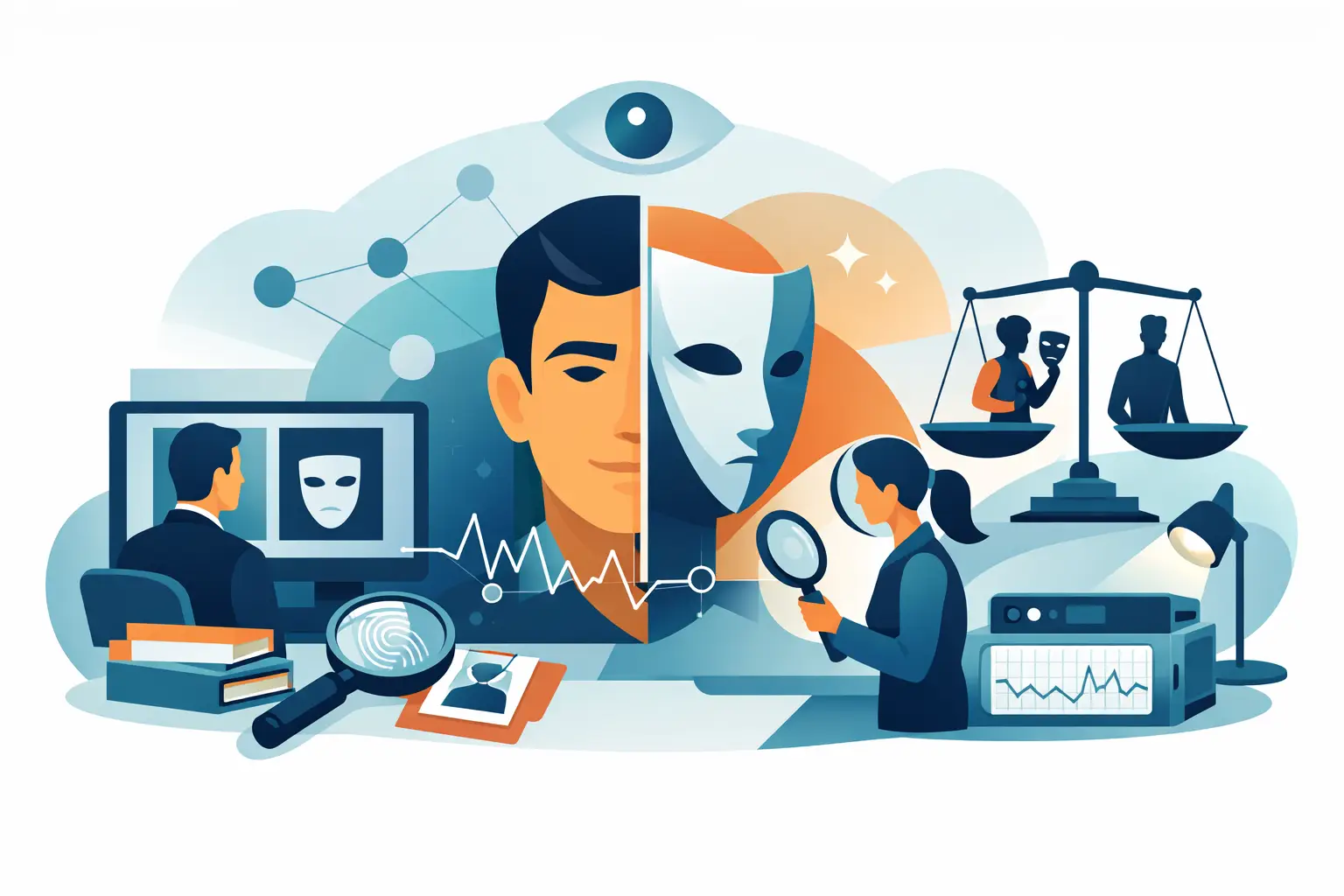
A subject may avoid eye contact, shift in a chair, answer too quickly, or offer an unusually detailed explanation. None of these behaviors proves deception. Understanding how deception detection works begins with this discipline: observable behavior can generate a question, but only evidence and careful assessment can support a conclusion.
For investigators, security professionals, compliance teams, interviewers, and behavioral specialists, the stakes are high. A false accusation can damage a person, an organization, and an investigation. A missed deception can expose victims, compromise assets, or permit misconduct to continue. Effective deception detection is therefore not the search for a single tell. It is a structured process of interviewing, analyzing information, testing accounts, and corroborating what can be verified.
Deception Is a Cognitive and Social Task
Deception usually requires more mental work than telling a straightforward truth. A deceptive person may need to construct an account, suppress relevant facts, anticipate questions, remember what has been said, and manage how they appear to others. That effort can create inconsistencies or behavioral changes, particularly when an interview becomes more specific or unexpected.
Yet cognitive effort is not unique to lying. A truthful person may struggle because of fear, trauma, cultural differences, memory limitations, language barriers, neurodiversity, or concern that they will not be believed. High-pressure interviews can make innocent people appear evasive. This is why professionals must distinguish between signs of stress and indicators that an account warrants further examination.
A more accurate question is not, “Does this person look deceptive?” It is, “What does this account predict, and can those predictions be tested?” That shift moves deception detection away from intuition and toward investigative reasoning.
How Deception Detection Works: A Multi-Source Process
Reliable assessment emerges from the relationship among verbal content, behavior, context, and independently available evidence. Each source has limits. Together, they can reveal where an account is coherent, where it changes, and where further inquiry is necessary.
Establishing context before interpreting behavior
Interviewers often begin by learning how a person communicates under relatively neutral conditions. This is sometimes described as establishing a baseline, but it should never be treated as a fixed personal standard. People do not behave consistently across all circumstances. A person can be calm while discussing routine matters and visibly distressed when discussing a painful but truthful event.
Context matters more than a checklist of gestures. The interviewer should consider the setting, relationship dynamics, power imbalance, cultural norms, prior experience with law enforcement or authority, sleep, medication, and the consequences the person believes may follow. A sudden change in speech rate or posture may be meaningful only when it appears alongside a specific topic, question, or contradiction.
Analyzing the account, not just the delivery
The content of an account is often more informative than eye movement, fidgeting, or vocal tone. Skilled interviewers listen for chronology, sensory detail, causal logic, and the natural complexity of real experiences. They also examine whether a person can clarify an account without simply repeating a rehearsed version.
Truthful narratives are not automatically perfect. Memory is reconstructive, and people commonly forget peripheral details. However, an account may deserve closer scrutiny when key elements are implausible, when the sequence changes in consequential ways, or when details conflict with records, timelines, physical evidence, or other verified information.
Open-ended questions are especially valuable at the beginning. “Tell me everything you remember from the time you arrived” invites a narrative rather than a narrow yes-or-no response. Follow-up questions can then probe the account from different angles: “What happened immediately before that?” “Who else was present?” “How did you know that?” “What would we expect to find if that occurred?”
The objective is not to trap someone in a minor inconsistency. It is to understand whether the explanation remains credible when examined with fair, precise, and non-leading questions.
Using strategic interviewing techniques
Strategic interviewing introduces cognitive demands that can help assess an account without relying on intimidation. An interviewer might ask for a timeline in reverse order, request clarification of an unexpected but relevant detail, or return to a central event later in the conversation. These approaches can reveal whether a narrative is grounded in an experienced event or maintained as a constructed explanation.
Still, technique must be calibrated. Reverse-order recall can be difficult for anyone, including a truthful witness with trauma or limited memory. Unexpected questions are useful only when they relate to facts that could reasonably be known. The interviewer’s task is to create diagnostic opportunities, not unnecessary confusion.
Professional practice also requires avoiding contamination. Leading questions, disclosure of unreleased evidence, repeated suggestions, and premature accusations can alter memory and encourage compliance rather than truth. A well-conducted interview preserves the integrity of the information it seeks to evaluate.
Corroboration is where confidence is earned
The strongest deception assessments are anchored in corroboration. Digital records, access logs, transaction histories, messages, video, witness accounts, location data, documentation, and physical evidence can confirm or challenge elements of a statement. Even the absence of expected evidence can be informative, although absence must be interpreted cautiously.
Consider an employee who says they were working remotely at the time of a suspicious transaction. Their demeanor in an interview cannot resolve the issue. Relevant questions include whether system logs show activity, whether device records align with the claimed time, whether the transaction trail supports their account, and whether other evidence offers an alternative explanation.
This is the central trade-off in deception detection: behavioral observations are immediate but uncertain; corroborative evidence may take time but carries greater evidentiary value. Responsible professionals resist the temptation to substitute speed for reliability.
Why Common “Lie Signs” Fail
Popular culture has made deception seem visible. Looking away, touching the face, crossed arms, nervous laughter, or delayed answers are frequently treated as signs that someone is lying. Research and professional experience offer a more restrained view. These behaviors can reflect discomfort, personality, cultural communication patterns, fear, shame, fatigue, or the simple pressure of being observed.
There is no universal behavioral signature of deception. Some deceptive individuals are composed and persuasive. Some truthful individuals appear anxious, defensive, or inconsistent. Confidence is not credibility, and discomfort is not guilt.
The same caution applies to technological tools. Polygraph examinations measure physiological responses, not deception itself. Voice analysis, facial-expression systems, and artificial intelligence tools may assist with screening, pattern recognition, or research under appropriate controls, but they do not eliminate the need for trained human judgment, transparent methodology, and corroboration. Their use raises additional questions about validity, bias, privacy, consent, and legal admissibility.
Ethical Boundaries Protect Both People and Evidence
Deception detection has consequences beyond the interview room. A flawed assessment can influence employment decisions, disciplinary action, criminal investigations, security clearances, and public trust. Ethical practice requires proportionality: the higher the consequence, the stronger the evidentiary standard should be.
Interviewers should document questions, responses, observed conditions, and the basis for any conclusions. They should separate facts from interpretations. “The subject paused for 12 seconds before answering” is an observation. “The subject paused because they were lying” is an inference that requires support.
Bias awareness is equally essential. Confirmation bias can lead an investigator to notice only the information that supports an early theory. Cultural bias can turn unfamiliar communication styles into suspicion. A disciplined investigator actively seeks disconfirming evidence and asks what facts would change their current assessment.
Developing Professional Competence
Expertise in this field combines behavioral science, investigative interviewing, evidence evaluation, ethics, and communication. It also requires humility. The most capable practitioners know that human behavior is complex and that certainty is rarely justified by one interview, one gesture, or one tool.
Advanced study can help professionals build the habits that matter most: forming testable hypotheses, designing fair interviews, recognizing the limits of memory and perception, assessing risk, and communicating findings with precision. For professionals working across law enforcement, fraud prevention, cybersecurity, human resources, compliance, and security, these capabilities strengthen both decision-making and institutional credibility.
The most useful question to carry into any high-stakes conversation is not whether you can spot a lie on sight. It is whether you can create the conditions for the truth to be examined fairly, carefully, and against the evidence.