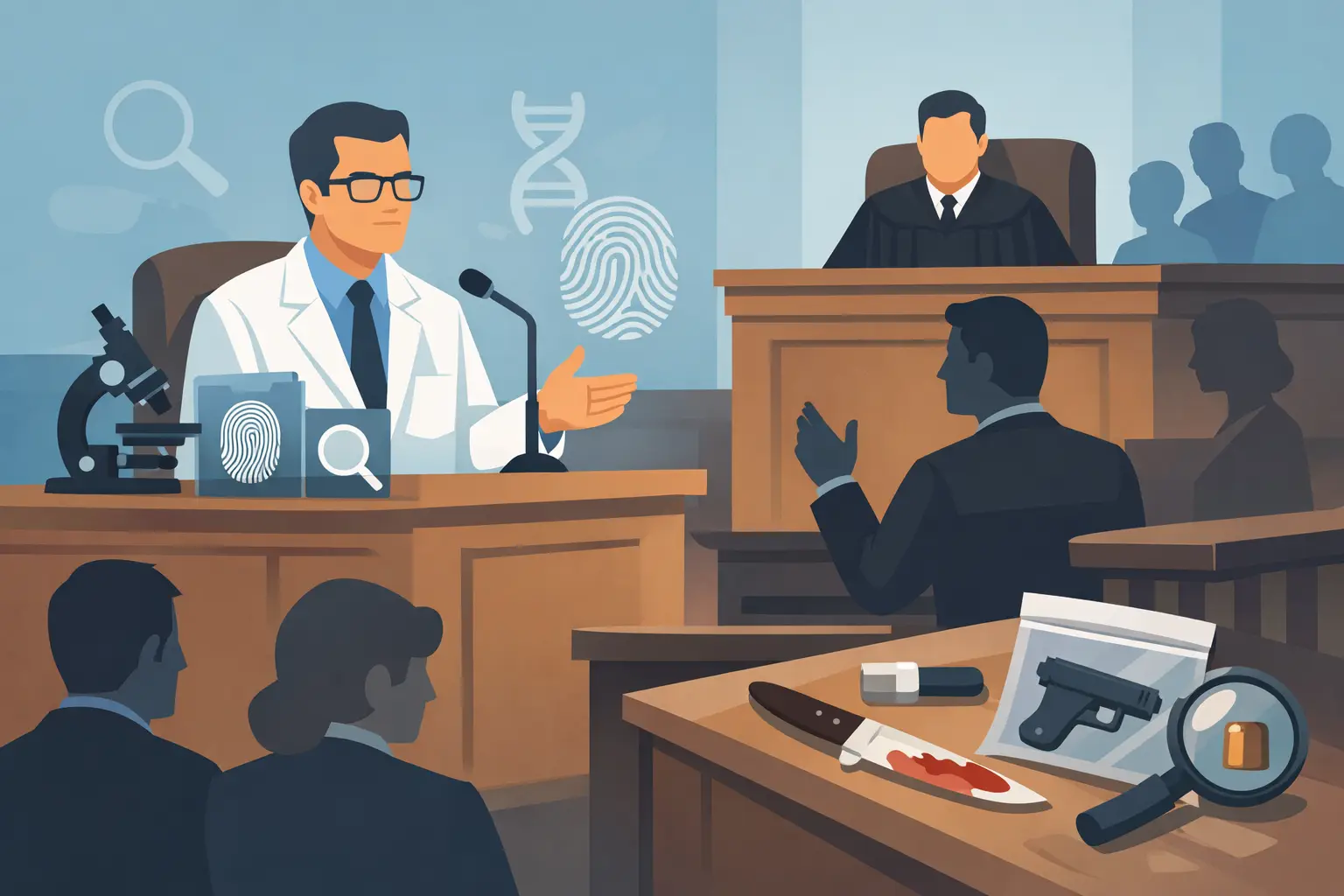
A forensic report can contain pages of technical terminology, measurements, and laboratory findings. In a courtroom, however, its value often depends on whether a qualified professional can explain what those findings mean, how they were reached, and where the limits lie. That is how forensic experts testify: not by repeating a report, but by translating specialized knowledge into reliable, understandable evidence for a judge or jury.
For professionals entering forensic, behavioral, or investigative fields, courtroom testimony is more than a presentation skill. It is a disciplined exercise in scientific reasoning, ethical judgment, and clear communication under scrutiny.
The Expert Witness Has a Defined Role
A forensic expert witness is called because the fact-finder needs assistance interpreting evidence outside ordinary experience. Depending on the case, that may involve DNA, digital devices, toxicology, questioned documents, firearms, trace materials, injury patterns, accounting records, or behavioral evidence.
The expert does not decide guilt or innocence. Nor should the expert become an advocate for the party that retained them. Their responsibility is to offer an independent opinion grounded in the available facts, a reliable method, and the boundaries of their expertise. That distinction matters. A persuasive witness who appears to favor one side at every turn can lose credibility quickly.
Testimony also differs from a factual witness account. A police officer may testify about what they observed at a scene. A forensic expert may explain what a bloodstain pattern, extracted data set, or chemical result can and cannot support. Experts are permitted to give opinions, but those opinions must rest on an adequate foundation.
Before Testimony: Qualification and Admissibility
Before the jury hears the technical evidence, the court must determine whether the witness is qualified and whether the proposed testimony is admissible. Qualifications can include formal education, specialized training, certifications, laboratory experience, professional publications, casework history, and teaching. No single credential automatically makes someone an expert. The question is whether the witness has knowledge that will genuinely assist the court on the specific issue at hand.
In federal courts and many state courts, judges assess expert testimony through standards associated with Rule 702 and the Daubert framework. The court considers whether the expert’s opinion is based on sufficient facts or data, whether the methodology is reliable, and whether the method has been applied reliably to the case. Some jurisdictions continue to use or incorporate the Frye standard, which emphasizes general acceptance within the relevant scientific community.
This stage is a reminder that credentials alone are not enough. A highly experienced examiner can still face exclusion if the method is unsupported, the testing was poorly documented, or the conclusion extends beyond what the evidence permits.
Building a Testimony File
Experienced experts prepare well before they enter court. They review their report, notes, photographs, laboratory records, chain-of-custody documentation, quality-control materials, and any prior statements. They also identify the precise questions they can answer and the questions they cannot.
Preparation should never mean rehearsing a preferred conclusion. It means ensuring that every statement can be traced back to the underlying work. If an attorney asks about a chart, calculation, or terminology, the expert should be able to explain it accurately without guessing.
A good testimony file also anticipates weaknesses. Was a sample limited? Was an item exposed to possible contamination? Did a software tool require analyst judgment? Were alternative explanations considered? Addressing such issues honestly is not a concession of failure. It demonstrates professional integrity and helps the court understand the true weight of the evidence.
How Forensic Experts Testify on Direct Examination
Direct examination is usually conducted by the attorney who called the expert. It often follows a logical sequence: qualifications, assignment, materials reviewed, methods used, findings, and opinions. This structure allows the expert to establish credibility before explaining the scientific or technical work.
The strongest testimony is precise but accessible. A jury should not need a graduate degree in chemistry, computer science, or psychology to follow it. Experts often use plain-language comparisons, visual demonstratives, and carefully chosen examples. Yet simplicity must not become oversimplification. A useful analogy can explain a principle, but it cannot replace the actual reasoning behind an opinion.
For example, a digital forensic examiner might explain that recovering deleted data does not necessarily reveal who created it, viewed it, or intended to retain it. A DNA analyst might explain the difference between detecting a profile and determining how or when biological material was deposited. These distinctions can be decisive because forensic findings frequently answer narrower questions than jurors expect.
Experts should speak at a measured pace, answer the question asked, and pause when an attorney objects. They should avoid jargon where possible, but define necessary technical terms rather than avoiding them altogether. Credibility often comes from calm clarity, not from sounding impressive.
Cross-Examination Tests the Opinion, Not Just the Witness
Cross-examination is designed to test the reliability, scope, and impartiality of expert evidence. Opposing counsel may question the witness’s training, compensation, laboratory procedures, error rates, underlying assumptions, prior inconsistent statements, or the possibility of alternative interpretations.
This can be demanding, particularly when questions are framed to invite a simple yes-or-no answer to a complex issue. The expert must remain responsive while refusing to let accuracy be distorted. When a yes-or-no answer would be misleading, a professional response may be: “That answer requires context,” followed by a concise explanation if permitted.
The objective is not to win an exchange with counsel. It is to help the fact-finder distinguish between a legitimate limitation and a manufactured doubt. Defensiveness, argument, sarcasm, or overstated certainty can damage even a well-supported opinion. A composed expert can acknowledge what is unknown while explaining why the conclusion remains justified.
Common Pressure Points
Cross-examination frequently focuses on whether a method has known limitations, whether the evidence was handled properly, and whether the expert considered competing explanations. It may also examine cognitive bias. Forensic professionals should understand how contextual information, expectations, and case narratives can influence interpretation, especially in disciplines involving judgment calls.
The appropriate response is not to claim that bias is impossible. It is to describe the safeguards used: blind verification where available, peer review, validated procedures, documented decision points, proficiency testing, and transparent reporting. The specific safeguards depend on the discipline and the organization. Their value lies in showing that reliability is actively managed rather than assumed.
The Language of Scientific Restraint
One of the most consequential skills in forensic testimony is calibrating language to the strength of the evidence. Experts should not state certainty where science supports only probability, association, consistency, or limited inference.
Phrases such as “consistent with,” “cannot be excluded,” and “supports the proposition” may sound cautious, but they can be accurate when properly explained. The expert should clarify what the phrase means in context. “Consistent with” does not automatically mean unique to a single source. “Cannot exclude” does not establish identification. Conversely, a qualified conclusion is not weak merely because it acknowledges uncertainty.
This principle is especially significant when testimony concerns statistical evidence or behavioral interpretation. Statistics can be misunderstood as statements about an individual’s guilt. Behavioral evidence can be overread when it is presented as a definitive indicator of motive, truthfulness, or future conduct. The expert’s duty is to prevent that leap, not encourage it.
Courtroom Credibility Is Built Long Before Trial
The most effective expert testimony begins in the laboratory, field office, interview room, or analytical workspace. Careful documentation, validated methods, continuing education, ethical independence, and clear reporting create the foundation for credible courtroom communication.
For aspiring specialists, that is the larger professional lesson. Courts do not need experts who offer certainty on demand. They need disciplined professionals who can explain what the evidence shows, identify what it does not show, and remain trustworthy when every conclusion is challenged. Advanced forensic education should prepare practitioners for that responsibility – because the quality of expert testimony can shape not only a case, but confidence in the justice process itself.