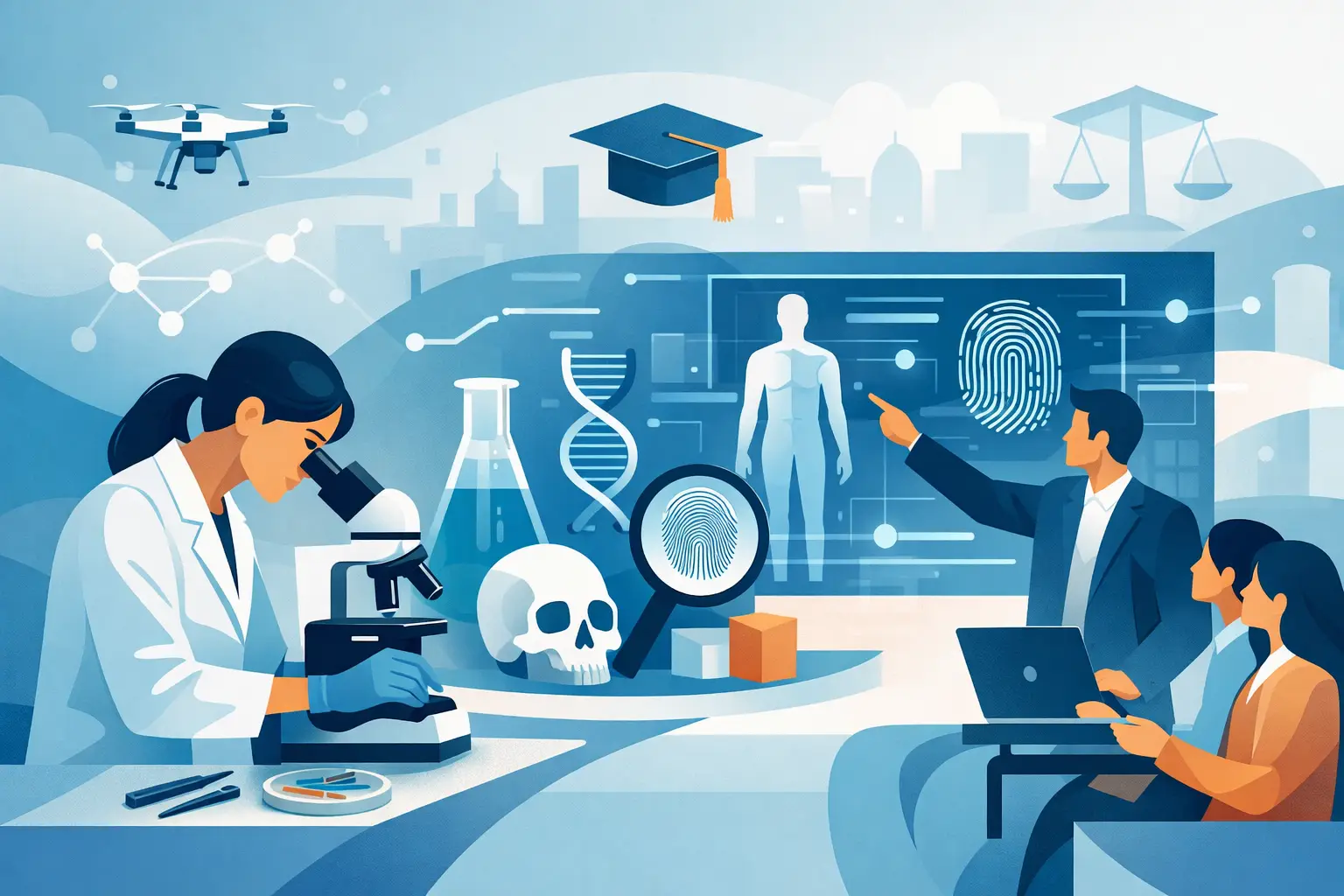
A latent print lifted from a surface, a hard drive recovered from a suspect device, and a witness statement shaped by trauma can all influence the same investigation. Yet each requires a different kind of expertise. The future of forensic science education will be defined by how well institutions prepare professionals to connect these forms of evidence with scientific discipline, behavioral insight, and sound judgment.
For working professionals, this shift is not abstract. Investigative decisions increasingly unfold under public scrutiny, evolving legal standards, and rapid technological change. Graduate education must therefore do more than transfer technical knowledge. It must develop practitioners who can assess evidence critically, explain findings clearly, recognize limits, and act responsibly when the stakes are high.
Why forensic education must change
Forensic science has never been limited to laboratory procedures. It sits at the intersection of science, law, technology, human behavior, and public trust. A professional may need to understand the reliability of a method, the chain of custody behind an exhibit, the psychology of memory, and the evidentiary implications of a digital record. Programs that teach these areas in isolation risk producing specialists who know a process but cannot see the wider investigative picture.
The pressure for change also comes from the field itself. Digital evidence grows faster than many agencies can process it. Artificial intelligence is entering analytic workflows. Financial crime, cyber-enabled fraud, human trafficking, and transnational offenses require professionals to work across disciplines and jurisdictions. At the same time, courts and communities rightly expect greater transparency about error rates, bias, validation, and the appropriate limits of expert testimony.
This does not mean every student must become a coder, a laboratory analyst, and a behavioral scientist at once. It means education should help learners identify where their expertise begins and ends, collaborate intelligently with other specialists, and make decisions grounded in evidence rather than assumption.
The future of forensic science education is interdisciplinary
The strongest programs will move beyond narrow subject silos without sacrificing depth. Technical forensic training remains essential, but it gains value when paired with behavioral sciences, investigative strategy, ethics, and communication. An analyst who understands cognitive bias may be better equipped to protect an examination from contextual influence. A fraud investigator with knowledge of behavioral economics may recognize patterns that a purely transactional review misses. A professional working with victims or witnesses may conduct more effective interviews when they understand trauma, memory, and nonverbal communication.
This interdisciplinary model reflects the reality of modern casework. Evidence does not arrive neatly separated into academic departments. A cybercrime case may involve technical artifacts, financial records, social engineering, victim behavior, and international legal questions. Effective professionals need a framework for integrating these signals without overstating what they prove.
Graduate-level education is particularly well positioned to support this work. Adult learners often bring operational experience from law enforcement, security, psychology, compliance, military service, law, or business. Their learning becomes more meaningful when theory is tested against realistic scenarios and when they can contribute perspectives from their own fields.
Practitioner-led instruction changes the standard
Textbooks establish foundations, but they cannot fully reproduce the judgment developed through complex investigations. Faculty and guest experts with experience in policing, federal investigation, criminology, psychology, intelligence, and applied research bring a necessary dimension to advanced education. They can show not only what a method is supposed to achieve, but where it can fail, how it is challenged, and how professionals respond when the available evidence is incomplete.
This approach should not replace academic rigor with anecdote. The goal is the opposite: to connect peer-reviewed research, legal standards, and validated practice to the decisions professionals must make. Case-based learning, structured simulations, and critical review of investigative outcomes allow students to practice that connection before they face it in their careers.
Technology will require more judgment, not less
Artificial intelligence, machine learning, advanced biometrics, automated document review, and data visualization are changing forensic workflows. These tools can help teams identify patterns, prioritize large volumes of information, and accelerate repetitive tasks. In digital investigations, they may be the only practical way to manage the scale of modern data.
But faster analysis is not the same as better reasoning. An automated system can produce a persuasive output without making its logic understandable. A model can reflect bias in its training data. A tool that works well in one environment may perform poorly in another. Forensic professionals must be able to ask difficult questions: What data informed this result? Has the method been independently validated? What is the error rate? Can the process be explained in a report or in court?
The future curriculum should therefore teach technological literacy alongside methodological skepticism. Students do not need to accept or reject emerging tools categorically. They need the capacity to evaluate their appropriate use. That includes data governance, privacy, cybersecurity, documentation, reproducibility, and the human accountability that cannot be delegated to software.
Ethics and communication will become core competencies
Forensic work carries unusual authority. A conclusion in a report, a risk assessment, or an expert statement can affect liberty, reputation, employment, and public confidence. Ethical education cannot be treated as a single unit completed early in a program. It must be present throughout the curriculum, informing how students approach bias, consent, confidentiality, cultural competence, conflicts of interest, and scientific uncertainty.
Clear communication is equally central. The best analysis loses value if it cannot be understood by investigators, attorneys, decision-makers, or jurors. Professionals must learn to write with precision, distinguish findings from interpretation, and avoid claims that exceed the evidence. They must also be ready to explain uncertainty without appearing evasive.
This is especially relevant for international learners. Legal systems, privacy rules, professional standards, and investigative structures vary widely. While principles such as integrity, validation, and due process travel across borders, their application depends on context. Globally accessible education should invite comparison rather than assume that one jurisdiction’s practice automatically fits every setting.
Online learning can strengthen professional readiness
The growth of online graduate education is often discussed in terms of convenience. Flexibility matters greatly for professionals balancing careers, family responsibilities, and service commitments. Yet the real opportunity is broader. Well-designed online programs can assemble a learning community that crosses agencies, industries, and national borders.
That diversity creates valuable intellectual friction. A compliance professional may approach risk differently than a detective. A psychologist may question assumptions that a cybersecurity specialist takes for granted. A student in one country may reveal how a different legal or cultural context changes an investigative decision. Structured discussion, live expert sessions, collaborative case analysis, and rigorous feedback can turn that variety into a serious academic advantage.
Online delivery also demands intentional design. Passive video libraries and generic discussion prompts are not enough for advanced forensic education. Learners need access to current research, challenging assessments, faculty engagement, and opportunities to apply concepts to realistic professional problems. The format succeeds when it preserves standards while expanding access.
At institutions such as Evidentia University, a specialist focus on forensic and behavioral sciences can support this model by bringing related disciplines into conversation. For a professional seeking meaningful advancement, the value lies not simply in adding a credential, but in developing a more defensible and adaptable way of thinking.
What prospective students should look for
Choosing an advanced program should begin with a clear question: what kind of problems do you want to solve more effectively? A laboratory professional may need deeper knowledge of quality assurance and courtroom communication. A law enforcement leader may benefit from behavioral analysis, digital evidence, and investigative ethics. A compliance or security professional may seek stronger capability in fraud detection, interviewing, or threat assessment.
The right program depends on career direction, prior experience, and the standards of the field in which a student intends to work. Prospective learners should look for curricula that engage current challenges rather than relying only on established doctrine. They should also consider whether faculty expertise reflects both scholarship and applied practice, whether assessment requires real analysis, and whether the learning environment supports a global professional network.
Credentials matter, but competence matters more. The most valuable education will make graduates more careful with evidence, more precise in their reasoning, and more credible when their judgment is tested.
The professionals who shape the next generation of forensic practice will not be those who merely adopt every new tool or repeat every established method. They will be the ones prepared to ask better questions, defend sound conclusions, and bring scientific integrity to problems where human consequences are never theoretical.