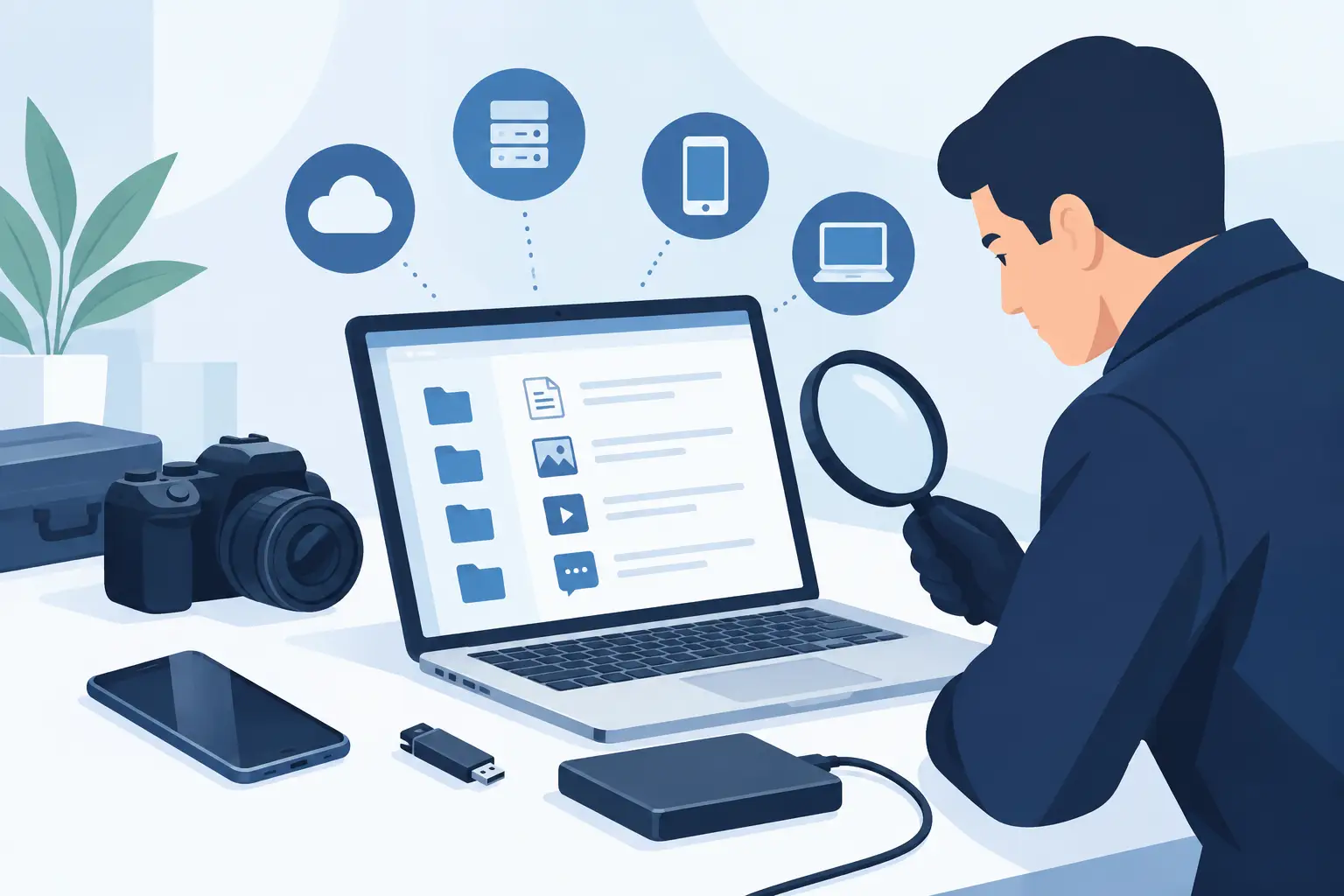
A phone recovered at a scene may contain location history, encrypted messages, cloud backups, financial records, and evidence of intent. It can also be altered remotely within minutes. That tension sits at the center of every digital evidence collection guide: investigators must move quickly enough to preserve volatile information while proceeding carefully enough to protect privacy, due process, and admissibility.
Digital evidence is not simply another category of property. It is often distributed across devices, networks, service providers, accounts, and jurisdictions. A disciplined collection process helps investigators establish what happened, demonstrate how they know it, and withstand close scrutiny from courts, counsel, internal reviewers, and professional peers.
Why Digital Evidence Requires a Different Mindset
Physical evidence generally remains where it is placed until someone moves it. Digital evidence behaves differently. A file can be overwritten, an account can be deleted, a device can receive a remote wipe command, and a cloud platform can change retention practices without notice. Even routine actions, such as opening an application or connecting a phone to a network, may change metadata.
The task is therefore not merely to obtain information. It is to preserve its integrity and context. Investigators should be able to explain what was collected, from where, by whom, under what authority, with which tools, and how the material was protected from alteration throughout its lifecycle.
This requires technical competence, but it also requires investigative judgment. The most technically complete extraction is not necessarily the most useful one if it exceeds the scope of legal authority, lacks contextual interpretation, or cannot be clearly communicated to a decision-maker.
Digital Evidence Collection Guide: Start With Legal Authority
Collection begins before a device is powered down or a preservation request is sent. First, define the investigative purpose and the authority supporting the collection. Depending on the setting, that authority may arise from a warrant, consent, organizational policy, contractual terms, a lawful regulatory process, or an emergency exception. The applicable standard depends on the jurisdiction, the role of the investigator, and the facts of the case.
Scope matters as much as authority. A broad warrant may authorize a search of a device, but it does not eliminate the need for reasoned limits around time periods, account types, search terms, or categories of data. In corporate inquiries, investigators must also distinguish between company-owned systems and personal accounts or devices, even where a bring-your-own-device policy exists.
Document the legal basis and the intended scope before collection. If circumstances change, such as the discovery of an additional account or an encrypted container, record why further action was necessary and seek appropriate authorization when required. This habit strengthens both the investigation and the credibility of the professional conducting it.
Secure the Scene Without Changing the Evidence
At the scene, the first objective is to prevent loss, damage, or unauthorized access. Photograph devices in place when practical, including their condition, visible screen content, connected cables, and nearby identifiers such as usernames, passwords written on paper, serial numbers, or network equipment.
A powered-on device presents a judgment call. Shutting it down may protect against remote access but can remove volatile data, including active sessions, memory-resident information, or encryption keys. Leaving it powered on may preserve that information but exposes the device to network-based changes. There is no universal answer. The correct choice depends on the device state, apparent encryption, available forensic expertise, legal authority, and immediate risk of remote interference.
Where policy and technical capacity permit, isolate the device from communications networks while preserving its current state. Avoid guessing passwords, browsing content, or using ordinary charging accessories without a documented forensic rationale. Small, undocumented actions can create large questions later.
Preserve Volatile and Remote Data Early
Not all evidence resides on the hardware in front of the investigator. Cloud-based email, collaboration platforms, social media accounts, vehicle telematics, smart-home systems, and mobile backups may hold the most relevant records. These sources can be highly probative, but they may also have short retention windows and complex access requirements.
A preservation request is often an early priority. It asks the relevant provider to retain data while legal process or authorized access is pursued. Investigators should identify relevant account names, user identifiers, device identifiers, dates, and time zones as precisely as possible. Vague requests can miss critical data; overly broad requests can create legal and practical difficulties.
Volatile data also includes live network connections, running processes, current system time, and active user sessions. In high-risk incidents such as ransomware, insider threats, or network intrusion, trained responders may need to capture this information before systems are isolated. That work should be coordinated, not improvised. A poorly managed response can destroy evidence while attempting to save it.
Create Forensic Copies, Not Working Originals
The original device or storage medium should be treated as evidence, not as a workspace. Where feasible, qualified personnel create a forensic image or other validated acquisition that preserves the data in a defensible form. The original is then secured, while analysis occurs on verified copies.
Hash values are central to this process. A cryptographic hash functions as a digital fingerprint: if the data changes, the resulting value changes. Recording hashes before and after transfer helps demonstrate that a forensic image remains identical to the acquired material. Hashing does not explain the relevance of a file, but it is powerful evidence of integrity.
Collection methods should be proportionate to the source. A full physical acquisition may be appropriate for one device, while a logical extraction, targeted export, or server-side preservation may be more appropriate for another. The choice depends on the investigative question, the technology involved, the authority available, and the risk of data loss. Methodological restraint is often a sign of professionalism, not a limitation.
Build a Chain of Custody That Tells a Clear Story
Chain of custody is more than a formality. It is the documented history of possession, transfer, storage, and handling of evidence. It allows a reviewer to follow an item from seizure or acquisition to analysis and presentation without unexplained gaps.
Each entry should identify the item, date and time, person releasing it, person receiving it, purpose of the transfer, and the storage location or condition. For digital materials, records should also capture acquisition tools and versions, relevant settings, hash values, source account details, and any processing performed.
Good documentation is contemporaneous and specific. “Phone data extracted” is not sufficient. A more reliable record identifies the device, extraction type, tool used, examiner, output location, hash value, and any limitations encountered. If a collection failed, was interrupted, or produced incomplete results, document that too. Transparency about limitations is more credible than an appearance of false certainty.
Interpret Data in Context, Not in Isolation
Digital artifacts rarely speak for themselves. A timestamp may reflect creation, modification, upload, download, synchronization, or a device clock set to the wrong time zone. A location point may indicate where a device reported being, not necessarily where its owner was. A deleted file may show intent to remove data, or it may result from automatic system behavior.
Investigators should test digital findings against other available evidence: witness accounts, access logs, financial records, surveillance, system documentation, and behavioral patterns. This is where technical collection becomes investigative analysis. The question is not simply whether an artifact exists, but what explanation it supports and what competing explanations remain plausible.
Specialized education can sharpen this judgment. At Evidentia University, the study of forensic and behavioral disciplines emphasizes the value of connecting technical evidence with human conduct, decision-making, and defensible analytical reasoning.
Protect Privacy, Security, and Professional Ethics
Digital collections often expose information about people who are not the focus of an investigation. Personal communications, health details, attorney-client material, intimate images, and trade secrets may all appear in a dataset. Investigators have a duty to minimize unnecessary review, protect sensitive information, and follow procedures for privileged or restricted material.
Security controls must continue after collection. Evidence should be stored in access-controlled environments, encrypted where appropriate, and shared only with authorized personnel. Audit logs, role-based access, and secure retention practices reduce the risk that evidence becomes compromised through internal mishandling.
The highest standard is not collecting everything possible. It is collecting what is authorized, relevant, reliable, and necessary – then being able to explain every decision with precision.
A well-managed digital investigation preserves more than files. It preserves confidence in the process, respect for individual rights, and the evidentiary foundation required for fair decisions.