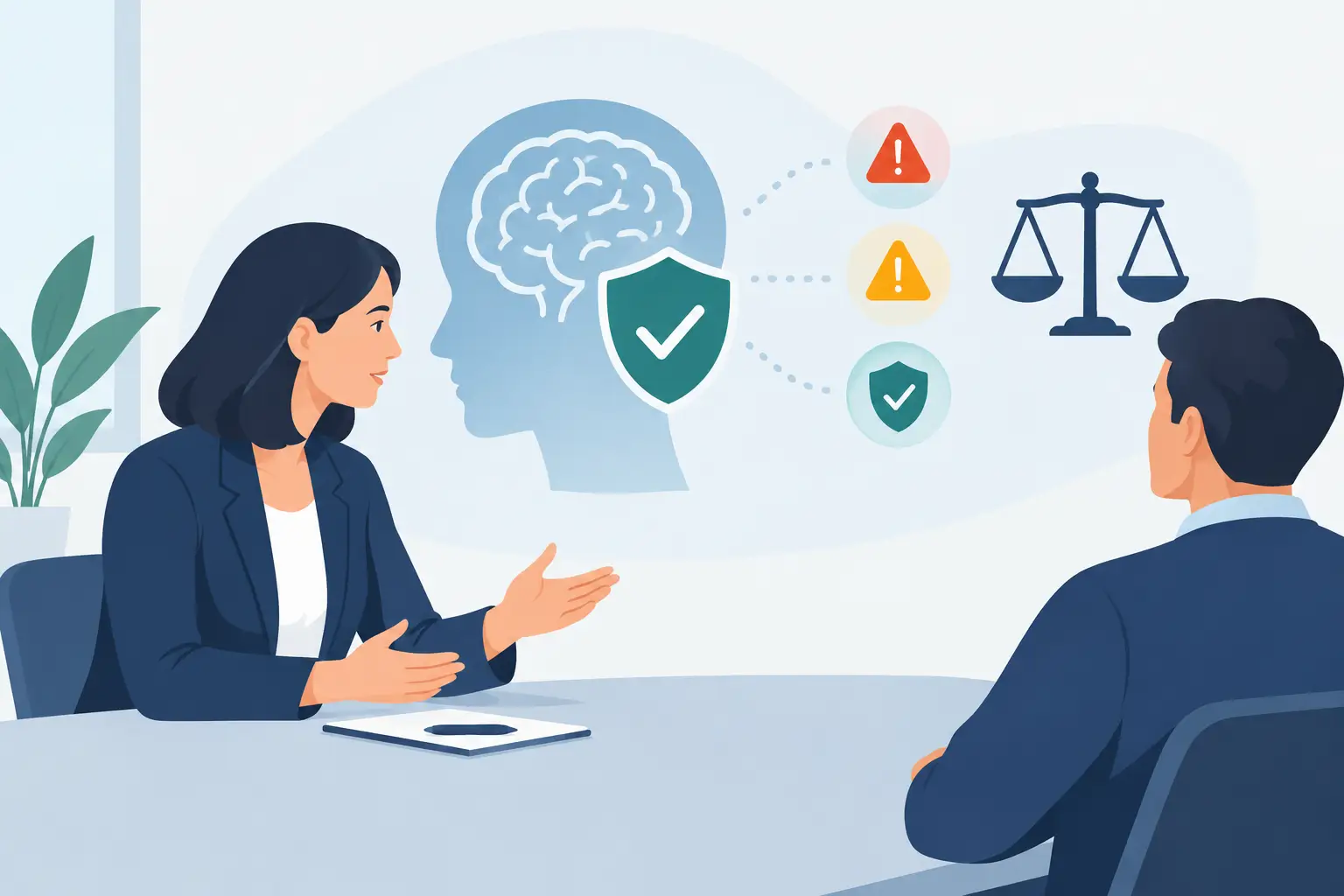
A concerning message, an unexplained purchase, or a colleague’s abrupt change in behavior rarely arrives with a clear label. Professionals must decide whether it reflects frustration, fraud, grievance, coercion, or a credible pathway toward harm. Cognitive threat interviews provide a disciplined way to make that judgment without mistaking confidence for evidence or suspicion for fact.
Used well, these interviews are not theatrical confrontations. They are structured conversations designed to gather accurate information, understand a person’s thinking, test competing explanations, and support proportionate decisions. For professionals in security, law enforcement, compliance, human resources, fraud prevention, and behavioral research, that distinction is consequential.
What Cognitive Threat Interviews Are Designed to Do
Cognitive threat interviews combine principles from investigative interviewing, behavioral threat assessment, psychology, and decision science. Their purpose is not simply to obtain an admission. It is to clarify behavior, context, capability, stressors, protective factors, and the meaning an individual assigns to events.
The word cognitive matters because an interviewer is seeking more than a chronological account. They are examining how a person perceives a conflict, explains setbacks, attributes blame, imagines possible actions, and responds when details are explored. A credible assessment considers observable facts alongside cognition, emotion, communication patterns, and access to potential means of harm.
This approach is especially relevant when the available information is incomplete. A fraud analyst may need to distinguish an intentional scheme from a misunderstood process. A corporate security team may be assessing threatening communications from a former employee. A compliance professional may be investigating pressure, conflicts of interest, or possible retaliation. In each case, the central question is not, “Does this person seem dangerous?” It is, “What does the evidence indicate about behavior, intent, opportunity, and escalation?”
A threat interview is not an interrogation
The distinction is practical as well as ethical. Interrogation is often associated with accusation, pressure, and confession-seeking. Cognitive threat interviewing prioritizes information quality. It begins with rapport, clear ground rules, and open-ended questions that allow the interviewee to provide a narrative in their own words.
That does not mean the interviewer avoids difficult subjects. It means difficult subjects are approached with purpose. When inconsistencies appear, they are explored through specific, evidence-informed questions rather than premature confrontation. This reduces defensiveness and can produce a fuller account of what happened, what the individual believes happened, and what may happen next.
Why Cognitive Threat Interviews Improve Risk Decisions
Threat assessment fails when professionals rely on a single signal: a hostile statement, a prior incident, an alarming online post, or a strong intuition. Those indicators may warrant attention, but they do not interpret themselves. A cognitive interview helps place them within a broader pattern.
An individual who expresses anger may be venting after a workplace conflict. Another may be expressing grievance while also describing a target, researching routines, acquiring materials, and rejecting every nonviolent avenue for resolution. The language may sound similar at first. The underlying risk picture is not.
A high-quality interview can help professionals assess several connected dimensions:
- The person’s narrative of harm, injustice, humiliation, or loss
- Their level of fixation on a person, organization, or perceived wrong
- Their capacity, access, planning behavior, and movement toward action
- The presence of stabilizing influences, support, treatment, accountability, or alternatives
No dimension should be treated as a standalone prediction tool. Human behavior is too variable, and false certainty can create serious operational and legal consequences. The value lies in examining the relationship among factors, then documenting why a particular response is justified.
It reduces the cost of untested assumptions
Investigators and managers work under pressure. That pressure can encourage confirmation bias: once a person is categorized as deceptive, unstable, malicious, or high-risk, every later detail may be interpreted to support that conclusion. Cognitive threat interviews create a counterweight by requiring the interviewer to seek disconfirming information.
For example, if an employee has made an ambiguous statement, the interviewer should not only explore why the statement was made. They should ask about immediate circumstances, intended meaning, prior communications, personal stressors, available supports, and whether the person has taken any steps consistent with a threat. Alternative explanations do not excuse harmful conduct, but they can prevent an inaccurate assessment from hardening into an unfair outcome.
This is also where documentation matters. Notes should distinguish direct observation, verified evidence, the interviewee’s account, and the interviewer’s professional inference. When those categories blur, later reviewers may mistake an assumption for a fact.
The Interviewer’s Mindset Shapes the Evidence
The most sophisticated protocol cannot compensate for an interviewer who approaches the conversation as a contest. Cognitive threat interviews require intellectual discipline: curiosity without naivety, empathy without endorsement, and skepticism without contempt.
Rapport is often misunderstood as friendliness. In an investigative setting, rapport means establishing enough professional trust that the interviewee can speak with specificity. It is supported by transparency about the interview’s purpose, respectful listening, and questions that demonstrate careful attention. It does not require promising outcomes that cannot be guaranteed or minimizing legitimate safety concerns.
Open prompts are particularly useful at the start. Questions such as “Tell me what led up to that message” or “Help me understand what you wanted the recipient to take from it” invite narrative detail. Follow-up questions can then establish sequence, sources of information, decision points, and perceived options. A person who genuinely experienced an event and a person who is constructing an account may both provide detail, but the pattern, consistency, and verifiability of those details can differ.
Interviewers should also be alert to their own emotional reactions. Fear, irritation, fascination, or moral judgment can narrow listening. The goal is not to eliminate judgment. It is to postpone final judgment until the account has been tested against available evidence and assessed through a multidisciplinary lens.
Where Structure and Flexibility Must Meet
A structured framework protects consistency, especially when multiple professionals contribute to a case. It can ensure that interviews address grievance, target focus, planning, access, stress, coping, and protective factors. Yet a rigid script can miss what is most revealing: the unexpected phrase, contradiction, emotional shift, or gap in an otherwise detailed account.
The strongest practice combines a defined assessment model with adaptive interviewing. The interviewer knows which domains require attention but follows the interviewee’s narrative where it produces relevant evidence. This is particularly important across cultures, languages, and professional contexts. Directness, eye contact, emotional expression, and deference to authority vary widely. Behavior that appears evasive in one cultural setting may be a normal response in another.
For international organizations, interpretation adds another layer of risk. Interpreters should understand confidentiality expectations and the importance of preserving meaning rather than merely translating words. A threat assessment can be distorted if cultural references, slang, or expressions of distress are stripped of context.
Ethical Boundaries Are Operational Necessities
Because threat interviews can affect employment, liberty, reputation, and personal safety, ethical practice is not an optional add-on. It is part of investigative quality. Professionals must understand the legal and organizational rules governing consent, representation, privacy, recording, disclosure, and mandatory reporting in their jurisdiction.
They must also recognize the limits of their role. An interviewer is not a clinician merely because mental health concerns arise, and a clinician is not automatically qualified to conduct a forensic interview. Cases involving imminent risk, severe impairment, domestic violence, stalking, or access to weapons may require specialized assessment, emergency action, and coordinated case management.
The same caution applies to technology. Digital communications, social media content, access logs, and transaction histories may sharpen an assessment, but they can also create an illusion of completeness. Data can show activity. It cannot, by itself, explain intent. The interview remains essential because it tests the human meaning behind the record.
Building Capability for High-Stakes Conversations
Organizations often train staff to recognize warning signs but provide limited preparation for the conversation that follows. That gap can lead to avoidance on one side and overreaction on the other. Effective capability requires practice in question design, active listening, evidence evaluation, bias awareness, report writing, and escalation decisions.
Scenario-based learning is particularly valuable. Professionals should practice handling an aggrieved employee, a suspected insider-risk case, a fraud subject with a plausible explanation, and a person whose communications raise concern but do not establish intent. Each scenario should be reviewed not only for what questions were asked, but for what assumptions guided them.
For learners seeking advanced specialization, this is where behavioral science becomes professionally transformative. At Evidentia University, the study of human behavior is approached as an applied discipline: one that connects rigorous theory with the real decisions professionals must make under uncertainty.
Cognitive threat interviews do not produce certainty, and responsible practitioners should never promise it. They offer something more useful: a defensible process for listening carefully, testing evidence honestly, and choosing interventions that protect people while preserving fairness.