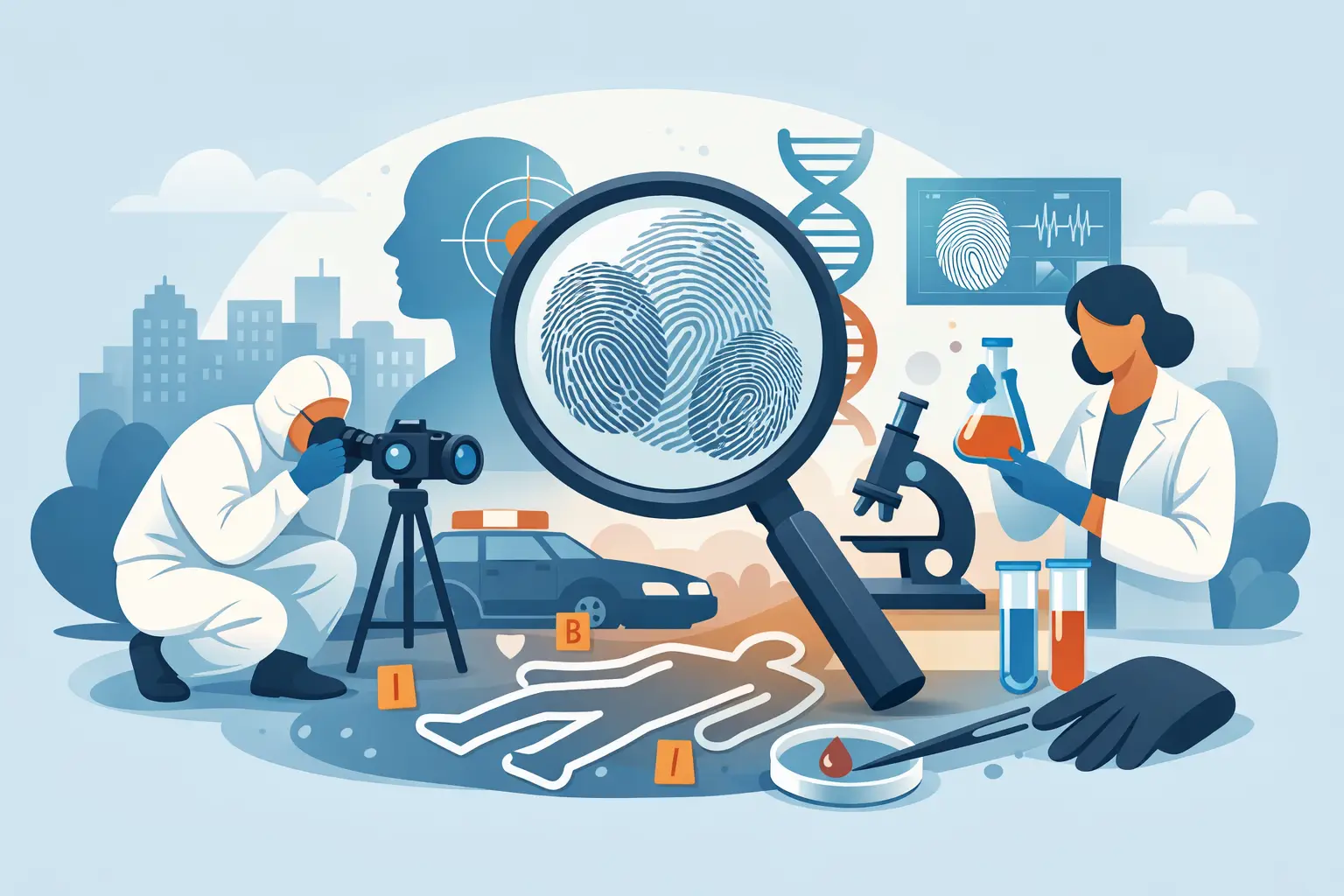
A fingerprint on glass rarely tells its story on its own. Neither does a blood pattern, a damaged hard drive, a questioned signature, or a fragment of soil on a shoe. The real work begins when trained professionals know how to collect, interpret, and present evidence with scientific discipline. That is the clearest way to answer the question, what is forensic science study: it is the study of how science is applied to legal and investigative questions.
For many prospective students, the term sounds narrower than it really is. Forensic science is not limited to crime labs and television-style breakthroughs. It sits at the intersection of biology, chemistry, physics, digital analysis, psychology, criminal investigation, and courtroom procedure. It asks not only what happened, but also what can be proven, how reliably it can be proven, and whether that proof can stand up under scrutiny.
What Is Forensic Science Study in Academic Terms?
In academic terms, forensic science studies the methods used to examine physical, biological, digital, and behavioral evidence for investigative and judicial purposes. The field is built on a straightforward principle: evidence must be handled systematically, interpreted carefully, and communicated clearly.
That means the discipline is both scientific and procedural. Students do not simply learn how evidence works. They learn chain of custody, validation, contamination control, ethics, report writing, expert testimony, and the legal standards that determine whether evidence is admissible. Science without procedure can collapse in court. Procedure without scientific rigor can mislead an investigation.
This is one reason the field attracts serious, career-minded learners. It rewards precision, intellectual discipline, and a comfort with ambiguity. Real cases are rarely tidy. A forensic scientist may work with incomplete evidence, conflicting interpretations, or results that are technically correct but limited in what they can prove.
More Than the Crime Lab
A common misunderstanding is that forensic science study only prepares someone to process crime scenes. Crime scene work matters, but it is only one part of a much larger ecosystem.
Forensic science can include DNA analysis, toxicology, trace evidence, forensic pathology support, digital forensics, questioned documents, forensic anthropology, and firearms examination. In many modern settings, it also overlaps with fraud detection, cyber investigations, intelligence analysis, and behavioral assessment.
That breadth matters for graduate-level learners and working professionals. Someone in law enforcement may need a deeper understanding of evidence interpretation. Someone in cybersecurity may need forensic methods for investigating data breaches. Someone in compliance or anti-fraud work may use forensic principles to identify patterns of deception, document manipulation, or financial misconduct. The underlying logic is the same: examine evidence objectively, preserve its integrity, and support defensible conclusions.
The Core Areas Students Usually Study
The exact curriculum depends on the program, but most serious study in forensic science includes a combination of scientific foundations and applied investigative practice.
Students often begin with evidence itself – what it is, how it is classified, and how it can be altered, degraded, or misunderstood. From there, they study analytical methods. In biological evidence, that may involve serology or DNA principles. In chemical evidence, it may involve toxicology or controlled substance analysis. In digital contexts, it can mean recovering deleted files, tracing user activity, or preserving metadata.
Another major area is crime scene and evidence management. This includes documentation, collection protocols, storage, transportation, and chain of custody. These topics may sound administrative, but they are central to the credibility of any forensic finding. A strong analysis can be undermined by poor handling.
Students also engage with law and ethics. Forensic evidence exists within a justice system, and that system requires standards. Professionals must understand legal thresholds, expert witness responsibilities, and the ethical risks of bias, overstatement, or premature conclusions.
At an advanced level, many programs also emphasize research literacy. Students learn how to evaluate studies, assess reliability, and understand the limits of methods that may look persuasive on the surface. That is especially important in a field where scientific confidence must be earned, not assumed.
Why the Field Demands Critical Thinking
If you are asking what is forensic science study because you want a clear-cut technical path, there is good news and a caution. The good news is that the field is highly practical. The caution is that it is not mechanical.
Forensic science is full of judgment calls. A pattern may suggest one interpretation but not exclude another. A digital artifact may show activity on a device but not prove who performed it. A behavioral indicator may be relevant in context but weak in isolation. Strong practitioners resist the urge to promise certainty where the evidence only supports probability.
This is where advanced education makes a difference. A serious program should not only teach techniques. It should teach discernment. That includes understanding error rates, avoiding confirmation bias, recognizing alternative explanations, and communicating findings without exaggeration.
For professionals already working in adjacent fields, this mindset is often what elevates their practice. Investigators become more careful. Analysts become more defensible. Leaders become better at evaluating the strength, and the limits, of the evidence in front of them.
What Is Forensic Science Study Preparing You to Do?
The answer depends on your background and goals. For some students, forensic science study is preparation for technical roles in laboratories, investigative units, or digital examination teams. For others, it is a specialization that strengthens an existing career in criminal justice, intelligence, security, psychology, fraud prevention, or public service.
This distinction matters. Not every program prepares students for the same destination. Some are strongly laboratory-based and designed for students with substantial natural science training. Others are broader, interdisciplinary, and better suited to professionals who need forensic knowledge for investigative, analytical, managerial, or courtroom-related functions.
That is why prospective students should look closely at program design. Does it emphasize chemistry and biology in depth? Does it focus on digital evidence? Does it integrate behavioral science and investigative reasoning? Does it prepare you for field application, policy leadership, expert analysis, or academic research? The right fit is not the most impressive-sounding option. It is the one aligned with how you want to use the knowledge.
The Relationship Between Forensic Science and Behavioral Insight
One of the most important shifts in modern forensic education is the recognition that evidence does not exist in a vacuum. Human behavior shapes crime, deception, decision-making, victimization, and investigative outcomes.
That does not mean behavioral insight replaces hard science. It means the strongest forensic thinking often benefits from interdisciplinary understanding. A cyber investigator may need technical evidence and behavioral pattern recognition. A fraud analyst may need document examination and deception awareness. A criminal investigator may need physical evidence, victimology, and interview strategy.
This is where specialized institutions can offer unusual value. A learning environment that connects forensic science with behavioral sciences, investigative psychology, anti-fraud analysis, and digital risk can reflect the realities of contemporary practice more accurately than a siloed curriculum. At Evidentia University, that interdisciplinary perspective is central to how advanced learners prepare for complex professional roles.
What Students Should Expect From Serious Forensic Science Study
Students entering the field should expect more than case stories and terminology. Serious study requires method, discipline, and intellectual honesty.
You should expect coursework that challenges assumptions. You should expect to read research, evaluate claims, and think carefully about validity. You should also expect to work across domains. Forensic science is not purely about laboratory skill or purely about investigation. It is about translating evidence into reliable knowledge that can withstand professional and legal scrutiny.
There is also a practical reality worth acknowledging. The field can be demanding because the stakes are high. Errors can affect prosecutions, civil cases, institutional decisions, and public trust. That is part of what makes the discipline meaningful. It asks professionals to bring scientific care to moments where the consequences are real.
Is Forensic Science the Right Field for You?
The best candidates are usually drawn to more than crime as a subject. They are drawn to analysis, evidence, and the disciplined search for truth. They tend to value precision over drama and credibility over quick answers.
If you are energized by complex questions, comfortable with nuance, and interested in work that connects science to justice, forensic science study may be an excellent fit. If you want a field where your expertise can support investigations, strengthen institutions, and contribute to fairer outcomes, it is a compelling path.
The strongest next step is not simply choosing a program with the right title. It is choosing one that matches your professional direction and challenges you to think at a higher level. In forensic science, the most valuable skill is not just finding evidence. It is learning how to understand what evidence can honestly say.