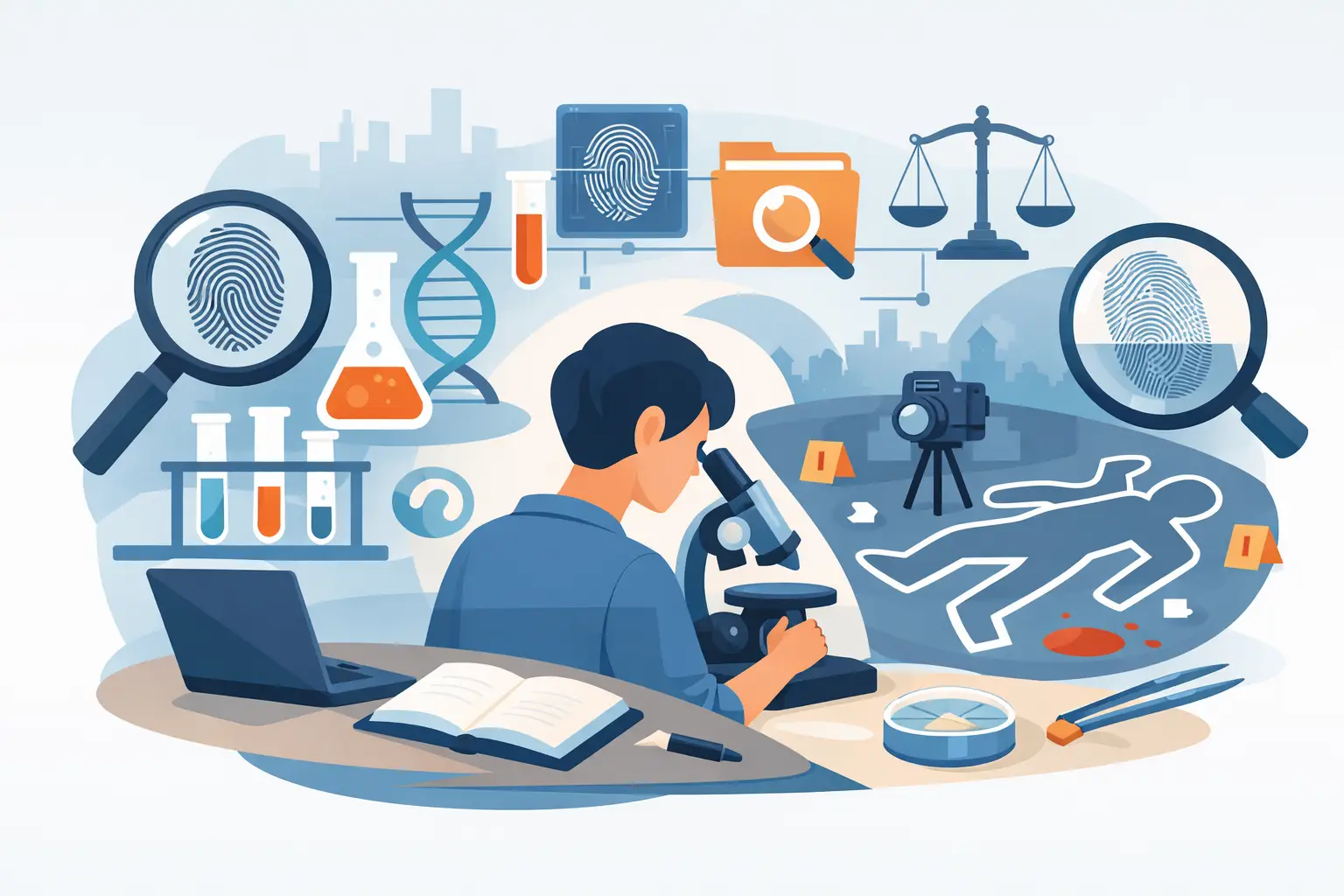
A forensic science student may spend one hour interpreting bloodstain patterns, the next reviewing chain-of-custody procedures, and later analyzing how bias can affect investigative judgment. That range is exactly why many learners ask how to study forensic science without feeling scattered. The answer is not to memorize more. It is to study with structure, intellectual discipline, and a clear understanding of how scientific evidence, human behavior, and legal standards intersect.
For adult learners and career-focused students, that approach matters even more. Forensic science is not a subject you simply absorb by reading passively. It demands technical accuracy, ethical judgment, and the ability to apply theory in professional contexts. If your goal is meaningful advancement, your study method should reflect the seriousness of the field.
How to study forensic science with a professional mindset
The strongest students begin by changing how they frame the discipline. Forensic science is often treated as a narrow laboratory specialty, but in practice it is broader and more demanding. It includes evidence analysis, investigative methodology, legal procedure, criminological reasoning, and, in many settings, behavioral interpretation. Studying it well means learning to connect those domains rather than keeping them in separate mental folders.
A professional mindset also means respecting precision. In many academic subjects, being approximately right can still earn partial credit or support a broad discussion. In forensic contexts, small errors in terminology, procedure, or interpretation can change the meaning of a case. That does not mean you should become anxious about every detail. It means you should develop habits of careful reading, disciplined note-taking, and evidence-based reasoning from the beginning.
Students who thrive in this field tend to ask a better question than “What do I need to remember for the exam?” They ask, “How would this hold up in an investigation, a report, or a courtroom setting?” That shift improves both retention and judgment.
Build your study plan around the core pillars
If you want to know how to study forensic science efficiently, start by dividing your learning into pillars. Most students perform better when they organize the field into major categories instead of trying to master everything at once.
The first pillar is scientific foundation. This includes biology, chemistry, anatomy, toxicology, trace evidence, DNA concepts, and laboratory reasoning. Even if your interests are more investigative or behavioral, weak scientific literacy creates gaps quickly.
The second pillar is forensic process. Here, you focus on evidence collection, documentation, preservation, contamination risk, chain of custody, reporting standards, and quality control. These topics may feel procedural at first, but they shape professional credibility.
The third pillar is legal and ethical context. Search and seizure issues, admissibility standards, expert testimony, due process, and professional ethics are not side topics. They determine whether scientific work has practical value.
The fourth pillar is analytical interpretation. This is where many advanced learners separate themselves. You are not only learning facts. You are learning how to interpret data carefully, recognize limits, weigh alternative explanations, and avoid overstatement.
When you map your courses, readings, or revision sessions to these pillars, the discipline starts to feel coherent. You can also identify your weak areas faster. A student may be strong in criminal justice theory but need deeper scientific grounding, while another may understand laboratory content but struggle with legal application.
Read less passively and think more like an investigator
Many students fall behind because they treat forensic science reading the way they treated general survey classes. They highlight too much, reread chapters, and confuse recognition with understanding. In a field built on analysis, passive review is rarely enough.
A better method is to read in layers. First, identify the central concept. Then ask what problem that concept solves in practice. After that, note the limitations. For example, if you are studying fingerprint analysis, do not stop at classification systems. Ask what can compromise print quality, what can lead to interpretive disagreement, and how findings should be communicated responsibly.
This habit strengthens comprehension because forensic science is full of conditional reasoning. Results are shaped by context, sample quality, methodology, and procedural integrity. A student who always asks “Under what conditions would this conclusion be stronger or weaker?” is usually preparing at a higher level.
Case-based thinking also helps. After each topic, create a short hypothetical scenario and test yourself. What evidence would matter most? What procedural risks are present? What claims could be made confidently, and which would require caution? This approach turns abstract content into professional judgment.
How to study forensic science online without losing depth
Online study offers extraordinary access, especially for working professionals and international students, but it demands intentional habits. Flexibility is valuable, yet flexibility without structure often becomes delay.
Set a weekly study architecture rather than relying on motivation. That means assigning distinct blocks for reading, note synthesis, discussion participation, and review. Try to study complex scientific material when your concentration is highest, not at the end of an exhausted day.
It is also worth separating intake from processing. Watching a lecture or reading an article is intake. Creating your own comparison chart, writing a short analytic response, or explaining a concept aloud is processing. Real learning happens in processing. If your schedule is tight, protect that time first.
Graduate-level and career-relevant online programs reward students who engage actively with faculty expertise and peer discussion. In a specialist environment such as Evidentia University, where applied disciplines intersect with behavioral and investigative sciences, this kind of interaction can deepen your understanding far beyond textbook familiarity. The advantage of online education is not simply convenience. It is access to focused expertise that can reshape how you interpret the field.
Use note-taking that supports analysis, not transcription
Forensic science courses generate dense information, so many students default to recording everything. The result is usually a notebook full of content and very little usable insight.
A more effective system is to divide notes into three parts: core concept, applied meaning, and limitations. Under core concept, capture the principle accurately. Under applied meaning, write how it would matter in an investigation, laboratory process, interview context, or legal setting. Under limitations, record uncertainties, challenges, and common misinterpretations.
This method is especially useful in advanced study because it prepares you for assignments that require evaluation rather than recall. It also keeps you from overstating certainty, which is one of the most important intellectual disciplines in forensic work.
Balance memorization with interpretation
Some parts of forensic science do require memorization. Terminology, procedural order, legal standards, chemical concepts, and biological mechanisms often need precise recall. But memorization alone will only carry you so far.
Interpretation is where academic maturity develops. You should be able to explain why a procedure matters, what makes evidence reliable or vulnerable, and how multiple forms of evidence interact. For instance, DNA evidence may appear powerful, but its meaning depends on collection quality, contamination controls, population statistics, and case context. The same is true across many forensic domains.
A useful test is this: can you explain a concept to a colleague outside your field without becoming simplistic or inaccurate? If yes, you likely understand it. If not, you may still be relying on memorized language.
Prepare for assessments the way professionals prepare for cases
Exam preparation in forensic science works best when it mirrors case preparation. Review your materials by category, compare similar concepts, and practice distinguishing between them. Students often lose points not because they know nothing, but because they confuse related procedures or fail to identify the most defensible conclusion.
Short-answer and essay questions usually reward precision over volume. Define terms carefully, support claims with method or principle, and avoid language that suggests certainty where caution is warranted. In forensic disciplines, overstating a conclusion is often more damaging than offering a measured one.
If your program includes projects, discussions, or applied analyses, start earlier than feels necessary. These assignments often require more synthesis than students expect. The challenge is not length. It is integrating science, procedure, ethics, and interpretation into a coherent argument.
Study for the career, not just the course
The most strategic way to study forensic science is to connect each topic to the professional identity you are building. A future analyst, investigator, behavioral specialist, fraud examiner, or graduate researcher will not all emphasize the same competencies. The fundamentals overlap, but the application differs.
That is why your study plan should include some forward-looking reflection. Which areas of forensic science align with your current role or intended specialization? Where do you need more depth to become credible? Which faculty perspectives, case studies, or research themes deserve closer attention because they connect directly to your goals?
There is no single perfect method for every student. A law enforcement professional returning to school may need to strengthen scientific writing. A psychology graduate entering forensic study may need more technical grounding in evidence procedures. The point is not to study identically. It is to study deliberately.
Forensic science attracts people who want to contribute to truth, accountability, and justice. That ambition deserves more than scattered effort. Build a system that respects the complexity of the field, and your progress will begin to match the seriousness of your goals.