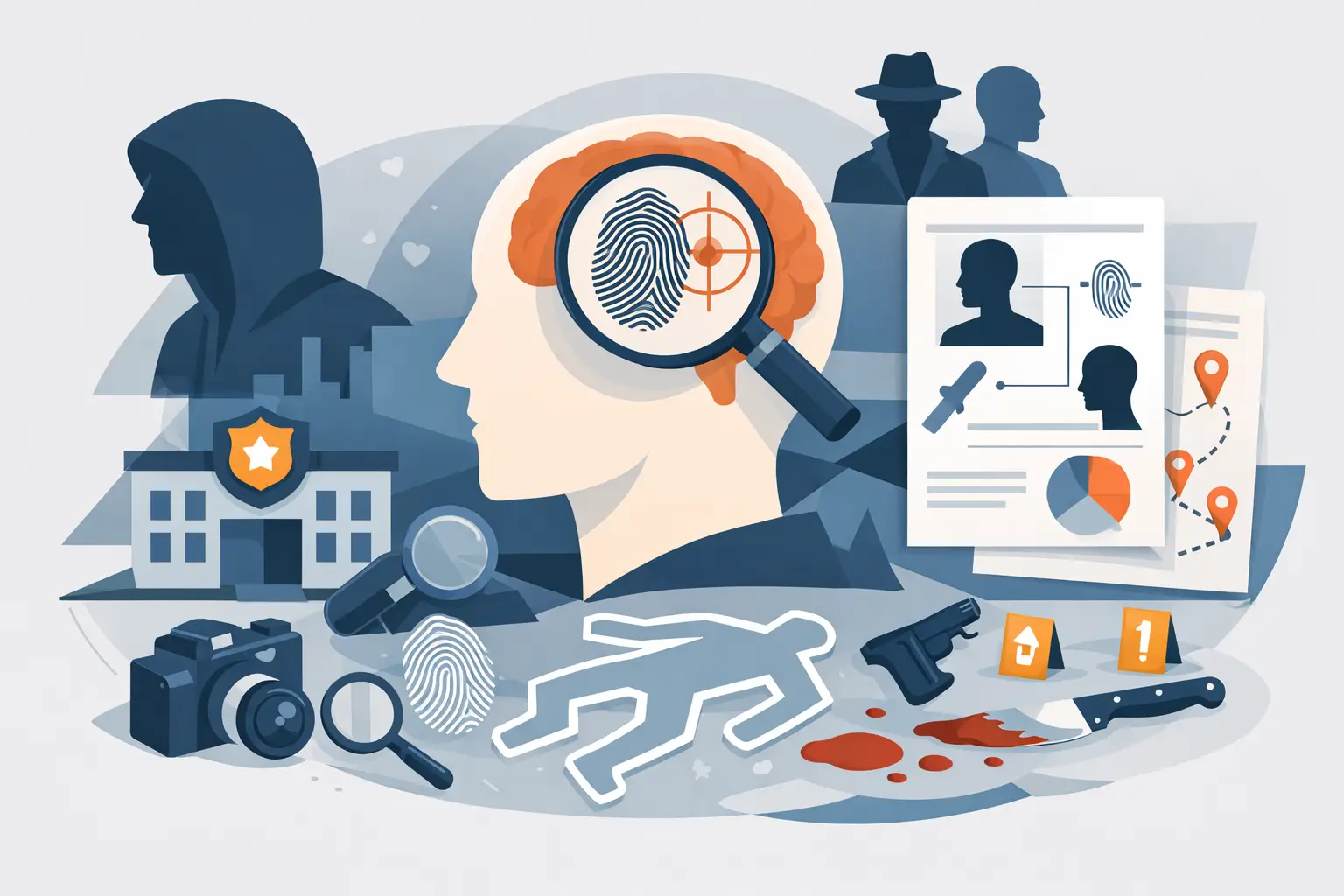
A homicide scene suggests planning, restraint, and post-offense control. A second case shows chaos, impulsivity, and no meaningful effort to avoid detection. Investigators may ask the same question in both cases, but the answer will not come from instinct alone. Understanding the types of criminal profiling matters because each model frames behavior, evidence, and offender inference in a different way.
For professionals in law enforcement, psychology, security, and forensic practice, criminal profiling is best understood as a set of analytical approaches rather than a single technique. Popular culture tends to present profiling as a near-mystical skill. In practice, it is a disciplined effort to interpret offense behavior, victimology, crime scene dynamics, and contextual evidence in order to generate investigative hypotheses. The key word is hypotheses. Profiling can support an inquiry, but it does not replace evidence, interviewing, or casework.
What criminal profiling actually does
Criminal profiling seeks to narrow possibilities, prioritize leads, and interpret patterns that may not be obvious when a case is viewed only through physical evidence. A profile may offer estimates about likely offender characteristics, behavioral tendencies, geographic comfort zones, victim selection patterns, or escalation risk.
That sounds straightforward until the real challenge appears. Behavior is not static. Offenders adapt, stage scenes, learn from prior offenses, or act inconsistently across events. A useful profile therefore depends on method, data quality, and restraint. The strongest profiling work is probabilistic, transparent, and tied closely to known facts.
The main types of criminal profiling
When professionals discuss the types of criminal profiling, they are usually referring to several distinct traditions or methodological lenses. These approaches overlap, but they do not start from the same assumptions.
Deductive criminal profiling
Deductive profiling begins with the specific case. Rather than relying first on broad offender categories, the profiler studies the crime scene, forensic findings, victimology, timeline, and known behaviors to infer what kind of offender could have produced that exact pattern.
This approach is case-driven and highly individualized. If a victim was approached in a controlled manner, bound with available materials, and left in a location with symbolic significance, a deductive analysis would ask what those details reveal about the offender’s knowledge, confidence, emotional state, and relationship to the scene. The emphasis is on evidence-based reasoning from particulars to conclusions.
Its major strength is precision. It is less vulnerable to forcing a case into a preexisting template. Its limitation is that it demands high-quality information and experienced interpretation. If the underlying facts are incomplete or contaminated, the deductions can become fragile.
Inductive criminal profiling
Inductive profiling works from general patterns observed across past cases. It draws on databases, crime statistics, offender studies, and known behavioral trends to suggest what kinds of offenders commonly commit offenses with similar features.
For example, if a series of burglaries occurs during work hours in affluent suburban neighborhoods with low forced entry, an inductive approach might compare the pattern with established burglary typologies and prior offender behavior. The goal is not certainty but informed probability.
This method can be efficient and operationally useful, especially in early-stage investigations. It helps teams organize thinking when leads are scarce. At the same time, it carries a clear trade-off. General patterns may obscure unusual offenders, local variation, or cultural differences. What is statistically common is not necessarily true in the case at hand.
FBI-style behavioral profiling
One of the most widely recognized traditions emerged from behavioral analysis work associated with the FBI. This model historically focused on crime scene behavior, offender motivation, victim selection, and patterns across violent offenses, especially serial crimes.
The classic public discussion around organized and disorganized offenders came from this tradition, although professionals today treat that distinction with more caution than popular media does. Real cases often do not fit neatly into one category. An offender may show planning in one domain and disorganization in another.
The value of this approach lies in its operational orientation. It was built to assist active investigations and link behavior to practical decision-making. Its weakness appears when simplified labels are treated as conclusions instead of starting points. Behavioral complexity rarely respects neat bins.
Investigative psychology
Investigative psychology is a more explicitly academic and research-based approach. It applies psychological theory, empirical methods, and statistical analysis to criminal behavior, offender decision-making, and investigative processes.
Rather than relying primarily on intuition shaped by case experience, investigative psychology asks what can be measured, replicated, and tested. It often examines consistency in offending, spatial behavior, interpersonal patterns, and the relationship between offense characteristics and offender background.
For graduate-level learners and practitioners, this model is especially important because it bridges behavioral science and investigative application. It offers a stronger scientific framework, but it can also be less dramatic and less immediate than media portrayals of profiling. That is not a weakness. In forensic work, rigor is often more valuable than flair.
Geographic profiling
Geographic profiling focuses on where offenses occur and what those locations suggest about an offender’s movement, familiarity, comfort zone, and anchor points such as home, work, or routine activity spaces.
This is not simply map reading. It is the behavioral interpretation of spatial choices. A serial offender may offend near enough to known territory to feel competent, but not so near as to increase personal risk. Patterns of clustering, travel routes, and site selection can help investigators prioritize search areas or suspect pools.
Geographic profiling is particularly valuable in serial crime investigations, but it depends on pattern stability and sufficient incident data. A transient offender, a highly mobile offender, or a case involving substantial victim movement can reduce its predictive value.
Clinical or diagnostic profiling
Some profiling efforts draw from clinical psychology or psychiatry, using behavioral indicators to infer possible personality features, psychopathology, or emotional drivers. This can be useful when offense behavior appears linked to fantasy, compulsion, grievance, or severe disturbance.
Still, this is one of the most easily misused approaches. A crime scene is not a therapy session, and diagnosis from offense behavior alone is inherently uncertain. Clinical insight can enrich an investigation, but only when it is integrated carefully with forensic evidence, victimology, and situational factors.
How these profiling types differ in practice
The most meaningful distinction among the types of criminal profiling is not academic terminology. It is the source of inference. Deductive profiling infers from the specific case. Inductive profiling infers from comparable cases. Investigative psychology leans on empirical research and testable models. Geographic profiling centers spatial behavior. Clinical approaches consider psychological functioning and pathology.
In actual investigations, these approaches are often blended. A behavioral analyst may start with deductive observations from the scene, compare them with inductive trends from prior cases, and then incorporate geographic analysis if multiple incidents are connected. That combination can be productive, provided the team stays clear about what is known, what is inferred, and what remains speculative.
Where profiling helps and where it can mislead
Profiling is most useful when investigators face pattern crimes, limited leads, or difficult questions about offender-victim interaction. It can help guide interview strategy, media decisions, case linkage analysis, and resource allocation. In complex cases, it also supports disciplined thinking by forcing teams to articulate behavioral assumptions instead of leaving them vague.
It becomes dangerous when it is overclaimed. A profile should not become a substitute for corroboration. It should not narrow an inquiry so aggressively that contradictory evidence is ignored. Profiling can also reflect bias if analysts import stereotypes about class, race, gender, or mental illness into their reasoning. Advanced training matters here because methodological error is not just academic. It can affect real investigations and real lives.
Why advanced study matters
For professionals seeking to work at the intersection of behavior and investigation, studying criminal profiling requires more than fascination with notorious cases. It demands fluency in psychology, criminology, research methods, forensic reasoning, and ethics. The field is strongest when it is taught not as mythology but as an applied behavioral science shaped by evidence and professional judgment.
That is why specialized education has become increasingly important. Institutions such as Evidentia University speak to a growing need in the market: rigorous, practitioner-informed training for professionals who want to interpret human behavior responsibly in investigative settings. The future of profiling will belong to those who can combine analytical discipline with real-world relevance.
If you are evaluating this field seriously, the right question is not which profiling type sounds most compelling. It is which method fits the case, which assumptions can be defended, and which conclusions remain open to revision as better evidence emerges.