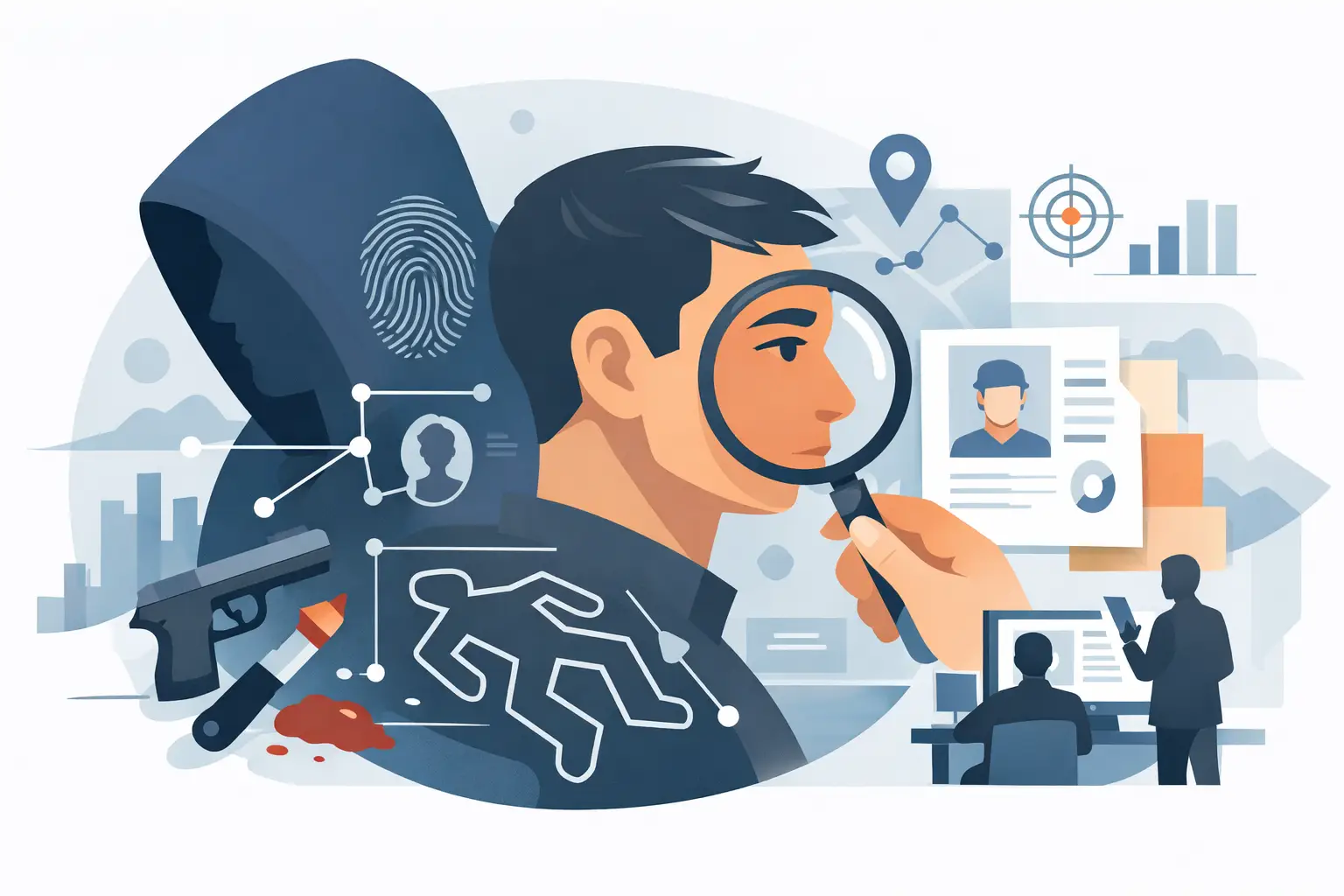
A behavioral profile is rarely the dramatic breakthrough television suggests. More often, criminal profiling techniques are used to narrow possibilities, sharpen investigative thinking, and help teams make better decisions when evidence is incomplete. Their value lies not in certainty, but in disciplined inference.
For professionals in law enforcement, behavioral science, security, and criminal justice, that distinction matters. Profiling sits at the intersection of psychology, criminology, victimology, and investigative method. Done well, it can support case prioritization, interview strategy, geographic focus, and offender risk assessment. Done poorly, it can harden assumptions and distract from evidence. That tension is exactly why the subject deserves serious study.
What criminal profiling techniques actually do
At its core, profiling is an attempt to infer characteristics of an unknown offender from patterns in behavior, crime scene dynamics, victim selection, and offense context. The goal is not to identify a single person by intuition. The goal is to generate structured, testable hypotheses that investigators can compare against facts as a case develops.
This is where many public misunderstandings begin. A profile is not a substitute for forensic evidence, witness statements, digital traces, or investigative legwork. It is one analytical tool among many. In the strongest cases, profiling contributes by helping investigators think more clearly about motive, offender habits, escalation, planning, social competence, and likely comfort zones.
The best practitioners approach a profile as provisional. They recognize that offender behavior can be strategic, impulsive, staged, or distorted by circumstances. A crime scene reflects not only personality, but also opportunity, stress, victim resistance, environmental constraints, and post-offense decisions. Behavioral interpretation without context can become speculation very quickly.
The main categories of criminal profiling techniques
Several approaches fall under the broad umbrella of profiling, and they are not interchangeable. Each relies on different assumptions and serves different investigative needs.
Crime scene analysis
Crime scene analysis focuses on what offender actions may reveal about planning, control, familiarity, emotion, and decision-making. Analysts examine how entry occurred, whether restraints were used, how the victim was approached, what level of force was applied, whether the scene was altered, and what behavior appears instrumental versus expressive.
This technique can help distinguish, for example, a highly planned offense from one driven by immediate opportunity. It may also suggest whether the offender acted with prior fantasy, forensic awareness, or familiarity with the victim or location. Still, interpretation must remain cautious. The same scene feature can carry different meanings depending on the total pattern.
Victimology
Victimology is one of the most consequential and underappreciated criminal profiling techniques. It asks who the victim was in context – daily routines, lifestyle, relationships, vulnerabilities, risk exposure, and symbolic significance. Understanding why this person became the target often says as much about the offender as the scene itself.
A victim selected at random implies one set of possibilities. A victim chosen for access, status, resemblance, occupation, or relational meaning implies another. In serial offending, victimology becomes even more valuable because it helps identify consistent preferences and shifts over time.
Behavioral pattern analysis
Behavioral pattern analysis looks across offenses for recurring actions, signatures, rituals, or decision habits. This is particularly relevant when assessing linked crimes. Analysts look for stable elements in approach, control, timing, communication, post-offense behavior, or object use.
The challenge is separating meaningful consistency from superficial similarity. Many offenses share common features simply because certain methods are efficient. Good analysis asks which behaviors are necessary to commit the crime and which appear psychologically meaningful to the offender.
Geographic profiling
Geographic profiling examines the spatial behavior of offenders – where crimes occur, how locations relate to one another, and what those patterns may suggest about an offender’s base of operations, routines, or mobility. It is especially useful in serial crime investigations when multiple event locations can be mapped and compared.
This approach does not pinpoint an address. What it can do is identify zones of probability and support resource allocation. It works best when integrated with local knowledge, transportation patterns, environmental criminology, and timing analysis.
Investigative psychology and statistical approaches
More academically grounded models draw on empirical research to classify offense behavior, identify correlations, and test assumptions against known cases. These approaches often emphasize measurable variables rather than purely intuitive interpretation. They can improve rigor by reducing reliance on anecdote and personal style.
That said, statistical approaches also have limits. Group-level trends do not always translate cleanly to an individual offender. The fact that a behavior is common in one offender population does not mean it is predictive in a specific case. This is where professional judgment still matters.
Where criminal profiling techniques help most
Profiling tends to be most useful in serious violent crime, serial offending, stalking, sexual offenses, threat assessment, and cases involving unusual behavioral patterns. In these contexts, behavior itself may carry investigative value beyond physical evidence alone.
One major benefit is prioritization. When investigators face a large field of possible suspects or an unclear offender type, a well-developed profile can help narrow focus. It may guide decisions about which prior offenders to review, which interview strategies to use, or which behavioral indicators deserve closer attention.
Another strength is interview and interrogation planning. If offender behavior suggests narcissism, grievance, sadism, compulsivity, social insecurity, or a need for dominance, communication strategy may be adjusted accordingly. This does not mean the profile determines the interview. It means the profile informs how rapport, challenge, timing, and evidence presentation might be handled.
Profiling can also support prevention. In threat management and protective intelligence settings, behavioral assessment helps professionals distinguish transient anger from sustained, escalating risk. Here the task is not solving a past crime, but identifying pathways to violence before harm occurs.
Limits, biases, and the danger of overreach
The prestige of profiling can sometimes exceed its reliability. That is a problem. Criminal profiling techniques become dangerous when they are treated as quasi-mystical expertise instead of disciplined behavioral analysis.
Confirmation bias is one of the clearest risks. Once investigators adopt a compelling profile, they may start seeing facts that support it while discounting facts that do not. Profiles can also unintentionally reflect cultural stereotypes, outdated typologies, or assumptions shaped by a small number of memorable cases.
Another issue is evidentiary inflation. A profile may sound precise, but precision is not the same as accuracy. Statements such as age range, employment status, relationship history, or personality traits should be framed as probabilities, not certainties. The more specific a profile becomes, the more carefully its basis should be explained.
This is why advanced education matters. Professionals working with behavioral evidence need training not only in profiling frameworks, but also in research methods, cognitive bias, ethics, trauma, and interdisciplinary collaboration. Serious practice depends on knowing where interpretation ends and unsupported inference begins.
Why training matters more than popular mythology
Many professionals arrive at this field because they are fascinated by the psychology of offenders. Curiosity is useful, but it is not enough. Effective behavioral analysis requires a foundation in criminology, psychopathology, investigative procedure, forensic interviewing, and data interpretation. It also requires humility.
The field has matured precisely because practitioners and scholars have challenged simplistic narratives. Organized versus disorganized typologies, for example, may offer a starting point, but real cases often blur those categories. Offenders change, adapt, regress, and improvise. Investigative environments vary. Cultural context matters. Behavioral meaning is rarely fixed.
For adult learners seeking advanced specialization, this is where rigorous graduate education becomes career-defining. Institutions such as Evidentia University serve a growing need for academically serious, professionally relevant training in applied behavioral sciences. The goal is not to create media-style profilers. It is to prepare professionals who can analyze human behavior with precision, ethical discipline, and real-world relevance.
The future of criminal profiling techniques
The future of profiling is likely to be more interdisciplinary, more data-informed, and more accountable. Behavioral analysis now increasingly overlaps with digital forensics, threat assessment, cyber investigations, and intelligence analysis. Offender behavior leaves traces across physical and virtual environments, and professionals must be able to interpret both.
At the same time, the human element remains central. Data can reveal patterns, but it does not interpret motive by itself. Algorithms can support prioritization, but they do not replace judgment. The strongest future practice will combine empirical methods with deep knowledge of behavior, context, and investigative realities.
For professionals who want to work at that level, the real question is not whether profiling is powerful. The real question is whether it is being used with enough rigor to deserve trust. That standard should guide every case, every classroom, and every career built around understanding criminal behavior.