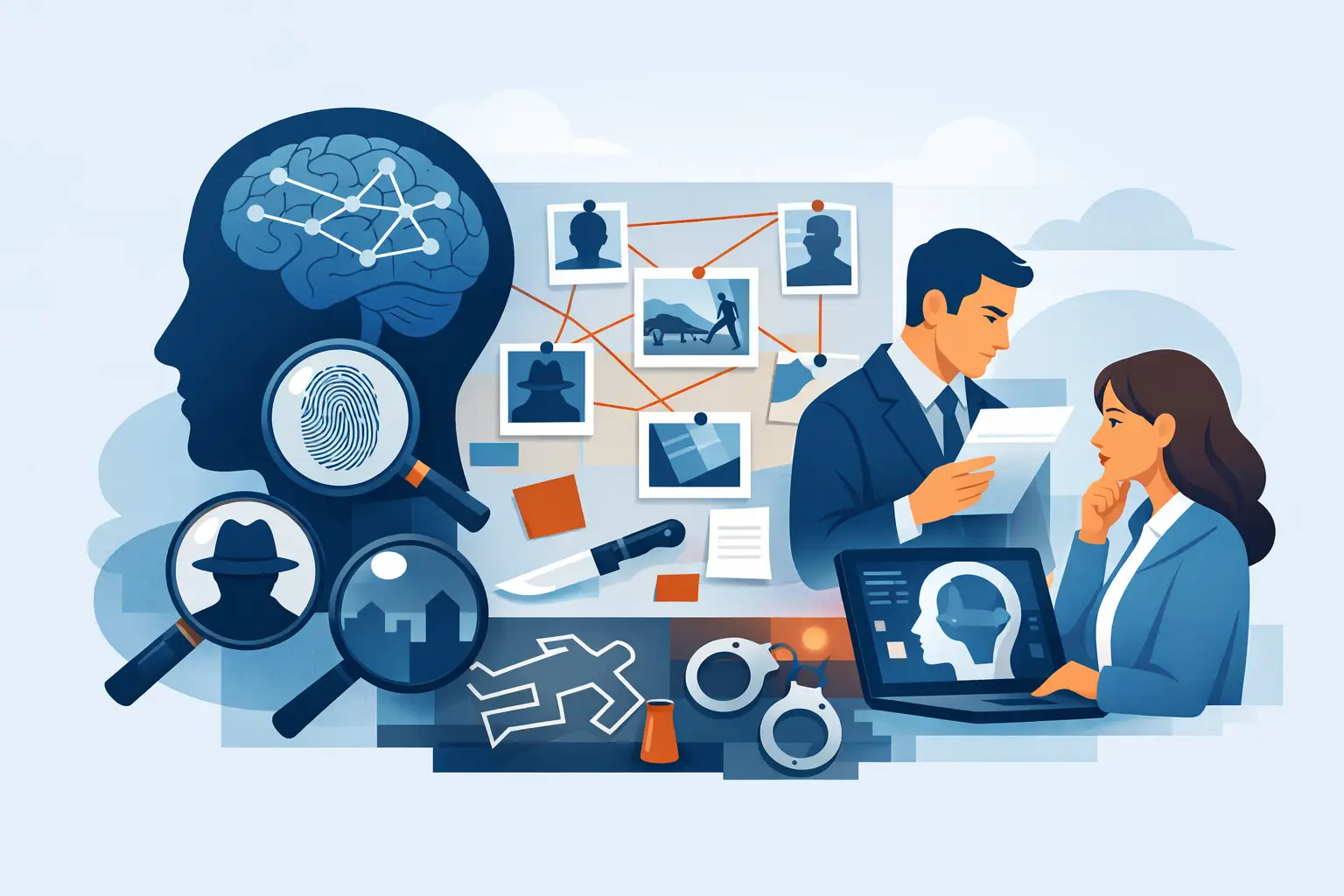
A case file rarely begins with certainty. More often, investigators face fragments – a crime scene that suggests intention but not identity, witness statements shaped by stress, and patterns that may or may not matter. This is where criminal profiling and investigative psychology become professionally valuable: not as dramatic shortcuts, but as disciplined ways of understanding behavior, decision-making, and offender patterns in support of an investigation.
For professionals in law enforcement, psychology, security, intelligence, and related fields, the distinction matters. Public culture has often treated profiling as intuition dressed up as expertise. Serious investigative work demands something else entirely. It requires analytical discipline, empirical caution, and the ability to connect human behavior to evidence without overstating what behavior alone can prove.
What criminal profiling and investigative psychology actually mean
Although the terms are sometimes used interchangeably, they are not identical. Criminal profiling is commonly understood as the attempt to infer likely offender characteristics from crime scene behaviors, victimology, and offense patterns. It asks what the known facts may suggest about the person who committed the act.
Investigative psychology is broader and more research-driven. It applies psychological theory and scientific methods to investigative problems such as offender behavior, decision-making, geographic patterns, interviewing, deception, memory, and risk assessment. Rather than focusing only on generating a profile, it examines how behavior can be studied systematically to improve investigative judgment.
That difference is more than academic. A narrow view of profiling can lead to oversimplified conclusions, especially when professionals are under pressure to produce answers quickly. Investigative psychology adds a more rigorous frame. It encourages hypothesis testing, attention to bias, and careful interpretation of behavioral evidence within a larger evidentiary context.
Why criminal profiling and investigative psychology matter in real investigations
The real value of behavioral analysis is not that it identifies an offender with certainty. Its value lies in improving the quality of investigative thinking. In a complex case, that can mean helping investigators prioritize leads, assess whether offenses are linked, refine interview strategy, or understand how offender behavior may escalate over time.
For example, victim selection can reveal whether a crime appears opportunistic, targeted, symbolic, or instrumental. Post-offense behavior may suggest planning, panic, staging, or an attempt to manipulate interpretation of the crime scene. Communication patterns, when present, can offer clues about motive, grievance, fantasy, or the offender’s need for control. None of these insights should be treated as proof on their own, but each can sharpen investigative direction.
This is especially useful in cases involving serial offending, sexual violence, stalking, coercive control, threat assessment, or crimes where behavioral consistency matters. In those settings, understanding how offenders think, adapt, and repeat can help professionals avoid missing connections that are not immediately obvious through forensic or documentary evidence alone.
The discipline works best when it resists certainty
One of the most common misconceptions about profiling is that it produces a definitive portrait of an unknown offender. In practice, the strongest behavioral work is probabilistic. It narrows, prioritizes, and contextualizes. It does not replace physical evidence, digital evidence, witness testimony, or investigative procedure.
That means trade-offs are unavoidable. A broad behavioral hypothesis may be more accurate but less operationally useful. A narrower hypothesis may be useful in practice but risks excluding possibilities too early. Good investigators understand that behavioral assessment is strongest when treated as one line of analysis among many.
This is also where professional maturity matters. Behavioral evidence can be compelling because it feels coherent. A profile may sound persuasive long before it is well supported. Investigative psychology pushes against that temptation by asking whether a conclusion is evidence-based, whether alternative explanations have been considered, and whether the analysis can withstand scrutiny.
Core methods behind investigative psychology
Investigative psychology draws from research rather than myth. Its methods vary by case type, but the field often relies on the systematic study of offender actions, crime scene characteristics, victim-offender relationships, temporal patterns, and geographic behavior.
Crime scene analysis examines what happened, how it happened, and what sequence of actions may reveal about planning, control, and interpersonal dynamics. Victimology studies the victim’s life circumstances, routines, vulnerabilities, and relationship networks to understand why that person may have been selected. Behavioral consistency analysis considers whether repeated acts across cases indicate a common offender or a similar offender type.
Geographic approaches can also be highly relevant. Offenders tend to operate within patterns shaped by routine activity, familiarity, perceived risk, and mobility. While geography alone does not identify a suspect, spatial behavior can help focus attention and support strategic resource allocation.
Interviewing is another major area. Investigative psychology contributes to how professionals assess statement reliability, recognize the effects of trauma and memory distortion, and structure interviews that improve information quality without contaminating recall. In many cases, this is where behavioral expertise has immediate practical value.
Where the field is strongest – and where caution is essential
Criminal profiling and investigative psychology are most effective when the available behavioral material is substantial and interpretable. A sustained pattern of offending, repeated victim targeting, pre-offense planning, signature behaviors, written or verbal communication, and meaningful post-offense conduct can all offer useful material for analysis.
The field is less reliable when investigators try to infer too much from too little. A single chaotic event, limited scene information, poor evidence preservation, or major unknowns about victim-offender interaction can sharply reduce interpretive confidence. Cultural assumptions can also distort analysis, especially in international or cross-community contexts where behavior may be read through the wrong social lens.
Bias is an equally serious concern. Confirmation bias, tunnel vision, and stereotype-based reasoning can all contaminate behavioral conclusions. If profiling becomes a way of validating an early theory instead of testing alternatives, it stops being useful. This is why advanced education in the field must go beyond fascination with offender psychology and train professionals in research literacy, ethics, and methodological restraint.
The growing professional demand for behavioral expertise
As investigations become more data-rich and more complex, the demand for professionals who can interpret behavior responsibly is increasing. Law enforcement agencies, intelligence units, private security teams, fraud investigators, threat assessment specialists, and forensic practitioners all face situations where human behavior is central to risk, decision-making, and case development.
At the same time, the field is evolving. Digital behavior, online radicalization, cyber-enabled coercion, transnational offending, and targeted violence have expanded what investigative psychology must address. Traditional models still matter, but they are no longer enough on their own. Professionals now need interdisciplinary fluency that combines psychology, forensic reasoning, interviewing, data interpretation, and investigative strategy.
For adult learners and working practitioners, this creates a meaningful academic opportunity. Specialized graduate study can provide more than subject knowledge. It can help professionals develop the intellectual rigor to separate evidence-based analysis from popular misconceptions, and the practical judgment to apply behavioral science where it genuinely improves outcomes. Institutions such as Evidentia University are part of that shift, preparing globally minded specialists for roles where behavioral insight must meet professional standards.
Education matters because the stakes are real
The consequences of weak behavioral reasoning are not abstract. Poor analysis can misdirect resources, reinforce bias, overlook victims, or contribute to investigative error. Strong analysis, by contrast, can help teams ask better questions, interpret patterns more carefully, and make decisions with greater confidence and accountability.
That is why criminal profiling and investigative psychology deserve to be treated as serious disciplines rather than cultural curiosities. Their purpose is not to make investigations look sophisticated. Their purpose is to improve how professionals understand behavior under conditions of uncertainty.
For those committed to advanced work in forensic and behavioral science, the field offers both challenge and responsibility. It asks professionals to think critically, remain evidence-led, and stay intellectually honest even when a case invites premature certainty. That combination of rigor and relevance is precisely what makes the discipline worth studying – and worth doing well.
The most credible investigators are rarely the ones who claim to know the most from the least. They are the ones who can read behavior carefully, question their own assumptions, and turn complexity into disciplined judgment.