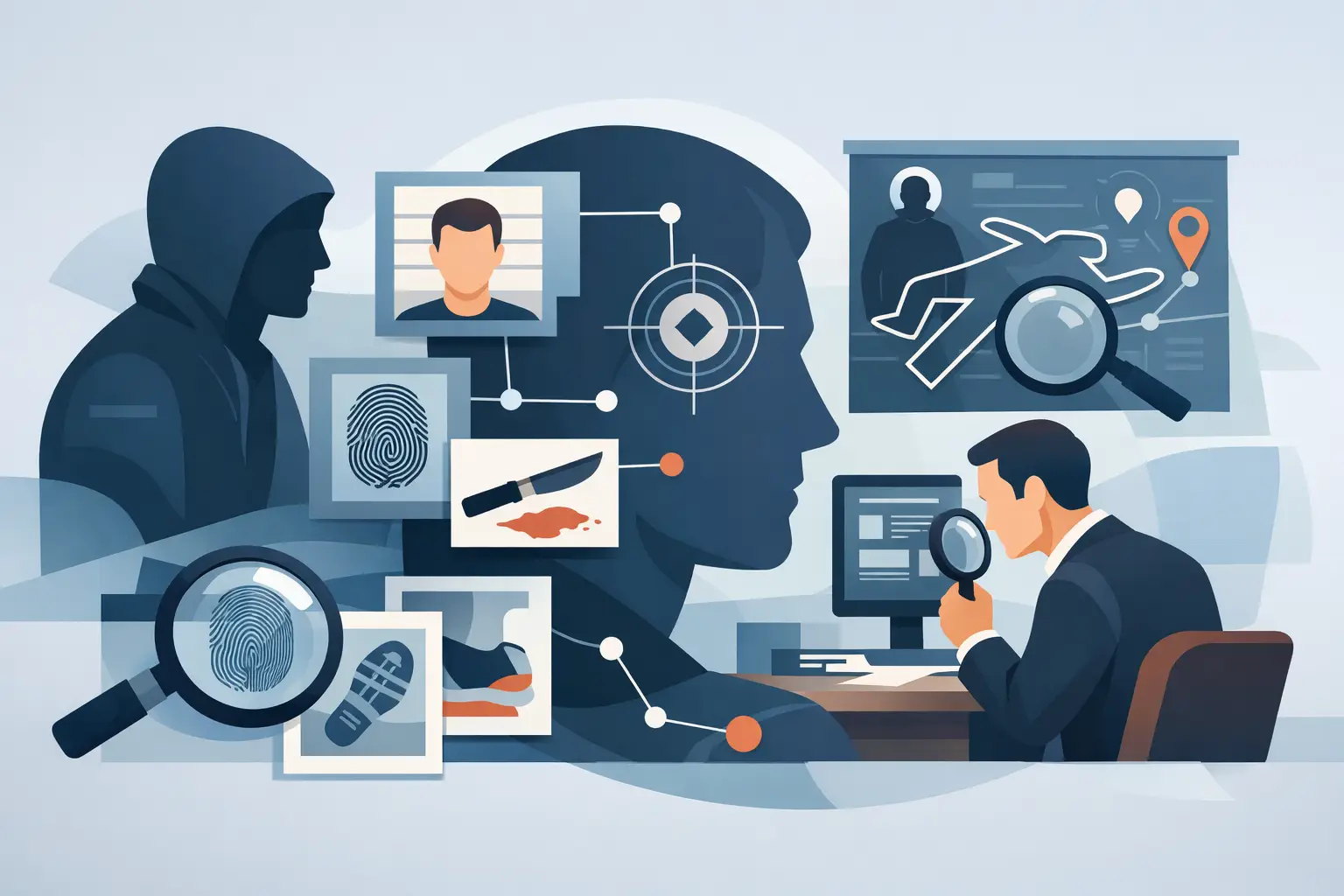
A violent crime scene rarely tells a complete story on its own. Investigators may have physical evidence, witness statements, and timelines, yet still face a critical question: what is the purpose of criminal profiling when the offender remains unknown? The answer is not that profiling magically identifies a suspect. Its real purpose is to help investigators make more informed, behavior-based decisions when evidence is incomplete, patterns are emerging, and every strategic choice matters.
What Is the Purpose of Criminal Profiling in Practice?
At its core, criminal profiling is an analytical method used to infer likely characteristics, behaviors, and patterns of an unknown offender based on crime scene evidence, victimology, case context, and behavioral indicators. The purpose is practical. Profiling helps narrow investigative focus, generate behavioral hypotheses, prioritize leads, and support resource allocation.
That distinction matters. Profiling is not a substitute for forensic science, interviewing, intelligence gathering, or legal procedure. It is a decision-support tool. When used correctly, it gives investigative teams a structured way to interpret behavior and ask better questions about offender motivation, escalation, victim selection, planning, and future risk.
For professionals in law enforcement, psychology, security, and forensic analysis, that makes profiling less about intuition and more about disciplined inference. The strongest profiling work is grounded in research, case comparison, and investigative logic rather than dramatic assumptions.
Profiling Serves the Investigation, Not the Myth
Popular culture has given criminal profiling an aura of near-mystical accuracy. In reality, the discipline is valuable precisely because it is narrower and more disciplined than fiction suggests. A profile does not announce a name, address, and occupation. It frames probabilities.
That means the purpose of criminal profiling is often misunderstood. Investigators do not use profiles because they expect certainty. They use them because behavior leaves patterns, and patterns can improve strategic thinking. A profile may suggest whether an offender is likely organized or disorganized, whether the crime reflects planning or impulse, whether victim targeting appears personal or opportunistic, and whether the offender may reoffend in a similar manner.
Those insights can shape interviews, surveillance priorities, geographic focus, and interagency coordination. They can also help investigators avoid wasting time on less plausible avenues, which is often just as important as identifying the right one.
The Main Functions of Criminal Profiling
Narrowing the suspect pool
In complex investigations, the number of possible suspects can quickly become unmanageable. Criminal profiling helps reduce that field by identifying behavioral and situational features that are more or less consistent with the offender’s likely profile. This may include age range, social functioning, criminal sophistication, familiarity with the victim, comfort with risk, or history of similar conduct.
This narrowing function is especially useful when there is no immediate forensic match. It does not prove guilt, but it can help focus attention where it is most justified.
Interpreting offender behavior
Behavior at the scene can reveal more than what happened. It can suggest why it happened and how the offender thinks. Did the offender bring tools? Control the environment? Move the body? Take trophies? Stage the scene? Each of those actions may have different implications.
The purpose of criminal profiling here is interpretive. It helps investigators distinguish between functional behavior, emotional expression, concealment efforts, and ritualized elements. That distinction can be crucial because two crimes that look similar at first glance may reflect very different offender motivations.
Assessing risk and future action
Profiling also supports threat assessment. If an offender appears to be escalating, targeting a specific population, or deriving psychological reinforcement from the crime, investigators may infer a higher likelihood of repetition. That can affect operational urgency, public warnings, and victim-protection strategies.
This is one reason profiling has relevance beyond homicide investigations. In stalking, sexual offending, workplace threats, terrorism-related behavior, and serial crimes, understanding likely progression can help authorities intervene earlier and more effectively.
Supporting interview and interrogation strategy
A strong behavioral analysis can inform how investigators approach a suspect or person of interest. Someone motivated by control, grievance, recognition, or sexual compulsion may respond differently to confrontation, empathy, evidence sequencing, or silence.
Profiling does not replace interviewing skill, but it can make interview planning more precise. In high-stakes cases, that precision matters.
Where Criminal Profiling Is Most Useful
Criminal profiling is typically most useful in cases where behavior is central to understanding the offense. Serial crimes are the classic example because repeated conduct often reveals stable patterns. Sexual offenses, arson, stalking, child abduction, and certain forms of targeted violence also lend themselves to behavioral analysis.
It can be less useful in offenses driven primarily by situational opportunity, intoxication, group dynamics, or minimal offender-victim interaction. In those cases, there may be too little behavioral material to support meaningful inference. That is an important limitation and one that serious practitioners acknowledge openly.
The best investigative teams understand that profiling is strongest when integrated with other disciplines. Crime scene analysis, digital evidence, victimology, forensic pathology, geospatial data, and interviewing all sharpen the quality of behavioral conclusions. Profiling works best as part of an evidence ecosystem.
What Is the Purpose of Criminal Profiling Beyond Solving a Case?
Although investigations are the most visible application, the purpose of criminal profiling extends further. It also contributes to research, prevention, training, and institutional learning.
From an academic and professional standpoint, profiling helps deepen understanding of how offenders select victims, develop routines, justify violence, and adapt to investigative pressure. Those insights can improve prevention models, threat assessment frameworks, and professional training in fields such as policing, intelligence, corrections, victim advocacy, and security management.
This broader value is especially relevant for graduate-level learners and practitioners seeking advanced expertise. Criminal profiling sits at the intersection of forensic science, psychology, criminology, and applied investigation. Studying it develops more than case knowledge. It develops a way of reasoning under uncertainty.
That is part of why the field continues to attract professionals who want to move beyond surface-level descriptions of crime and toward a more rigorous understanding of human behavior.
The Limits and Trade-Offs of Profiling
Serious discussion of profiling must include its limits. Behavioral inference always involves uncertainty. A profile can be thoughtful and evidence-based yet still be incomplete, too broad, or wrong in key respects. Bias is a real concern, especially if assumptions about gender, race, class, or mental illness distort interpretation.
There is also a difference between a useful profile and an admissible conclusion. Profiling may guide an investigation, but it does not carry the same legal weight as direct evidence. Courts, investigators, and analysts must be careful not to overstate what profiling can establish.
Another trade-off is that profiles can sometimes create false confidence. If a team becomes too committed to one behavioral theory, it may miss contradictory evidence. The discipline is most effective when used with intellectual humility. Good profilers do not force a case into a template. They revise hypotheses as evidence develops.
This is where advanced education matters. High-quality training teaches not just how to build a profile, but how to evaluate one critically, test assumptions, and recognize when the available data cannot support strong conclusions.
Why the Field Still Matters
Despite its limitations, criminal profiling remains relevant because investigations often unfold in conditions of ambiguity. Professionals still need tools for making sense of offender behavior when certainty is unavailable and time is limited.
The field matters not because it offers dramatic answers, but because it improves the quality of investigative thinking. It encourages structured analysis of motive, method, escalation, and risk. It creates a bridge between behavioral science and operational decision-making.
For institutions committed to applied forensic education, including Evidentia University, this is exactly the kind of interdisciplinary knowledge that prepares professionals for complex real-world challenges. Profiling is not a cinematic shortcut. It is a serious analytical practice that rewards rigor, restraint, and informed judgment.
The most valuable way to think about criminal profiling is this: its purpose is not to replace evidence, but to make evidence more intelligible through the lens of behavior. That is where its real power lies, and that is why the field continues to deserve careful study.