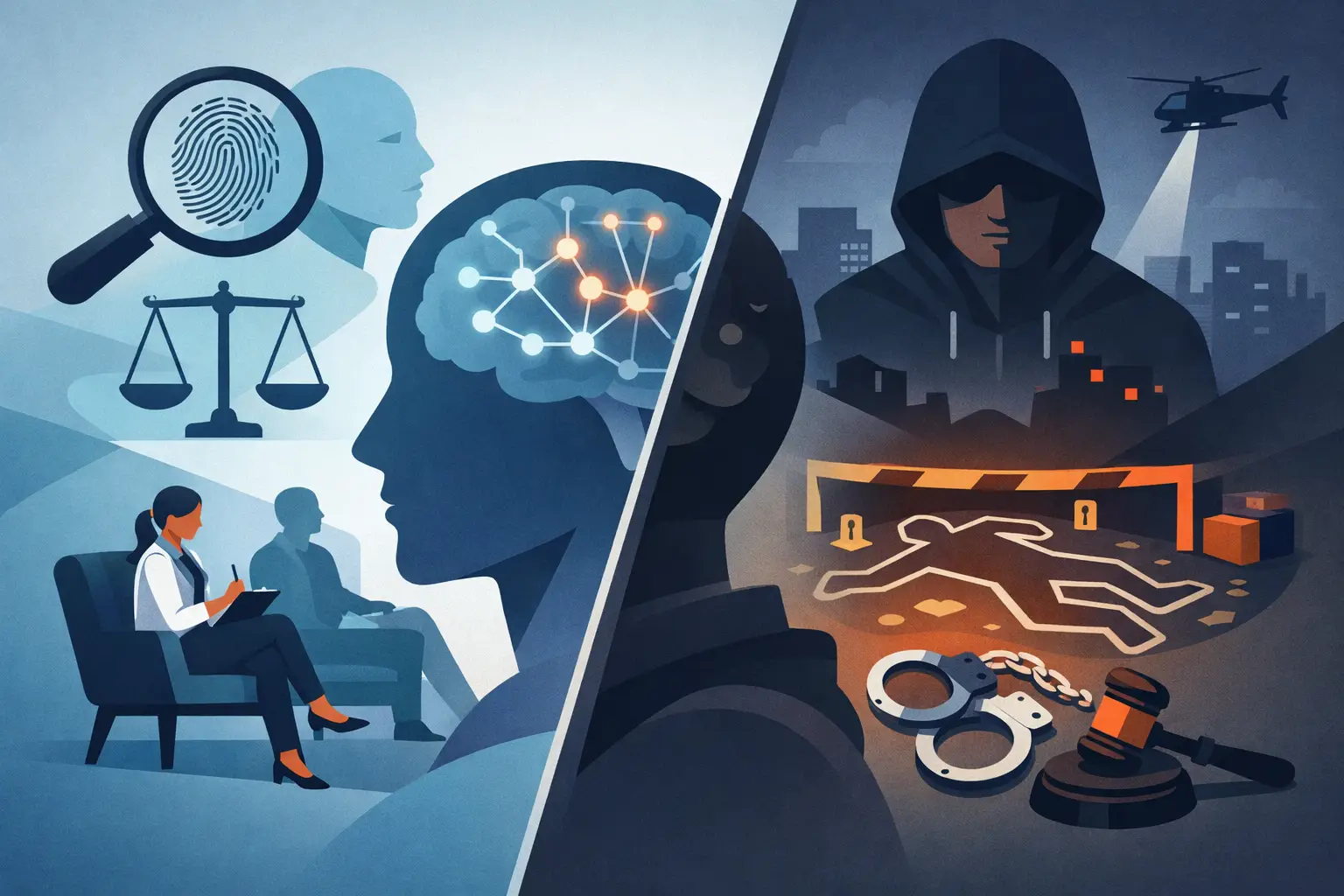
A detective reviewing an interview transcript, a clinician assessing competency, and a researcher mapping crime patterns may all work within the same justice ecosystem, yet they are not doing the same job. That is the real issue behind forensic psychology vs criminology. These fields overlap around crime, law, and human behavior, but they ask different questions, use different methods, and prepare professionals for different forms of impact.
For adult learners considering graduate study, the distinction matters. If your long-term goal is to assess individuals, contribute psychological expertise to legal settings, or understand behavior at a clinical and investigative level, one path may fit far better. If your interests lean toward crime systems, social causes, prevention, policy, and patterns across communities, the other may be the stronger academic and professional match.
What forensic psychology vs criminology really means
At a high level, forensic psychology applies psychological science to legal and criminal justice contexts. It focuses on individuals – how they think, behave, respond to trauma, make decisions, or function within court, correctional, and investigative environments. A forensic psychology professional may study witness memory, risk assessment, deception, offender behavior, competency, trauma, or the psychological dimensions of criminal conduct.
Criminology, by contrast, studies crime as a social phenomenon. It asks why crime happens across groups, places, and systems. It looks at patterns, causes, consequences, and responses to crime through lenses such as sociology, law, public policy, economics, and social theory. A criminologist is less likely to evaluate one person in a legal setting and more likely to analyze crime trends, institutions, prevention strategies, or the broader forces shaping offending and victimization.
That difference sounds simple, but in practice it shapes everything from coursework to career trajectory. One field tends to move closer to the psychology of the individual. The other tends to move closer to the structure of society and the operation of justice systems.
The core difference is the unit of analysis
One of the clearest ways to compare forensic psychology vs criminology is to ask what each field is primarily trying to understand.
Forensic psychology often starts with the person. Why did this individual act this way? Is this witness credible and psychologically reliable? What is this defendant’s mental state? How should trauma, personality, cognition, or behavioral risk be assessed in a legal context? The work may involve clinical reasoning, behavioral analysis, interviewing, and psychological theory applied to real cases.
Criminology usually starts with the pattern. Why are certain crimes increasing in one area and declining in another? How do poverty, opportunity, policing, education, family systems, or public policy affect offending? Which interventions reduce recidivism? What does the data say about victimization across populations? The work may involve theory, statistical analysis, research design, and policy evaluation.
There is overlap, of course. Both fields care about causes of crime and both can inform prevention. Both may engage with corrections, victim services, and public safety. Still, if you are drawn to human behavior at close range, forensic psychology tends to be more personally focused. If you are drawn to crime as a social and institutional issue, criminology generally offers the broader lens.
How the coursework usually differs
Graduate learners often discover the difference through the curriculum long before they see it in a job title.
A forensic psychology program commonly includes psychological assessment, psychopathology, trauma, memory, ethics, behavioral analysis, criminal behavior, victimology, and psychology within courts or corrections. Depending on the level and orientation of the program, students may also study investigative interviewing, threat assessment, forensic report writing, and the application of research to legal questions.
A criminology program is more likely to emphasize criminological theory, criminal justice systems, research methods, crime prevention, statistics, public policy, juvenile justice, penology, and social inequality. Students learn how to interpret crime trends, evaluate interventions, and understand how institutions respond to offending and victimization.
This is where many prospective students make a useful mistake: they assume criminology is simply the broader version of forensic psychology, or that forensic psychology is the more specialized branch of criminology. Neither is quite right. They are distinct disciplines with different intellectual centers. The best choice depends less on which one sounds more impressive and more on which way of thinking fits your goals.
Career paths are related, but not interchangeable
The phrase forensic psychology vs criminology often comes up because people want to know which field leads to better careers. The more accurate question is which field leads to the kind of career you actually want.
Forensic psychology can support roles connected to behavioral analysis, correctional settings, victim advocacy, investigative support, research, mitigation work, case consultation, and, with the appropriate licensure and advanced clinical training, assessment and treatment in forensic contexts. Some professionals work in courts, law enforcement-adjacent environments, private consulting, or behavioral research. Others build expertise that complements careers already established in policing, security, intelligence, mental health, or compliance.
Criminology can support careers in criminal justice policy, research institutes, community safety, corrections administration, intelligence analysis, public sector planning, program evaluation, academic research, and nonprofit or governmental work focused on prevention and reform. It is especially valuable for professionals who want to understand systems, shape interventions, or work with large-scale data and policy questions.
The trade-off is worth stating plainly. Forensic psychology may feel more directly connected to the drama of individual cases, but it can also require a more specific understanding of ethics, psychological science, and in some career tracks, licensing rules. Criminology can open wide institutional and policy pathways, but it may be less satisfying for students who want deeper training in individual assessment or clinical behavior.
Which field is better for investigators and applied professionals?
For working adults, this question is often more practical than theoretical. A law enforcement professional, fraud analyst, interviewer, negotiator, HR investigator, or security specialist may not be choosing between two abstract academic labels. They are choosing which knowledge base will make them more effective.
If your work depends on reading behavior, understanding trauma, improving interviews, analyzing deception claims carefully, evaluating risk, or interpreting how stress and cognition affect statements and decisions, forensic psychology may offer more immediate relevance. It tends to sharpen person-centered judgment.
If your work involves prevention strategy, institutional response, compliance patterns, organizational risk, community-level offending, or the design of programs and policies, criminology may be the stronger fit. It tends to sharpen systems thinking.
For some professionals, the answer is not either-or but sequence. A criminology background can provide structural understanding of crime and justice, while later forensic psychology study can deepen behavioral expertise. Others move the other way, starting with psychology and then broadening into crime analysis and policy. What matters is clarity about your professional horizon.
Graduate study should match the role you want, not just the subject you like
Interest alone is not enough when selecting an advanced degree. A student may enjoy true crime, courtroom narratives, or criminal profiling and still choose the wrong program if they do not connect that interest to the actual competencies a field develops.
A better question is this: what kind of problems do you want to solve five years from now? If you want to assess, interpret, consult, and apply behavioral science to legal or investigative contexts, forensic psychology is likely to align more closely. If you want to analyze crime trends, influence policy, improve institutions, or study offending at a population level, criminology may be the stronger route.
This is also why specialist institutions can matter. In a focused graduate environment such as Evidentia University, students are able to connect theory to practitioner-led insight in fields where credibility depends on applied understanding, not just textbook familiarity. For adult learners balancing career ambition with online flexibility, that connection between academic rigor and professional use is often decisive.
There is no prestige gap, only fit
Some prospective students worry that one field sounds more advanced or more respected than the other. That is usually the wrong frame. Employers, agencies, and institutions do not reward titles in the abstract. They value relevant expertise, sound judgment, analytical depth, and the ability to apply knowledge to real problems.
Forensic psychology is not automatically more specialized in a way that makes it superior. Criminology is not automatically broader in a way that makes it more strategic. Each field produces a different kind of professional thinker. The better option is the one that equips you for the work you are actually called to do.
If you are still deciding, pay close attention to the questions that keep your attention longest. Are you most interested in why this person acted, remembered, confessed, escalated, or deceived? Or are you more compelled by why this pattern emerged, this policy failed, or this system produced unequal outcomes? Your answer points toward the discipline that will challenge you in the right way.
Choose the field that makes you more useful, more credible, and more capable of serving justice with precision.