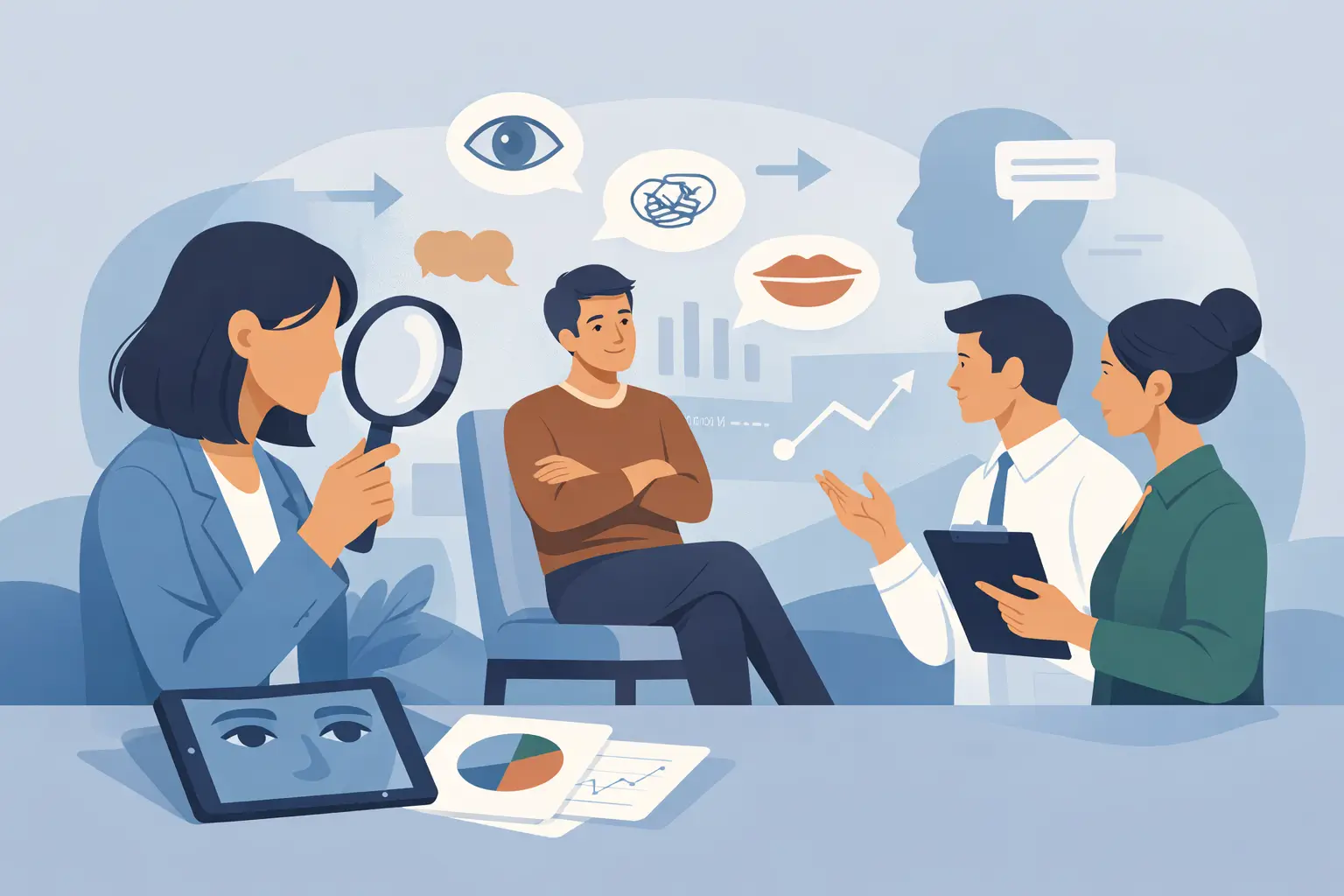
A candidate says all the right things in an interview, yet their timing feels off. A witness appears calm while describing a high-stakes event, but their shoulders tighten when one detail comes up. In moments like these, knowing how to analyze nonverbal behavior can sharpen professional judgment – but only if it is done with discipline.
Nonverbal behavior is not a shortcut to the truth. It is a stream of observable signals that may reflect emotion, cognitive load, social dynamics, culture, personality, or situational pressure. For professionals in investigation, security, HR, psychology, compliance, and negotiation, the value lies in interpretation that is careful, evidence-based, and context-aware. The goal is not to “catch” people through body language. The goal is to form better questions, test assumptions, and make more informed decisions.
What nonverbal behavior really tells you
When people hear nonverbal analysis, they often think of deception detection. That is too narrow and often misleading. A person may avoid eye contact because they are anxious, deferential, fatigued, culturally reserved, or simply concentrating. Another person may maintain steady eye contact because they are confident, trained, or trying hard to appear credible. The same behavior can point to very different internal states.
That is why strong analysis begins with a more serious premise: nonverbal behavior gives you data, not verdicts. It can suggest stress, discomfort, rapport, dominance, uncertainty, engagement, or incongruence between words and delivery. It cannot, on its own, prove intent or confirm dishonesty.
This distinction matters in professional practice. Overconfidence in body language leads to weak interviews, biased evaluations, and preventable errors. Skilled observers treat nonverbal behavior as one layer of information to be assessed alongside verbal content, timeline consistency, known facts, and situational context.
How to analyze nonverbal behavior without overreading it
The most reliable approach is cumulative rather than dramatic. You are not looking for one “tell.” You are looking for patterns that emerge across time, topics, and conditions.
Start with a baseline. Before drawing meaning from any gesture or expression, observe how the person behaves when discussing neutral topics. How fast do they speak? How much eye contact do they usually maintain? Are they naturally animated or restrained? Do they tend to sit still, fidget, smile often, or pause before answering? Without a baseline, normal behavior can easily be mistaken for suspicious behavior.
Then watch for changes from that baseline. A shift in posture, facial tension, vocal pace, blinking, self-touch, or hand movement may become relevant when it appears in response to a specific topic or question. The key is the shift, not the behavior in isolation.
Next, think in clusters. A single cue rarely means much. Several cues appearing together, especially around the same moment, deserve more attention. For example, a person may pause longer than usual, press their lips together, lean away, and reduce illustrators when a certain subject arises. That cluster does not prove deception, but it does suggest the topic carries weight and may warrant follow-up.
Finally, anchor everything in context. Was the room cold? Is the person under formal evaluation? Are there cultural norms affecting expression, personal space, or eye contact? Is this an interview after a night shift, a crisis meeting, or a cross-border negotiation? Context is not a side note. It is central to interpretation.
The channels that matter most
Nonverbal behavior is broader than posture and facial expression. Serious analysis considers several channels at once.
Facial behavior is often the first place people look, but it is also easy to misread. Expressions can be brief, partial, socially managed, or disconnected from deeper emotion. Instead of hunting for dramatic microexpressions, pay attention to timing and fit. Does the expression align with the content? Does it appear quickly and fade naturally, or does it look delayed and performative? Is there tension around the eyes, jaw, or mouth that contrasts with the spoken message?
Posture and body orientation reveal comfort, attention, and relational dynamics. A forward lean can indicate engagement, but in another setting it may signal pressure or confrontation. Turning the torso away may suggest withdrawal, yet it can also reflect habit or physical discomfort. Again, change and pattern matter more than textbook meanings.
Gestures are especially useful when they support or depart from speech. When people speak from direct experience, gestures often flow with the narrative. When speech becomes more controlled, vague, or cognitively demanding, gestures may decrease, become delayed, or appear less synchronized. That does not mean dishonesty. It can mean the person is carefully managing language or working harder to formulate a response.
Voice is frequently underrated. Pace, pitch, volume, pauses, hesitations, and emphasis can reveal shifts in confidence, emotional arousal, or cognitive effort. In many professional settings, vocal behavior is as informative as body movement because it is harder to fully regulate over time.
Interpersonal distance and touch also matter, particularly in leadership, conflict, and negotiation contexts. People regulate space differently depending on culture, status, relationship, and setting. What appears warm in one context may seem intrusive in another.
Where professionals go wrong
The most common mistake is certainty. Popular media encourages the idea that crossed arms mean defensiveness or that looking away means lying. Real behavior is less theatrical and more probabilistic.
Another mistake is confirmation bias. Once an observer forms an impression, they start selecting cues that support it. A manager who already doubts an employee may interpret nervousness as evasiveness. An investigator who believes a subject is truthful may dismiss equally relevant signs of strain. Good analysis requires disciplined self-correction.
A third mistake is ignoring cultural and neurodiversity factors. Communication norms vary widely across societies, professions, and individuals. Some people are highly expressive. Others are controlled, flat, or atypical in ways that have nothing to do with credibility. Any professional standard for observation must account for difference rather than treating one style as normal.
How to analyze nonverbal behavior in interviews and assessments
In professional interviews, the strongest use of nonverbal analysis is strategic, not accusatory. Notice when behavior shifts, then use that shift to improve your questioning.
If a candidate becomes noticeably less fluid when discussing a claimed accomplishment, ask for a detailed sequence: what happened first, who was involved, what constraints existed, and what decisions they made. If a witness grows visibly tense around a timeline detail, return to that point from a different angle later. If a negotiator becomes more rigid when terms change, explore what concern the new condition may have triggered.
This approach keeps the process evidence-centered. Rather than announcing interpretations, you test them. Nonverbal observations help you identify where to probe, slow down, clarify, or revisit. They inform the next question.
Documentation is also essential. Record what you actually observed, not what you concluded too quickly. “Subject looked down for five seconds and stopped gesturing when asked about the meeting” is stronger than “Subject appeared deceptive.” Behavioral notes should be specific, observable, and separated from interpretation.
The role of training and professional judgment
Learning to observe well is not the same as learning a set of body language myths. It requires repeated exposure, methodological discipline, and a willingness to tolerate ambiguity. That is one reason advanced education in behavioral science has become increasingly relevant across investigative and decision-making fields.
Professionals who work with high-stakes human interaction benefit from a framework that integrates psychology, communication, interviewing, and research literacy. At that level, nonverbal analysis becomes less about reading signs and more about evaluating behavior in a structured way. That distinction elevates practice.
For adult learners seeking that edge, institutions such as Evidentia University have helped define a more rigorous path forward by treating human behavior as a serious applied discipline rather than a collection of pop-psychology claims. In fields where judgment carries consequences, that standard matters.
What strong analysis looks like in practice
Strong analysts stay curious longer than others. They do not rush to label a behavior, and they do not force certainty where the data is thin. They observe the person, the setting, the sequence, and the interaction itself.
They also accept trade-offs. A fast assessment may be necessary in security or law enforcement, but speed raises the risk of error. A more structured interview may produce better behavioral data, but it takes time and training. Technology can assist with review and pattern recognition, yet it still depends on human interpretation. There is no frictionless method, only better and worse standards of practice.
If you want to improve how you analyze people, start by becoming more precise in what you see. Observe before you infer. Compare behavior to baseline. Look for clusters. Test your impressions through better questions. And remember that the most credible interpretation is often the one that remains open until the evidence truly narrows it.