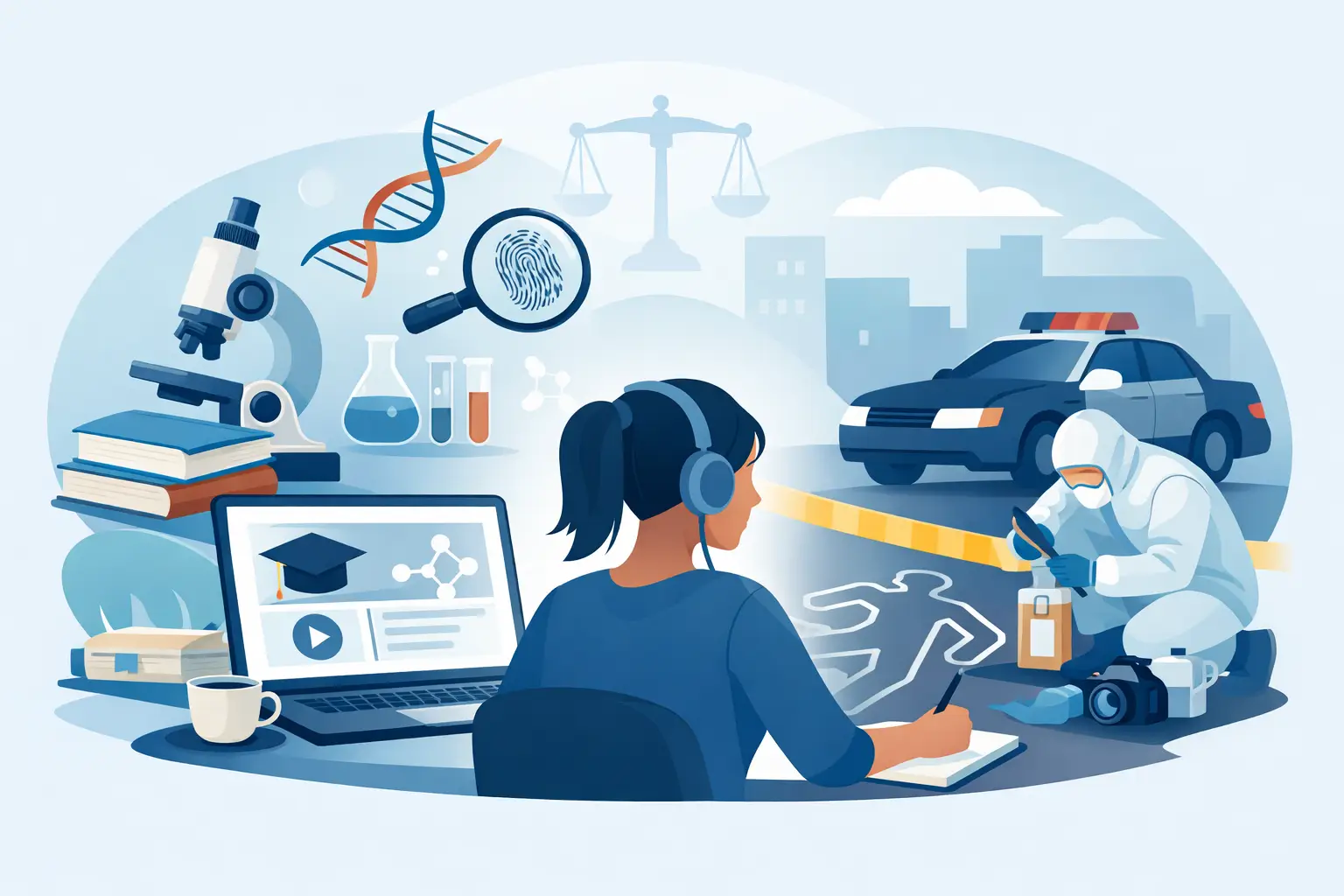
A promotion in investigations rarely goes to the person with the most interest alone. It goes to the professional who can interpret evidence carefully, think across disciplines, and communicate findings with precision. That is why an online forensic science degree has become a serious option for working adults who want more than convenience. They want advanced training that strengthens judgment, credibility, and career range.
For many prospective students, the real question is not whether online education is accepted anymore. That debate has largely moved on. The better question is whether a given program can deliver the scientific rigor, applied relevance, and professional value that forensic work demands. In forensic science, the standard cannot be access alone. It has to be substance.
What an online forensic science degree should actually teach
A strong program does more than introduce crime scene terminology or laboratory concepts. It should help students understand how forensic methods operate within legal, investigative, and institutional systems. That means learning how evidence is collected, interpreted, challenged, and presented, but also how bias, procedure, and ethics shape outcomes.
This is where many applicants benefit from slowing down. “Forensic science” sounds narrow, but the field is not. Some programs lean heavily into laboratory science and physical evidence. Others emphasize investigative analysis, behavioral evidence, digital environments, fraud, or interdisciplinary problem-solving. Neither approach is inherently better. The right fit depends on the work you want to do.
A professionally relevant curriculum often includes research methods, forensic psychology, criminal behavior, legal procedure, ethics, and evidence interpretation alongside more technical subject matter. For adult learners, that broader frame matters. Many are not training for an entry-level lab role. They are building expertise they can apply in law enforcement, intelligence, compliance, cybersecurity, victim advocacy, private investigation, or graduate research.
Who benefits most from an online forensic science degree
Online study is especially well suited to professionals who already operate in high-stakes environments and need education that can match that pace. A police officer preparing for investigative leadership, a compliance specialist moving into anti-fraud analysis, or a psychology graduate seeking a forensic direction may all arrive with different goals. What they share is the need for advanced learning without putting a career on hold.
That flexibility is one of the clearest strengths of the format, but it should not be mistaken for ease. A respected online degree asks for discipline. Reading loads can be demanding. Writing expectations are often higher than students anticipate. Discussions, case analyses, and applied assignments require real engagement, not passive attendance.
For that reason, the best candidates tend to be self-directed and professionally motivated. They are looking for education that connects directly to practice. They want theories they can test against experience, not abstract content detached from the realities of work.
The advantages of studying forensic science online
The practical appeal is obvious. Online learning expands access for students who cannot relocate, commute, or interrupt employment. That includes military personnel, international students, parents, and mid-career professionals managing complex schedules. Geography stops being the barrier it once was.
Yet accessibility is only part of the value. A high-quality online environment can create a different kind of academic strength. Students from multiple sectors and countries bring varied professional contexts into the classroom. A discussion about interview techniques, evidentiary standards, cyber investigations, or behavioral assessment becomes richer when participants are comparing systems, institutions, and case realities across borders.
There is also a strong argument for relevance. In modern investigative work, collaboration increasingly happens across digital platforms, distributed teams, and cross-jurisdictional networks. Learning online can reflect that professional reality rather than stand apart from it. At a specialist institution such as Evidentia University, that model aligns naturally with the needs of ambitious adult learners seeking expert-led education with international reach.
The limitations students should think through honestly
Not every online forensic science degree serves the same purpose. This is where expectations need to stay grounded.
If your goal is a highly technical laboratory position that requires extensive in-person scientific training, you need to examine program structure very carefully. Some roles in forensic biology, chemistry, or crime lab operations may require specific undergraduate science coursework, hands-on lab components, or credentials that a fully online program does not provide by itself. In that case, online study may still be valuable, but perhaps as part of a broader academic pathway rather than the entire route.
There is also the question of learning style. Some students thrive in asynchronous environments. Others find that without fixed classroom rhythms, momentum slips. A prestigious curriculum still depends on student follow-through. Flexibility can support achievement, but it can also expose weak time management.
A final trade-off is perception. While online degrees have earned far greater acceptance, employer confidence still depends on institutional quality. Hiring managers tend to care less about the format than about what the degree represents – the reputation of the school, the seriousness of the curriculum, and the credibility of the faculty.
How to evaluate an online forensic science degree
Program evaluation should be more rigorous than a quick scan of tuition and course titles. Start with academic scope. Does the curriculum reflect current forensic realities, or does it read like a generic criminal justice package with a forensic label attached? Specialized education should feel specialized.
Then look at faculty. In a field like forensic science, practitioner-led instruction can make a decisive difference. Students benefit when faculty can connect theory to investigative practice, legal scrutiny, behavioral insight, and research design. Experience in policing, federal investigation, forensic psychology, intelligence, fraud analysis, or academic research is not cosmetic. It shapes the quality of the questions students learn to ask.
You should also assess whether the program supports the kind of career you want. Some degrees are best for advancement within an existing profession. Others are designed to prepare students for doctoral study, consulting work, policy roles, or interdisciplinary specialization. A good admissions team should be able to discuss these distinctions clearly, not blur them.
Finally, pay attention to the academic ecosystem around the degree. Serious institutions do more than deliver courses. They cultivate research culture, professional dialogue, publications, events, and scholarly community. For adult learners, that environment can matter as much as the syllabus because it extends the degree beyond isolated coursework.
Career outcomes depend on how you use the degree
An online forensic science degree does not guarantee a single job title, and that is often a strength rather than a weakness. The field intersects with multiple professions, which means the degree can support different forms of advancement depending on your background.
For some students, the value lies in vertical growth. They use the degree to strengthen credibility for promotion in law enforcement, investigative services, corrections, or public-sector analysis. For others, it creates lateral mobility into adjacent areas such as behavioral analysis, fraud prevention, cybersecurity, threat assessment, or expert support roles.
There is also a group of students who pursue the degree for intellectual specialization. They want graduate-level competence in forensic and behavioral science because their work increasingly demands more refined analytical thinking. That is common among professionals in HR, legal support, policy, security, and organizational investigations, where evidence, behavior, and risk intersect in sophisticated ways.
The degree, then, is not a shortcut. It is a platform. Its impact depends on prior experience, geographic market, professional goals, and how intentionally the student translates learning into practice.
Is an online forensic science degree worth it?
For the right student, yes. But worth is measured by alignment, not marketing.
If you want specialized education that sharpens investigative thinking, deepens your understanding of evidence and behavior, and fits around a demanding professional life, the online model can be exceptionally effective. If you choose a program with academic seriousness, expert faculty, and a clear professional orientation, it can become a career-defining investment.
If, however, you need a very specific technical lab credential and assume any online option will provide it, you may end up disappointed. The field asks for precision, and so should your decision-making.
The strongest applicants tend to approach this choice the same way they would approach an investigation. They look closely at the evidence, test assumptions, and choose the program that best fits the outcome they actually want. That mindset will serve you well long before the first class begins.