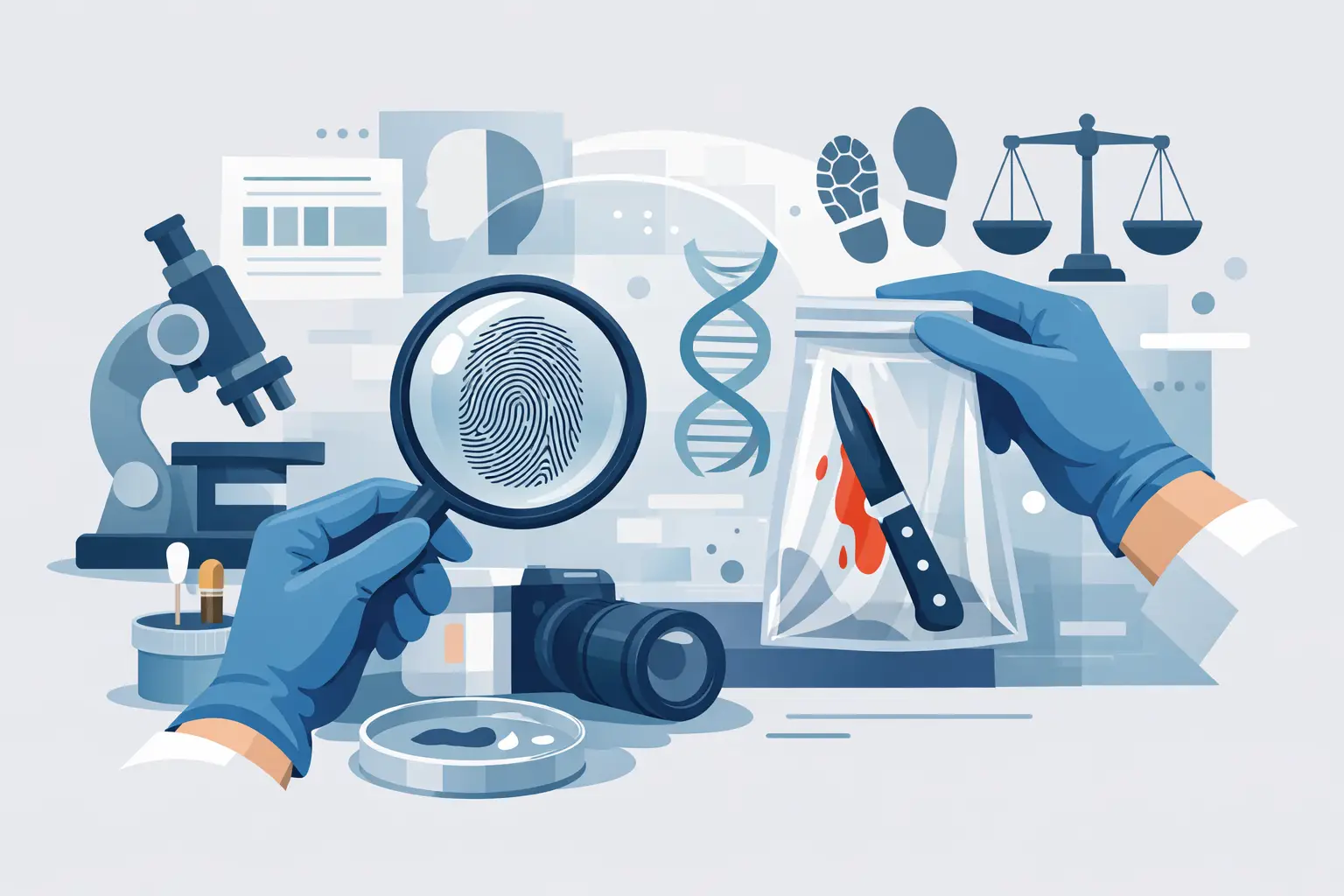
A latent fingerprint, a DNA profile, an interview recording, or a recovered file can appear decisive long before it has earned that status. Learning how to evaluate forensic evidence means resisting the urge to treat a scientific-sounding result as a final answer. The central question is not simply whether evidence exists. It is whether the evidence was obtained, preserved, tested, interpreted, and communicated in a way that justifies the conclusion being offered.
Forensic evaluation is therefore a disciplined exercise in reasoning. It requires attention to science, procedure, context, and human judgment. For investigators, legal professionals, security specialists, and behavioral practitioners, this discipline can determine whether evidence clarifies a case or quietly distorts it.
How to Evaluate Forensic Evidence: Start With the Question
Every evaluation should begin with a precise question. What proposition is the evidence meant to support or challenge? A DNA profile may help assess whether biological material is associated with a person. It does not, by itself, establish when that material was deposited, why it was present, or whether the person committed an alleged offense.
This distinction matters because evidence can be highly reliable for one proposition and weak for another. A video may reliably show that an individual entered a building, yet reveal little about intent. A digital artifact may demonstrate that an account was accessed, while leaving uncertainty about the person operating the device. Sound evaluation separates the observation from the inference.
Define the competing explanations early. Rather than asking, “Does this prove guilt?” ask whether the evidence is more consistent with one explanation than another. That shift encourages a more scientific and professionally defensible analysis.
Examine Collection, Preservation, and Provenance
An impressive laboratory result cannot repair a compromised collection process. Before assessing an examination, assess the history of the item itself. Where was it found? Who collected it? What was its condition? How was it packaged, transported, stored, and transferred?
Chain of custody is not administrative paperwork alone. It is the documented basis for confidence that the item examined is the item recovered and that it was not altered, contaminated, substituted, or improperly handled. Gaps do not automatically make evidence unusable, but they should affect the weight assigned to it.
Contamination risk must be considered according to the evidence type. Biological evidence may be vulnerable to transfer from people, tools, surfaces, or inadequate protective procedures. Digital evidence can change when a device is powered on, connected to a network, or searched without appropriate forensic protocols. Trace evidence may be lost through poor packaging or commingling.
Provenance also includes source transparency. An analyst should be able to identify the original source of a photograph, recording, document, sample, or dataset. Copies, edited material, screenshots, and secondhand reports may still have value, but their limitations must be explicit.
Assess the Method, Not Just the Result
The next question is whether the method used is fit for purpose. A method should be validated for the task it claims to perform, applied under appropriate conditions, and supported by trained personnel using documented procedures.
Validation asks whether a technique can produce accurate and reproducible results. This is particularly significant when evaluating pattern evidence, digital analysis, toxicology, forensic anthropology, or behavioral assessment. A technique may be well established in controlled conditions but less dependable with degraded samples, low-quality images, partial prints, limited comparison material, or ambiguous data.
Look for known error rates, quality assurance measures, proficiency testing, and clear operating standards. No method is error-free. The professional question is whether the likely error, uncertainty, and limitations have been measured and honestly described.
Ask What the Method Can Actually Distinguish
Some forensic methods can strongly discriminate among sources. Others offer a more limited basis for comparison or classification. For example, a chemical analysis may identify a substance with considerable confidence, while a visual comparison of marks or impressions may depend more heavily on examiner judgment and image quality.
Avoid language that exceeds the method. Terms such as “match,” “identification,” “consistent with,” and “cannot be excluded” carry different implications, yet they are often misunderstood. A finding that an item is consistent with a source does not necessarily establish exclusivity. Conversely, an exclusion may depend on the quality and completeness of the available material.
The strongest reports explain both the finding and the boundary around it. They state what was observed, how it was assessed, and what the examiner cannot reasonably conclude.
Evaluate the Analyst’s Reasoning and Possible Bias
Forensic science is conducted by people, and people are susceptible to cognitive bias. Contextual information can shape what an examiner notices, how ambiguous features are interpreted, and how strongly a conclusion is framed. This does not imply misconduct. It reflects a well-documented challenge in any field involving human interpretation.
A careful evaluation asks what information the analyst knew before examining the evidence. Were they aware of a suspect’s identity, a confession, witness accounts, or other incriminating facts? Were procedures in place to limit irrelevant contextual influence? Was a second examiner asked to review the work independently?
Documentation is especially revealing. Notes, images, instrument outputs, comparison charts, and decision records can show whether the conclusion emerged from the evidence itself or was shaped by assumptions introduced along the way. An opinion with a transparent reasoning trail deserves more confidence than an unsupported assertion, even when both reach the same apparent result.
This is also where professional humility matters. Analysts should be prepared to explain uncertainty, revise a conclusion when new information emerges, and distinguish between data and interpretation. Certainty is not a sign of expertise when the underlying evidence is limited.
Consider Relevance, Weight, and Alternative Explanations
Evidence must be evaluated in context. Relevance asks whether a finding bears on a fact that matters to the investigation. Weight asks how strongly it changes the assessment of competing explanations.
A fingerprint on an object may be relevant, but its weight depends on location, accessibility, timing, and the possibility of innocent contact. DNA on a surface may be informative, but secondary transfer, shared environments, and prior legitimate presence may provide plausible alternatives. Location data can assist with timelines, but precision varies by technology, settings, and the way the data was generated.
This is why isolated evidence can be dangerous. A sound case assessment tests whether independent sources converge. Do physical findings align with timelines, records, witness testimony, digital artifacts, and behavioral indicators? Convergence can strengthen an inference, but only if the sources are genuinely independent. Repeating the same flawed assumption across multiple reports does not create corroboration.
Probabilistic thinking is useful here. Instead of treating evidence as proof or disproof in absolute terms, ask how expected the evidence would be if each explanation were true. That approach makes room for uncertainty without allowing uncertainty to become an excuse for vague reasoning.
Read Forensic Reports With Precision
The wording of a forensic report deserves close attention. A report may contain factual observations, laboratory findings, interpretive opinions, and administrative statements. These should not be blended together.
Read the scope of the examination first. Determine what material was tested and what was not. Then identify the limitations: insufficient quantity, degradation, poor image quality, missing reference samples, incomplete device extraction, or inconclusive results. An inconclusive finding is not evidence of guilt or innocence. It means the available examination did not support a reliable determination.
Pay attention to statistics and verbal probability statements. If a report gives a random match probability or likelihood ratio, identify the relevant population, assumptions, and comparison being made. Numbers can add rigor, but they can also be misunderstood when presented without context. A statistic about the rarity of a profile is not automatically a statistic about the probability that a person is innocent or guilty.
When the stakes are significant, independent review is a professional safeguard. A qualified second opinion may identify a methodological issue, an overlooked limitation, or a more cautious interpretation. The value of review is greatest when it is genuinely independent rather than a simple confirmation of the first examiner’s conclusion.
Build a Defensible Evaluation Record
A forensic evaluation should be reproducible in its reasoning, even when another professional reaches a different ultimate opinion. Record the questions asked, the evidence reviewed, the source and condition of each item, the methods used, the limitations identified, and the alternative explanations considered.
This record supports accountability and makes later review possible. It is valuable in court, internal investigations, compliance inquiries, security incidents, and academic research alike. It also protects professionals from a common failure: remembering a conclusion while losing sight of the evidence and assumptions that produced it.
For adult learners entering advanced investigative fields, this habit is foundational. Evidentia University approaches forensic and behavioral sciences as disciplines that demand both technical literacy and intellectual rigor. The strongest practitioners do not merely recognize evidence. They can explain why it deserves confidence, where that confidence ends, and what further inquiry is required.
The most useful closing question is often the simplest: what would have to be true for this evidence to mislead us? Asking it before acting creates space for better science, fairer decisions, and more credible investigations.