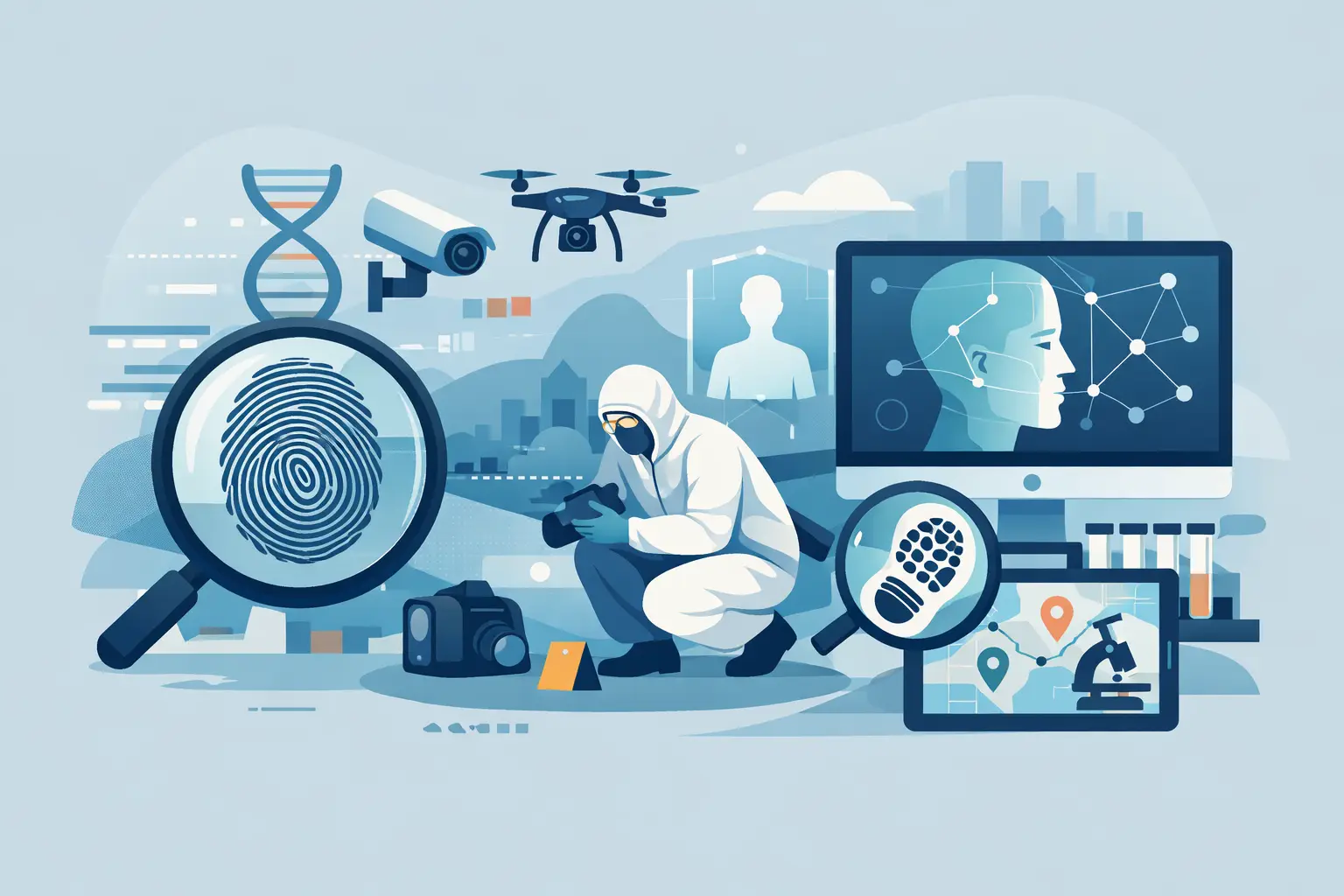
A fingerprint lifted at a scene, a phone recovered from a vehicle, and a trace DNA sample may all become part of the same case. The difference is that forensic technology trends now shape how quickly those items are identified, interpreted, challenged, and explained in court. For working investigators and forensic professionals, the central question is no longer whether technology will influence casework. It is whether its use will remain scientifically defensible, legally sound, and intelligible to the people making consequential decisions.
The most significant developments are not replacing forensic judgment. They are changing the volume, speed, and complexity of information that judgment must address. This creates extraordinary possibilities for public safety and accountability, but it also raises the standard for education, validation, documentation, and ethical leadership.
Why forensic technology trends demand more than new tools
Technology can narrow a lead, connect fragmented evidence, or reveal patterns that would be difficult to see manually. It cannot independently determine the meaning of evidence in a human investigation. A match, probability score, location record, or behavioral indicator must still be evaluated within the conditions under which it was collected and the limitations of the method used.
That distinction matters because forensic evidence is often presented with an aura of certainty. Yet every discipline has sources of uncertainty: contamination risk, incomplete data, degraded samples, subjective interpretation, software limitations, and contextual bias. The professional responsibility is not to avoid advanced tools. It is to understand where their outputs are reliable, where they require caution, and how to communicate those boundaries with precision.
For graduate learners and experienced practitioners, this is a defining professional challenge. Technical fluency must be paired with scientific reasoning, legal awareness, and an understanding of human behavior. The strongest investigators will be those who can ask not only, “What did the system find?” but also, “How did it find it, what assumptions did it make, and what alternative explanation remains plausible?”
Artificial intelligence is moving from experiment to casework support
Artificial intelligence has become one of the most discussed forces in forensic science. Machine learning can assist with image comparison, video analysis, digital triage, document examination, pattern recognition, and the organization of large evidentiary datasets. In cybercrime and financial investigations, it may help identify anomalies across transaction records or flag connections within a vast network of communications.
Its practical value is often speed. A digital forensic team may face multiple devices, cloud accounts, encrypted applications, deleted files, and years of communications. AI-supported tools can help prioritize material for human review, reducing time spent on routine sorting. In video-heavy investigations, automated search functions may identify objects, vehicles, or recurring movements across many hours of footage.
The output is not the conclusion
AI is most useful when it supports a trained professional rather than substitutes for one. An algorithm can classify an image or rank a possible match, but it may not account adequately for lighting, compression, demographic bias, unusual context, or the evidentiary relevance of what it detects. A technically impressive system can still produce an unreliable result if the data used to train it are unrepresentative or if its performance has not been independently validated.
Courts and investigative agencies will increasingly scrutinize explainability. If an expert cannot describe the process, error rates, limitations, and chain of reasoning behind an AI-supported finding, the result may be difficult to defend. This is why future-facing forensic education must include data literacy and ethics alongside practical familiarity with investigative technologies.
Digital evidence is becoming the default, not the exception
Nearly every serious investigation now has a digital dimension. Smartphones, wearables, connected vehicles, smart-home systems, cloud platforms, social media accounts, and workplace applications can create records of movement, communication, intent, and opportunity. The challenge is no longer simply acquiring data. It is preserving its integrity while extracting meaning from an expanding and volatile evidence environment.
Cloud evidence illustrates the complexity. Relevant data may be stored across jurisdictions, controlled by service providers, duplicated across devices, or altered by automatic synchronization. Investigators must understand the difference between what a device displays locally and what exists on a remote account. They must also work within warrant requirements, privacy laws, organizational policy, and international legal processes.
The technical dimension is only part of the task. Digital evidence can be persuasive, but it is rarely self-explanatory. A location artifact may indicate where a device was, not necessarily who possessed it. A message may reveal communication without proving intent. Metadata can be valuable, but its reliability depends on the source system and the method of extraction. Careful interpretation protects both investigative quality and due process.
Faster biological analysis brings new opportunities and new safeguards
Advances in DNA analysis continue to extend the reach of biological evidence. Rapid DNA technologies, probabilistic genotyping, improved mixture interpretation, and forensic genetic genealogy have expanded the ability to generate investigative leads from complex or limited samples. Cold cases that once appeared to have reached an evidentiary dead end may be revisited with methods unavailable only a few years ago.
However, speed should not be confused with simplicity. A rapid result may assist with investigative decisions, especially where time is critical, but confirmatory testing and laboratory standards remain essential. Complex DNA mixtures require specialized interpretation, and probabilistic software produces statistical assessments rather than absolute declarations of identity.
Forensic genetic genealogy raises particularly significant questions. It has demonstrated the capacity to identify previously unknown suspects and victims, yet it also involves sensitive familial information and depends on carefully governed database practices. Agencies must establish clear policies for when the method is appropriate, how leads are verified, and how privacy interests are protected. The legitimacy of forensic innovation depends as much on governance as on scientific capability.
Three-dimensional documentation is changing how scenes are preserved
Laser scanning, photogrammetry, drones, and immersive visualization are changing crime scene and accident reconstruction. These technologies can create detailed spatial records that allow experts, attorneys, jurors, and investigators to revisit a scene after it has been released or physically altered. In major incidents, this can be especially valuable when the relationship between people, objects, trajectories, and sightlines is contested.
A three-dimensional model can clarify complex physical relationships. It can also create a false sense of completeness if users forget that every model is a representation. Resolution, measurement accuracy, operator choices, camera angles, and missing environmental details all affect what the final visualization communicates.
The discipline lies in distinguishing documentation from demonstration. A model built from measured scene data may be highly reliable for certain purposes, while an animated reconstruction that incorporates assumptions about movement or sequence requires more cautious framing. Professionals who work with these materials must be able to articulate that difference clearly.
The next frontier is integration across disciplines
The most consequential forensic technology trends are converging rather than developing in isolation. Digital artifacts may corroborate behavioral timelines. DNA findings may be considered alongside geospatial data. Financial records may reveal patterns that inform cybercrime, fraud, or organized crime investigations. This integration can produce a more coherent evidentiary picture, but it also makes siloed expertise less adequate.
Interdisciplinary competence does not mean every professional must become a programmer, geneticist, and behavioral analyst. It means understanding enough to collaborate intelligently, recognize methodological limits, and know when a case requires specialized consultation. It also means resisting confirmation bias when multiple systems appear to point toward the same narrative. Independent evidence streams are valuable only when their dependencies and limitations are understood.
This is where advanced study becomes career-defining. Evidentia University’s focus on forensic and behavioral sciences reflects a broader need across the profession: practitioners who can connect rigorous analysis with the human, legal, and ethical realities of investigation.
Trust will be the decisive measure of progress
The future of forensic science will not be determined by which agency adopts the most sophisticated platform first. It will be determined by whether new methods earn and sustain public, scientific, and judicial trust. That requires validated tools, transparent standards, secure evidence handling, meaningful oversight, and professionals prepared to explain uncertainty without weakening the integrity of their findings.
For those entering or advancing within the field, the opportunity is substantial. Learn the technologies, but study the assumptions beneath them. Seek methods that can withstand independent scrutiny. Build the judgment to recognize when a faster answer is not yet a better answer. That is how forensic innovation can serve both investigative effectiveness and justice.