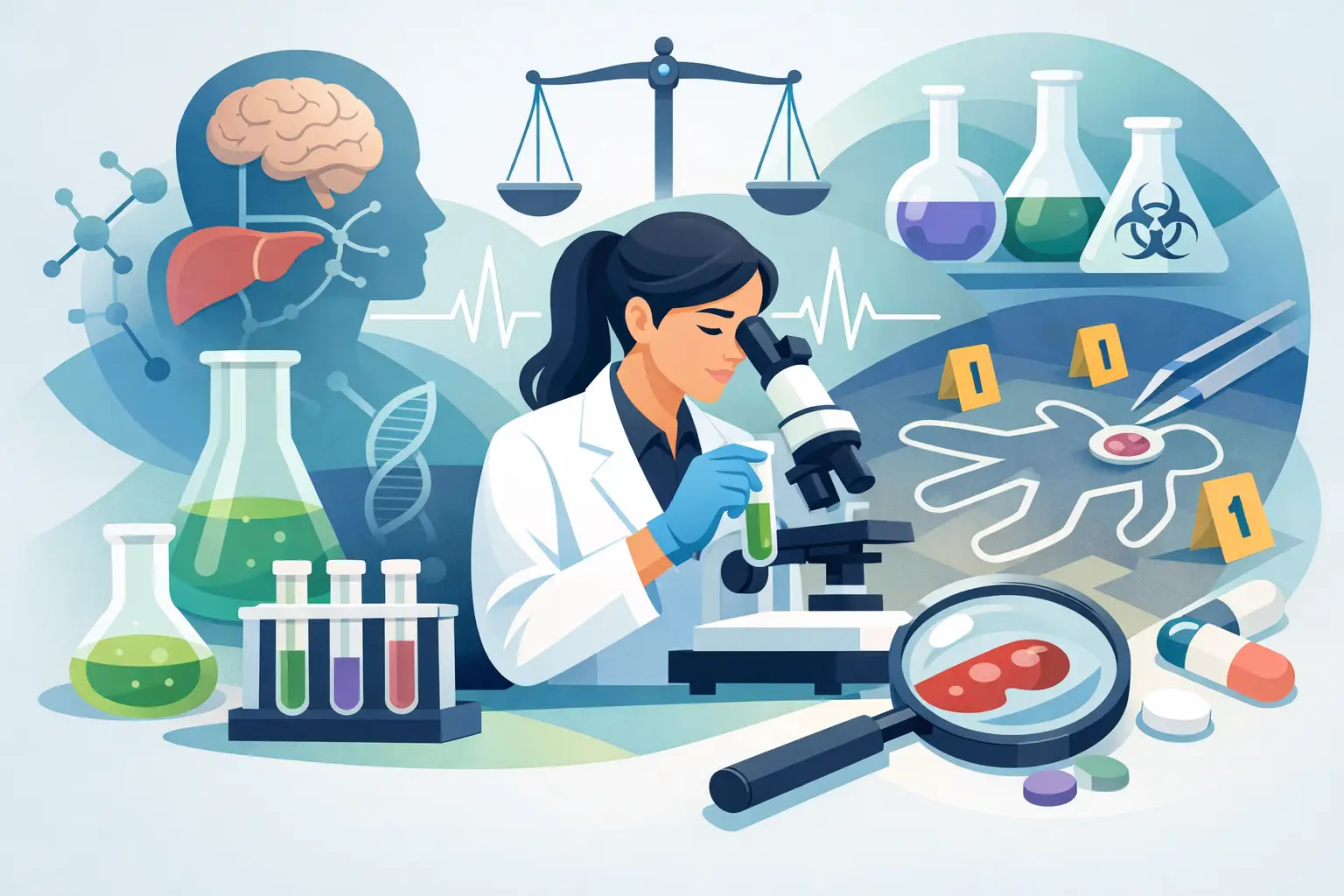
A toxicology report can shape a charging decision, corroborate a timeline, or challenge an assumption that initially seemed certain. That level of consequence is why choosing graduate education in this field requires more than comparing course titles. This forensic toxicology graduate program guide is designed for professionals and academically driven students who want to assess whether a program develops the scientific judgment, laboratory competence, and investigative perspective the field demands.
Forensic toxicology sits at the intersection of analytical chemistry, pharmacology, biology, medicine, and the justice system. Graduate study should respect that complexity. The strongest programs do not treat toxicology as a collection of substances to memorize. They prepare students to ask defensible questions about specimen selection, analytical limitations, drug metabolism, interpretation, reporting, and expert communication.
What Graduate Study in Forensic Toxicology Should Prepare You to Do
A forensic toxicologist does not simply determine whether a substance is present. The work often involves determining what the result means within a specific human, medical, legal, and investigative context. A concentration alone may be less informative than the interpretive reasoning behind it.
At the graduate level, students should expect to examine postmortem toxicology, human performance toxicology, controlled substances, drug-facilitated crimes, alcohol analysis, emerging psychoactive substances, and analytical method validation. Depending on the program, study may also include quality assurance, laboratory management, ethics, courtroom testimony, and scientific writing.
This breadth matters because professional roles vary. A graduate seeking employment in a medical examiner laboratory may need substantial exposure to postmortem interpretation and pathology-adjacent concepts. Someone pursuing workplace drug testing, public health, pharmaceutical safety, or regulatory work may need a different emphasis. There is no single ideal curriculum independent of the career you intend to build.
The Difference Between Detection and Interpretation
Analytical instruments can identify and quantify compounds, but data do not interpret themselves. A graduate program should teach students to recognize the difference between an analytical finding and a scientifically supportable opinion.
For example, the presence of a drug does not automatically establish impairment, cause of death, timing of use, or intent. Tolerance, route of administration, postmortem redistribution, sample integrity, co-ingested substances, and individual physiology may all influence interpretation. Programs that foreground these limits build the intellectual discipline essential to credible forensic work.
How to Evaluate a Forensic Toxicology Graduate Program
Begin with the curriculum, then look beyond it. A polished program page may describe advanced science, but your decision should rest on evidence of depth, instructional quality, and meaningful application.
Examine the Scientific Foundation
A credible curriculum should include rigorous work in analytical chemistry and toxicology. Look for course content addressing instrumental analysis, chromatography, mass spectrometry, pharmacokinetics, pharmacodynamics, analytical method development, and validation.
If your undergraduate degree is outside chemistry or a related laboratory science, pay close attention to prerequisites. Many forensic toxicology graduate programs expect previous coursework in general chemistry, organic chemistry, biochemistry, statistics, and laboratory science. Some offer pathways or conditional preparation for students with nontraditional backgrounds, but no program can replace foundational scientific literacy with enthusiasm alone.
Ask whether the program explains its prerequisite expectations clearly. Transparency is a positive sign. Graduate-level toxicology moves quickly, and students need enough scientific grounding to interpret complex data rather than merely repeat terminology.
Assess Laboratory Training Honestly
Forensic toxicology is an applied laboratory discipline. Online education can provide substantial value through theoretical instruction, case analysis, data interpretation, quality systems, research methods, and practitioner-led discussion. Yet virtual learning does not automatically replicate hands-on experience with biological specimens, instrumentation, chain of custody, extraction techniques, or laboratory safety protocols.
That does not make an online program a poor choice. It means prospective students should understand its design. Some programs incorporate intensive residencies, partner laboratory experiences, simulations, or research components. Others focus primarily on the academic and interpretive dimensions of forensic science. Either model can serve a legitimate purpose, provided it is presented accurately and matches your intended role.
Ask direct questions: How are laboratory competencies taught and assessed? Is there access to real instrumentation or supervised practical work? Are there in-person requirements? Can the program help students identify experiential opportunities near their location? The answers will matter especially for applicants seeking bench-level laboratory positions.
Look at Faculty Through a Practitioner Lens
Faculty credentials are more than a biography section. In a specialized field, instructors should demonstrate command of both scientific methods and forensic realities. Experience in accredited laboratories, medical examiner offices, law enforcement settings, research institutions, or expert witness work can add valuable perspective to academic instruction.
The most compelling faculty environments combine active researchers with experienced practitioners. Research helps programs remain attentive to new analytical challenges, while practice keeps discussion grounded in reporting standards, laboratory constraints, casework pressures, and the scrutiny that accompanies legal proceedings.
Review whether faculty expertise aligns with your interests. A student focused on drug-impaired driving, for instance, may benefit from instructors whose work includes human performance toxicology. A student interested in death investigation may value expertise in postmortem interpretation and multidisciplinary case review.
Accreditation, Standards, and Professional Readiness
Accreditation deserves attention, but it should not become a shortcut for judgment. Where applicable, review whether a forensic science program holds recognized programmatic accreditation and what that status covers. Institutional accreditation, programmatic accreditation, laboratory accreditation, and professional certification are distinct concepts, each serving a different purpose.
A program may be academically valuable even if it does not hold a particular specialized accreditation. Conversely, accreditation alone does not guarantee that a curriculum fits your professional goals. Examine course content, practical opportunities, faculty expertise, graduation requirements, and student support together.
Students interested in future professional certification should also research current eligibility requirements from the relevant certifying bodies. Requirements can involve specific coursework, degree levels, professional experience, and supervised practice. A graduate degree may strengthen your preparation, but it does not necessarily confer certification or qualify you for every laboratory role on its own.
Questions Working Professionals Should Ask Before Applying
For adult learners, program quality includes whether the academic structure makes serious study possible alongside professional responsibilities. Flexibility should never mean lowered expectations. A well-designed online graduate program sets clear deadlines, offers purposeful faculty engagement, and creates opportunities for scholarly exchange across geographic boundaries.
Before submitting an application, consider these questions:
- Does the course sequence fit my current scientific preparation and long-term career direction?
- What practical laboratory or research experiences are available, and are they sufficient for my target role?
- Who teaches the courses, and what forensic or scientific practice informs their instruction?
- How are students assessed: exams, case analyses, research projects, laboratory exercises, or applied writing?
- What support exists for international students, working professionals, and learners returning to science after time away?
- Will the degree support the requirements commonly requested by the employers or professional pathways I am considering?
The final question is often the most decisive. Read job descriptions from laboratories, medical examiner offices, government agencies, and private-sector employers you may wish to join. Notice the required coursework, technical skills, and experience levels. Then compare those expectations with the program’s published outcomes.
Research, Communication, and the Ability to Defend Your Work
Graduate education should cultivate more than technical familiarity. Forensic toxicologists must communicate uncertainty precisely, write reports that withstand review, and explain scientific principles to audiences with widely different levels of expertise.
A strong program will require research literacy and advanced writing. Students should learn to evaluate peer-reviewed literature, identify weak inferences, distinguish correlation from causation, and articulate the limitations of a method or conclusion. These are not secondary skills. In forensic settings, the ability to explain why a result matters, and where its meaning ends, is central to professional credibility.
Look for opportunities to complete a capstone, thesis, applied research project, or intensive case analysis. The best project format depends on your circumstances. A thesis may be especially valuable for students considering doctoral study or research careers, while an applied project may better serve professionals seeking to solve a real laboratory, policy, or investigative challenge.
Choosing a Program That Supports the Work You Want to Do
The right program is rarely the one with the broadest marketing claims. It is the one that connects rigorous science with the professional future you can clearly name. For some students, that means a laboratory-intensive path toward forensic casework. For others, it means advanced expertise in interpretation, investigative decision-making, research, compliance, or interdisciplinary forensic leadership.
Evidentia University recognizes that modern investigative education must connect scientific knowledge with human behavior, ethical judgment, and real-world professional application. For students building careers across forensic and behavioral disciplines, that connection can sharpen both analytical capability and institutional impact.
Choose graduate study that asks more of you than completion. Seek a program that challenges your assumptions, strengthens your scientific voice, and prepares you to treat every result with the care that evidence, communities, and justice require.