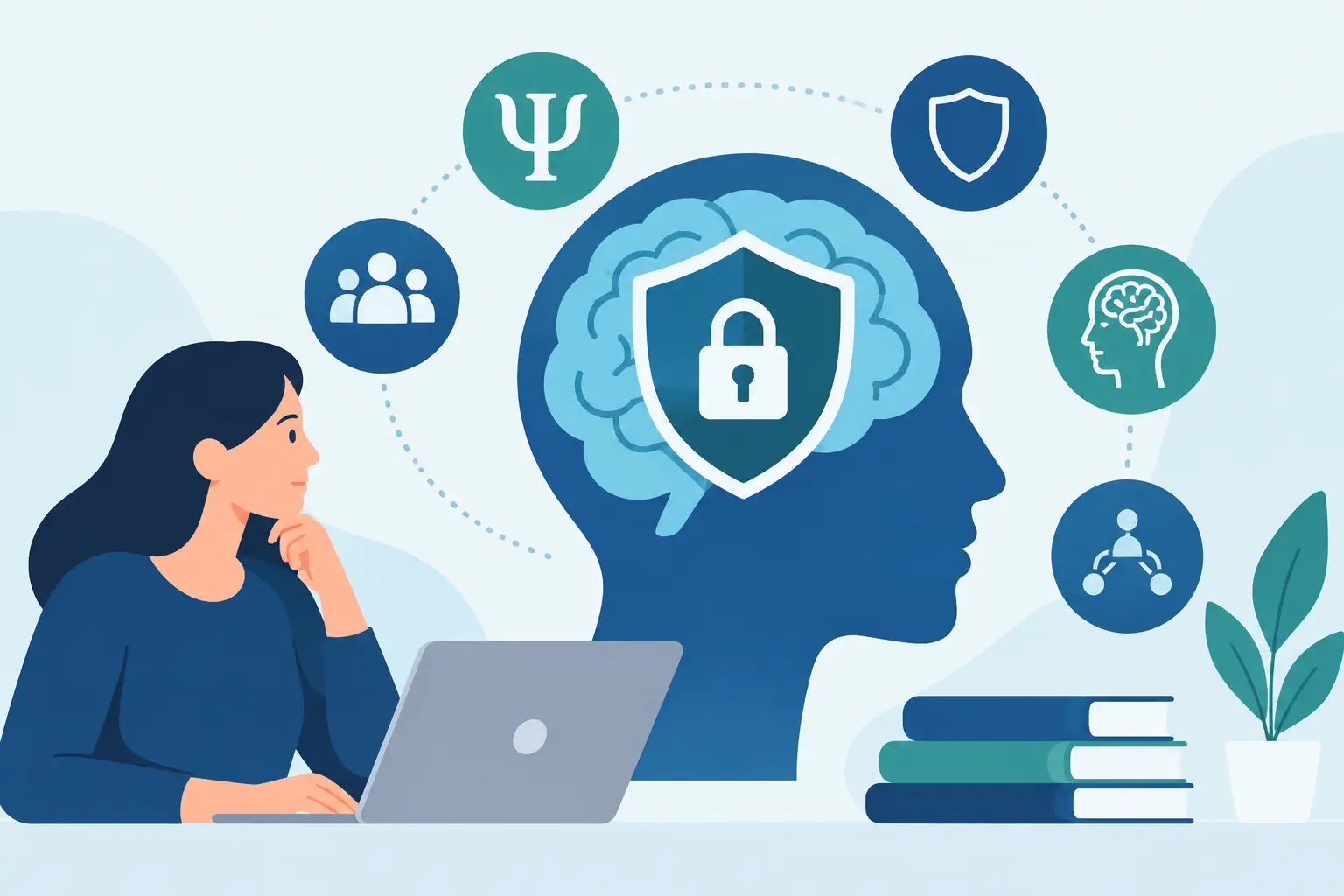
A phishing email rarely succeeds because its code is sophisticated. It succeeds because it arrives at a rushed moment, appears to come from someone trusted, and asks for a small action that feels reasonable. Cybersecurity psychology programs study this human layer of security: the decisions, pressures, perceptions, and behaviors that can either expose an organization or protect it.
For professionals who work at the intersection of security, investigation, policy, compliance, and behavior, this field offers a more complete view of cyber risk. Technical controls matter. So do encryption, access management, threat detection, and incident response. Yet each of those controls is used, configured, interpreted, or sometimes bypassed by people. Understanding why is no longer a peripheral skill.
Why human behavior belongs in cybersecurity
Cybersecurity has often been framed as a contest between attackers and technical defenses. That framing is incomplete. Social engineering, insider threats, credential sharing, poor reporting practices, alert fatigue, and unsafe workarounds all involve human judgment within a particular environment.
A person who clicks a malicious link is not necessarily careless or uninformed. They may be responding to authority, urgency, fear of professional consequences, cognitive overload, or a workflow that makes the secure path unusually difficult. Likewise, an employee who avoids reporting a suspicious message may worry about being wrong, wasting time, or being blamed. These patterns are behavioral, organizational, and psychological before they become technical incidents.
This perspective changes the questions security professionals ask. Instead of asking only, “Why did the user fail?” they can ask, “What conditions made this action likely?” That shift supports better security design, better communication, and more credible prevention strategies.
What cybersecurity psychology programs typically teach
The strongest programs connect behavioral science to practical security challenges. They do not treat psychology as a soft add-on to a technical curriculum. They use it as an analytical discipline for understanding adversarial influence, organizational decision-making, and risk reduction.
Cognitive bias, judgment, and digital risk
Students examine how people make decisions under uncertainty, limited attention, and time pressure. Concepts such as confirmation bias, authority bias, habituation, risk perception, and cognitive overload help explain why warning messages are ignored, why fraud narratives work, and why capable professionals can still make costly errors.
The goal is not to label every error as a bias. Human behavior is context-dependent. A useful analysis considers the task, the incentives, the organizational culture, and the design of the technology itself. A security warning that is technically accurate but poorly timed or difficult to interpret may create more friction than protection.
Social engineering and influence operations
Attackers routinely exploit trust, reciprocity, urgency, scarcity, and social proof. A cybersecurity psychology curriculum may analyze phishing, business email compromise, impersonation, pretexting, romance fraud, and other forms of digital manipulation through the lens of influence and deception.
This work is especially relevant for professionals who investigate fraud or develop awareness strategies. Effective training does more than tell people to “be careful.” It helps them recognize how a manipulation attempt creates emotional momentum and gives them a simple, low-risk way to pause, verify, and report.
Insider risk and organizational culture
Insider risk is one of the most misunderstood areas of cybersecurity. It includes malicious conduct, but it also includes negligence, burnout, role conflict, poor access practices, and employees who create insecure workarounds to meet operational demands.
Psychology provides a framework for examining motivation without making unsupported assumptions about intent. It also encourages proportional responses. Monitoring, reporting systems, and intervention practices must be balanced with privacy, procedural fairness, and employee trust. A culture built entirely on surveillance can discourage the honest reporting that security teams need most.
Human-centered security design
Security tools often fail because they expect ideal behavior from people working in non-ideal conditions. Human-centered security asks whether a process is understandable, usable, and realistic in the context of actual work.
Students may learn to evaluate security communications, authentication workflows, reporting channels, and awareness campaigns through behavioral evidence. The practical question is direct: does the secure action feel possible at the moment it is required? If not, policy language alone will not solve the problem.
Who benefits from this specialization
Cybersecurity psychology is not limited to security analysts. It can be valuable for professionals whose decisions shape risk, communication, or investigative outcomes. This includes law enforcement personnel, fraud investigators, compliance professionals, HR leaders, intelligence and threat analysts, behavioral researchers, policy specialists, and security awareness leaders.
For technically trained cybersecurity professionals, behavioral expertise can strengthen their ability to communicate findings, design interventions, and investigate incidents involving social engineering or insider conduct. For psychology, criminal justice, and business professionals, cybersecurity knowledge offers a way to apply behavioral insight to a rapidly expanding area of societal and organizational risk.
The best fit depends on a learner’s goals. Someone seeking a role in penetration testing or cloud security engineering will need substantial technical training beyond behavioral coursework. Someone aiming to lead security culture, fraud prevention, insider-risk analysis, or cybercrime investigations may find the behavioral dimension central to their professional development.
How to evaluate cybersecurity psychology programs
Because this is an emerging interdisciplinary field, program titles can be misleading. Some offerings focus primarily on general cybersecurity awareness, while others offer serious study of behavioral science, research methods, investigative practice, and cyber risk. Prospective students should look beyond the name.
A meaningful graduate-level experience should demonstrate four qualities:
- Interdisciplinary depth: The curriculum should connect psychological theory with cybersecurity, fraud, deception, organizational behavior, or investigative practice.
- Applied learning: Case analysis, simulations, behavioral assessments, and problem-based assignments help translate theory into professional judgment.
- Faculty credibility: Instruction is strongest when it includes scholars and practitioners with relevant backgrounds in psychology, security, criminology, policing, intelligence, or cyber investigations.
- Ethical rigor: The study of influence, monitoring, and behavioral data requires careful attention to privacy, fairness, consent, and responsible use.
It is also worth examining the academic level and expected outcomes. A short certificate may be ideal for a working professional seeking focused knowledge. A master’s program may be more appropriate for learners pursuing advanced specialization, research capability, or leadership roles. Neither format is automatically better. The right choice depends on prior education, career direction, available time, and the depth of expertise required.
From awareness campaigns to behavioral security strategy
Many organizations still treat the human side of cybersecurity as an annual compliance exercise. Employees watch a short module, answer a quiz, and return to work. That approach may satisfy a reporting requirement, but it rarely changes behavior under pressure.
A behavioral security strategy is more demanding. It begins with evidence: which actions create risk, who faces those decisions, and what conditions shape them? It tests whether communications are clear, whether reporting is psychologically safe, and whether secure processes fit real workflows. It also measures outcomes beyond course completion, such as reporting rates, response time, recurring error patterns, and employee confidence.
This work requires intellectual humility. Not every security problem has a psychological solution. Some failures come from inadequate staffing, weak system architecture, unclear governance, or outdated technology. Behavioral analysis is most valuable when it complements technical and operational improvements rather than shifting responsibility onto individual employees.
A field with growing professional significance
As cyber threats become more persuasive, personalized, and scalable, organizations need professionals who can understand both the attack surface and the human environment surrounding it. Generative AI has increased the volume and apparent credibility of deceptive communications, making judgment and verification practices more consequential. At the same time, remote and hybrid work have changed how trust, supervision, collaboration, and access operate.
For adult learners, cybersecurity psychology offers an opportunity to develop a distinctive professional profile. Institutions such as Evidentia University reflect the value of studying cyber risk alongside behavioral and investigative sciences, rather than treating these domains as separate conversations.
The most valuable education in this field does not promise that people will stop making mistakes. It prepares professionals to build systems, cultures, and responses that account for how people actually think and work – especially when the pressure is highest.