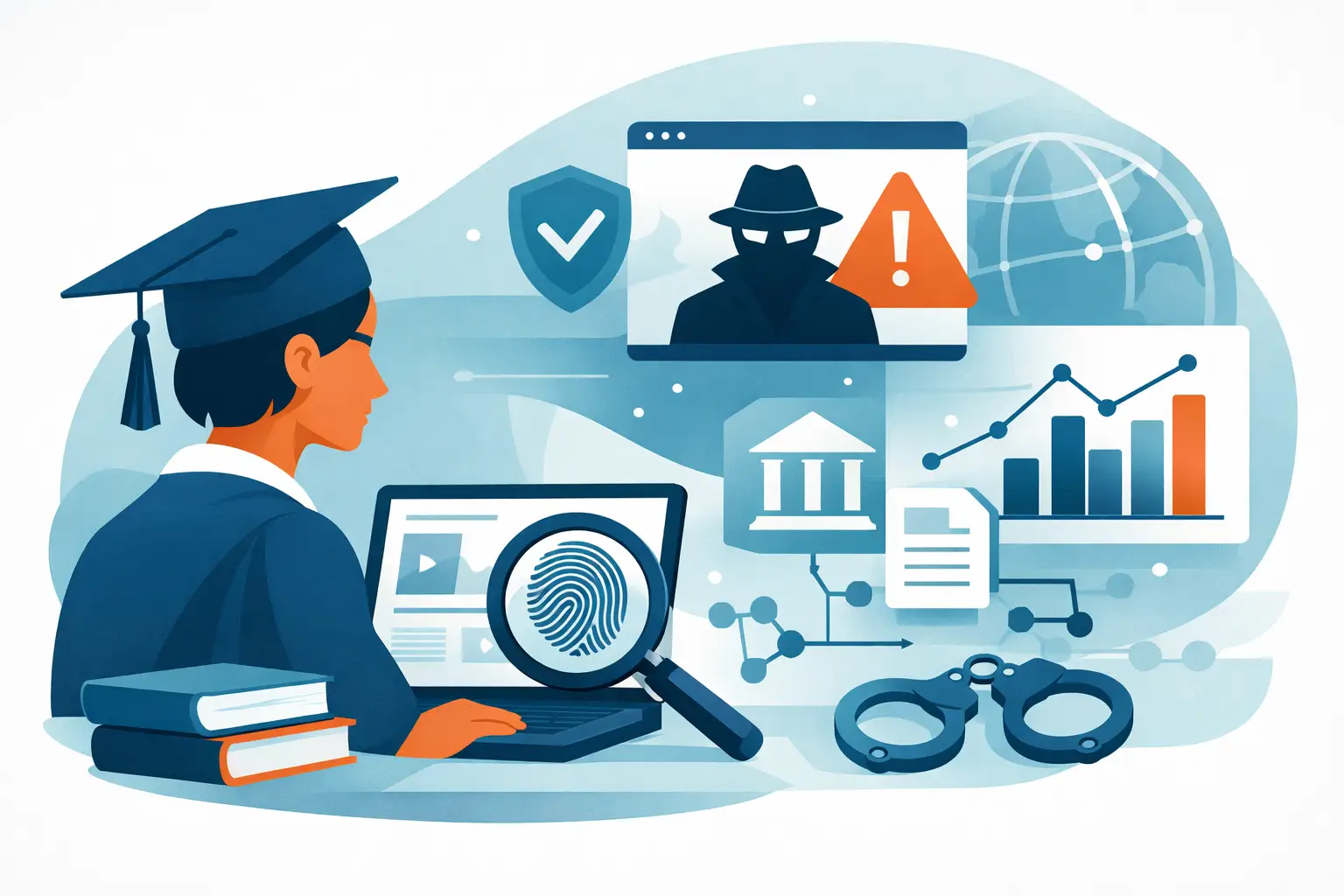
A suspicious transaction rarely tells its full story on its own. The meaningful evidence often sits across systems, time periods, policies, and human decisions: an unusual vendor relationship, a control bypassed by a trusted employee, a customer profile that does not fit the activity, or a pattern that becomes visible only when data is interpreted with context. Graduate education for fraud analysts is designed to prepare professionals for this level of complexity.
Fraud analysis is no longer limited to reviewing losses after they occur. Organizations need specialists who can identify emerging risk, distinguish anomalies from misconduct, conduct defensible inquiries, communicate findings to decision-makers, and help strengthen the systems that prevent recurrence. That work demands more than familiarity with regulations or spreadsheets. It requires analytical discipline, investigative judgment, behavioral insight, and the ability to make sound decisions when facts are incomplete.
Why Fraud Analysis Has Become a Graduate-Level Discipline
Financial crime has evolved alongside digital commerce, global supply chains, remote work, artificial intelligence, and increasingly sophisticated social engineering. A fraud analyst may examine payment fraud in one case, internal misconduct in another, and identity-related or cyber-enabled fraud in the next. The common challenge is not simply recognizing a red flag. It is determining what the evidence supports, what it does not support, and what should happen next.
This is why advanced education matters. Entry-level training can introduce common schemes, reporting obligations, and basic detection methods. Graduate study moves beyond recognition toward analysis. Students learn to frame investigative questions, assess competing explanations, evaluate evidence quality, and connect technical indicators with the human behavior behind them.
The distinction is significant. A high number of refunds, for example, may reflect fraud, a failed operational process, a poorly designed promotion, or a legitimate change in customer behavior. Treating every anomaly as proof of wrongdoing creates risk of its own. Strong fraud professionals know how to investigate proportionately, preserve fairness, and document conclusions with precision.
Graduate programs also create space for the questions that daily work often leaves unanswered. Why do people rationalize misconduct? How do incentives, pressure, and organizational culture influence fraud risk? What biases can distort an internal investigation? How should investigators balance urgency with due process? These are not abstract concerns. They shape the quality, credibility, and defensibility of professional decisions.
What Graduate Education for Fraud Analysts Should Develop
A meaningful graduate experience should build an integrated set of capabilities rather than treat fraud as a narrow compliance topic. Technical competence remains essential, but it is only one part of the professional profile required in complex investigations.
Investigative reasoning and evidence assessment
Fraud analysts must be able to move from a concern to a structured inquiry. This begins with defining the allegation or risk signal, identifying relevant evidence sources, and testing reasonable hypotheses without allowing an early assumption to control the investigation.
Graduate coursework can strengthen this discipline through case-based analysis. Students may work through scenarios involving procurement irregularities, employee theft, digital payment fraud, financial statement manipulation, or misconduct within regulated environments. The value lies in learning how to reason through ambiguity. Evidence must be weighed for relevance, reliability, limitations, and corroboration.
This approach also develops clearer reporting. A well-written investigative report separates verified facts from inference, explains methodology, acknowledges unresolved issues, and gives leaders a usable basis for action. In many roles, the report is as consequential as the analysis itself.
Behavioral insight
Fraud is a human act, even when technology enables it. Perpetrators respond to opportunity, incentives, perceived grievance, pressure, rationalization, and the belief that they will not be detected. Understanding these dynamics does not mean assuming that behavior can provide certain proof. It means using behavioral science responsibly to ask better questions and recognize patterns that merit examination.
For professionals working in internal investigations, compliance, security, or law enforcement, behavioral knowledge can improve interviews and stakeholder communication. It can help an analyst understand resistance, deception risks, organizational blind spots, and the conditions that allow misconduct to continue unnoticed.
This is especially valuable in workplace fraud. Many cases do not begin with an obvious criminal profile. They begin with ordinary access, weak controls, an overlooked conflict of interest, or a culture where concerns are discouraged. An analyst who understands both systems and behavior is better positioned to identify the real source of exposure.
Data literacy without false certainty
Modern fraud work is increasingly data-intensive. Analysts may use transaction monitoring, case-management systems, link analysis, visualization tools, digital records, and statistical models to detect possible risk. Graduate education should help students become fluent in interpreting these tools while remaining cautious about their limits.
A model can prioritize alerts. It cannot independently establish intent. A dashboard can reveal a cluster of unusual activity. It cannot explain whether the behavior reflects fraud, error, or a legitimate operational exception. Technology is most effective when paired with a professional who understands context, evidence, and the consequences of a false positive.
The ideal curriculum therefore combines analytical methods with ethics and judgment. Students should learn not only how to identify patterns, but also how to challenge data quality, consider bias, protect sensitive information, and explain analytical findings to nontechnical audiences.
Legal, ethical, and organizational awareness
Fraud investigations operate within legal and institutional boundaries. Rules governing privacy, employment, record retention, reporting, evidence handling, and regulatory obligations may vary by jurisdiction and industry. A graduate-level foundation helps professionals understand when to involve legal counsel, when to escalate concerns, and how to avoid actions that compromise an inquiry.
Ethics are equally central. Fraud analysts often handle confidential information, sensitive allegations, and decisions that may affect reputations or livelihoods. Professional credibility depends on impartiality, discretion, and a commitment to evidence-based conclusions. These principles matter whether the analyst works in a corporate compliance unit, a financial institution, a government agency, an insurance organization, or an investigative consultancy.
Choosing the Right Graduate Path
The best program depends on the professional’s current role and intended direction. Someone seeking leadership in financial crime compliance may prioritize risk governance, regulation, and transaction monitoring. A professional focused on corporate investigations may benefit more from forensic methods, interviewing, behavioral analysis, and case management. Those working at the intersection of cybersecurity and fraud may need stronger preparation in digital evidence, identity risk, and cyber-enabled deception.
Prospective students should look beyond a program title. Course content, faculty experience, assessment methods, and the opportunity to apply knowledge to realistic cases are stronger indicators of fit. A curriculum taught only at the conceptual level may not prepare a learner for the pressure of an actual investigation. Conversely, practical training without scholarly rigor may limit a professional’s ability to evaluate emerging methods, lead complex teams, or contribute to policy and prevention strategy.
Faculty expertise deserves particular attention. In a specialized field, practitioner-led instruction can connect academic learning to the realities of investigative work: managing incomplete records, interviewing difficult subjects, presenting findings to executives, and navigating institutional constraints. The strongest learning environments also welcome interdisciplinary perspectives from criminology, psychology, economics, law, security, and research.
For working adults, format matters as well. Online graduate study can make advanced specialization accessible across geographic boundaries, but flexibility should not mean isolation. Consider whether a program offers meaningful faculty engagement, structured feedback, peer discussion, research opportunities, and a professional community. These elements turn an online credential into an academic and career-building experience.
Turning Advanced Study Into Professional Impact
A graduate degree does not replace experience, professional certifications, or organizational knowledge. It can, however, give professionals a more rigorous framework for using all three. The strongest outcomes occur when learners connect their studies to the challenges they already see in practice.
A compliance professional may use graduate research to improve an escalation protocol. A security manager may develop a more behaviorally informed fraud-awareness initiative. An investigator may refine interview preparation, evidence documentation, or case triage. A finance professional may gain the confidence to question control weaknesses that previously seemed outside their remit.
This is where specialized institutions can make a distinctive contribution. At Evidentia University, advanced study in forensic and behavioral disciplines reflects the reality that fraud prevention is not only a financial or technical challenge. It is an investigative and human one.
The career value of graduate education also extends beyond a single job title. Fraud analysts can progress into roles in financial crime, corporate security, compliance, internal audit, risk management, intelligence, investigations, consulting, and public-sector enforcement. The path varies, but the underlying capabilities remain portable: critical thinking, evidence assessment, ethical judgment, clear communication, and the ability to see connections that others miss.
For professionals considering their next step, the most useful question is not simply whether a graduate degree will add a credential to a resume. It is whether the program will change how they think when the evidence is unclear, the stakes are high, and a decision cannot wait. That is the standard advanced education should meet.