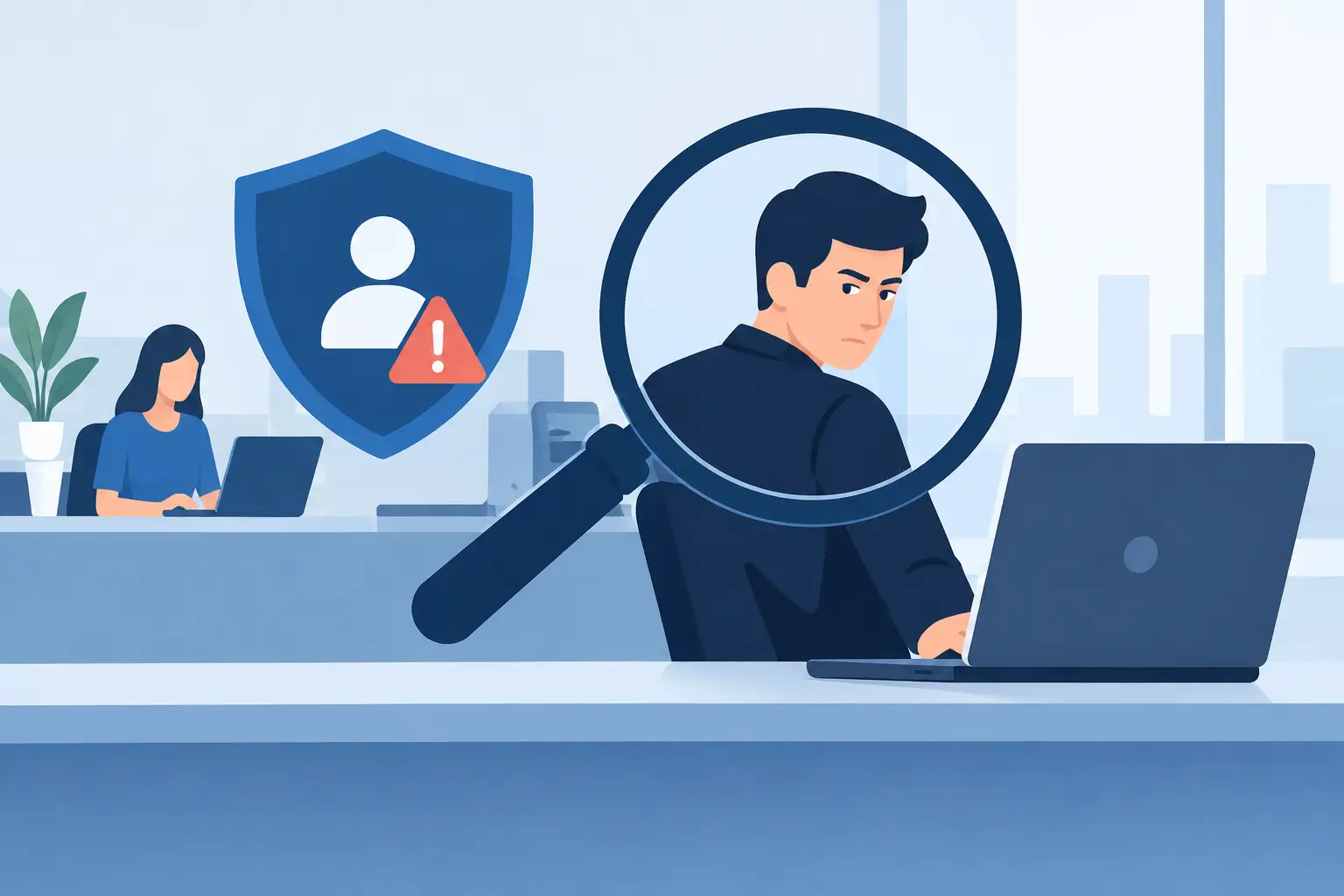
A trusted employee downloads a sensitive client list shortly before resigning. A contractor repeatedly requests access outside the scope of an assignment. A finance professional receives a convincing phishing message and unknowingly exposes credentials. These scenarios look different, but each raises the same operational question: how to identify insider threats before a minor anomaly becomes financial loss, reputational harm, or a public investigation.
Insider threat detection is not about treating every employee as a suspect. It is the disciplined practice of recognizing when behavior, access, and circumstance no longer align with a person’s legitimate role. For security, compliance, human resources, and investigative professionals, the work requires technical awareness and behavioral judgment in equal measure.
What Counts as an Insider Threat?
An insider is anyone with authorized access to an organization’s people, facilities, systems, data, or decision-making processes. That includes full-time employees, executives, temporary staff, consultants, vendors, researchers, and departing personnel. Authorization is what makes the risk difficult to detect: the person may already have the credentials needed to cause harm.
Not all insider threats are malicious. Some arise from carelessness, fatigue, poor training, or a misplaced desire to help a colleague move work along faster. Others result from external compromise, where an attacker gains control of a legitimate account. A smaller but often more consequential group involves intentional misconduct, such as theft of intellectual property, fraud, sabotage, coercion, or unauthorized disclosure.
The distinction matters because the appropriate response differs. A negligent employee may need training and tighter process controls. A compromised account calls for containment and technical investigation. Deliberate misconduct may require a carefully managed inquiry involving legal counsel, human resources, security, and, in some cases, law enforcement.
How to Identify Insider Threats Through Patterns
No single behavior proves harmful intent. People work late, change jobs, make mistakes, and experience personal stress without posing a threat. Effective identification begins when several indicators converge and conflict with a credible business explanation.
Look for deviations from normal access behavior
Access data is most useful when it establishes a baseline. Consider what systems a person normally uses, when they work, what data they handle, and how much information their role genuinely requires. A sales manager accessing engineering files, or an employee downloading a volume of records far beyond normal activity, deserves review because the action is inconsistent with role-based expectations.
Timing can also be revealing. Unusual access immediately before resignation, termination, a denied promotion, litigation, or a major organizational change may elevate risk. Context is essential, however. A late-night download may be suspicious in one role and entirely routine for an international incident-response team.
Pay attention to changes in behavior, not personality
Behavioral indicators should be interpreted cautiously and never used as a substitute for evidence. The goal is not to label someone difficult, introverted, frustrated, or ambitious. The relevant question is whether observable conduct has changed in ways connected to access, security, or organizational harm.
Potential indicators may include persistent disregard for security procedures, unusual secrecy around work, attempts to bypass approval channels, or an escalating conflict tied to privileged access. A person who begins copying files to personal storage after being told their role will change presents a more meaningful concern than someone who simply appears dissatisfied.
Investigators should avoid amateur profiling. Personal hardship, political views, cultural background, or mental health assumptions are not threat indicators. A defensible assessment rests on work-related facts, verified digital activity, credible reports, and a clear understanding of opportunity and intent.
Notice pressure points and triggering events
Insider incidents often emerge at moments of transition. Restructuring, performance action, financial strain, disciplinary proceedings, access revocation, and disputes over ownership or recognition can increase risk. These circumstances do not establish wrongdoing, but they can inform proportionate monitoring and support.
Organizations are sometimes reluctant to connect human factors with security because they fear appearing intrusive. The alternative is not to ignore context. It is to build an ethical process in which human resources, security, and leadership share only the information necessary to manage a defined risk.
Treat reports seriously, but test them carefully
Colleagues frequently see conduct that logs cannot capture: unexplained copying, unauthorized visitors, suspicious conversations, or a pattern of policy evasion. A confidential reporting channel can surface these concerns early. Yet reports can also be shaped by conflict, bias, or misunderstanding.
Every report should therefore be documented, assessed for specificity, and corroborated where possible. Ask what was observed, when it occurred, who else was present, and whether the conduct violated a known policy. A fair process protects both the organization and the individual named in the report.
Build Detection Around Roles, Not Suspicion
The strongest insider-risk programs reduce unnecessary access before an investigation is ever needed. Least-privilege access, separation of duties, periodic permissions reviews, and prompt offboarding limit the opportunity for accidental and intentional misuse.
This is especially important for privileged users. Administrators, finance approvers, database managers, researchers handling sensitive records, and executives may have access broad enough to circumvent ordinary controls. Their activity should be subject to accountable oversight, but the controls must not create a culture of humiliation or mistrust.
A useful review asks three practical questions: Does this person still need this level of access? Is the access being used in a way consistent with the role? Would a second person’s approval reduce exposure? The answers often reveal control gaps more clearly than a generic security audit.
Investigate Without Creating a Second Problem
Once concerning indicators appear, organizations can damage themselves by reacting too quickly. Confronting a person before evidence is preserved may prompt deletion, retaliation claims, or disclosure of an ongoing inquiry. Doing nothing can allow harm to continue. The appropriate response depends on immediacy, potential impact, and the quality of available evidence.
Begin by preserving relevant logs, communications, device records, access-control events, and policy documentation according to established retention and legal requirements. Limit knowledge of the case to personnel with a legitimate need to know. Then develop hypotheses rather than conclusions: Was the data transfer authorized? Could the account be compromised? Is there an operational explanation?
For high-risk matters, establish a cross-functional response group that includes security, human resources, legal counsel, compliance, and the relevant business leader. Each function sees a different part of the problem. Security can assess technical evidence; human resources can address employment obligations; legal counsel can guide privacy, labor, and reporting considerations.
Documentation is central. Record the concern, the evidence reviewed, decisions made, and the rationale for any action. This discipline improves fairness and can become decisive if the matter leads to litigation, regulatory scrutiny, or criminal referral.
Make Prevention Part of Organizational Culture
Technology can detect anomalous behavior, but it cannot replace a workplace where people understand boundaries, report concerns safely, and receive support before pressure turns into misconduct. Training should move beyond annual compliance reminders. Staff need realistic examples of data handling, social engineering, conflicts of interest, and the risks associated with personal devices or cloud storage.
Leaders also shape insider-risk outcomes. When employees believe concerns will be ignored, they stop reporting. When every mistake is treated as evidence of disloyalty, they hide mistakes. A mature culture distinguishes accountability from blame and makes security a shared professional responsibility.
For professionals advancing in cybersecurity, fraud examination, behavioral science, or investigative practice, insider risk is a defining interdisciplinary challenge. It calls for the ability to interpret evidence without overreaching, understand human behavior without stereotyping, and act decisively without abandoning due process. Those are not merely security skills. They are the foundations of credible, ethical investigation.
The most capable organizations do not wait for a dramatic breach to take insider risk seriously. They create conditions in which unusual activity can be recognized early, assessed fairly, and addressed with the judgment that sensitive institutions and the people they serve deserve.