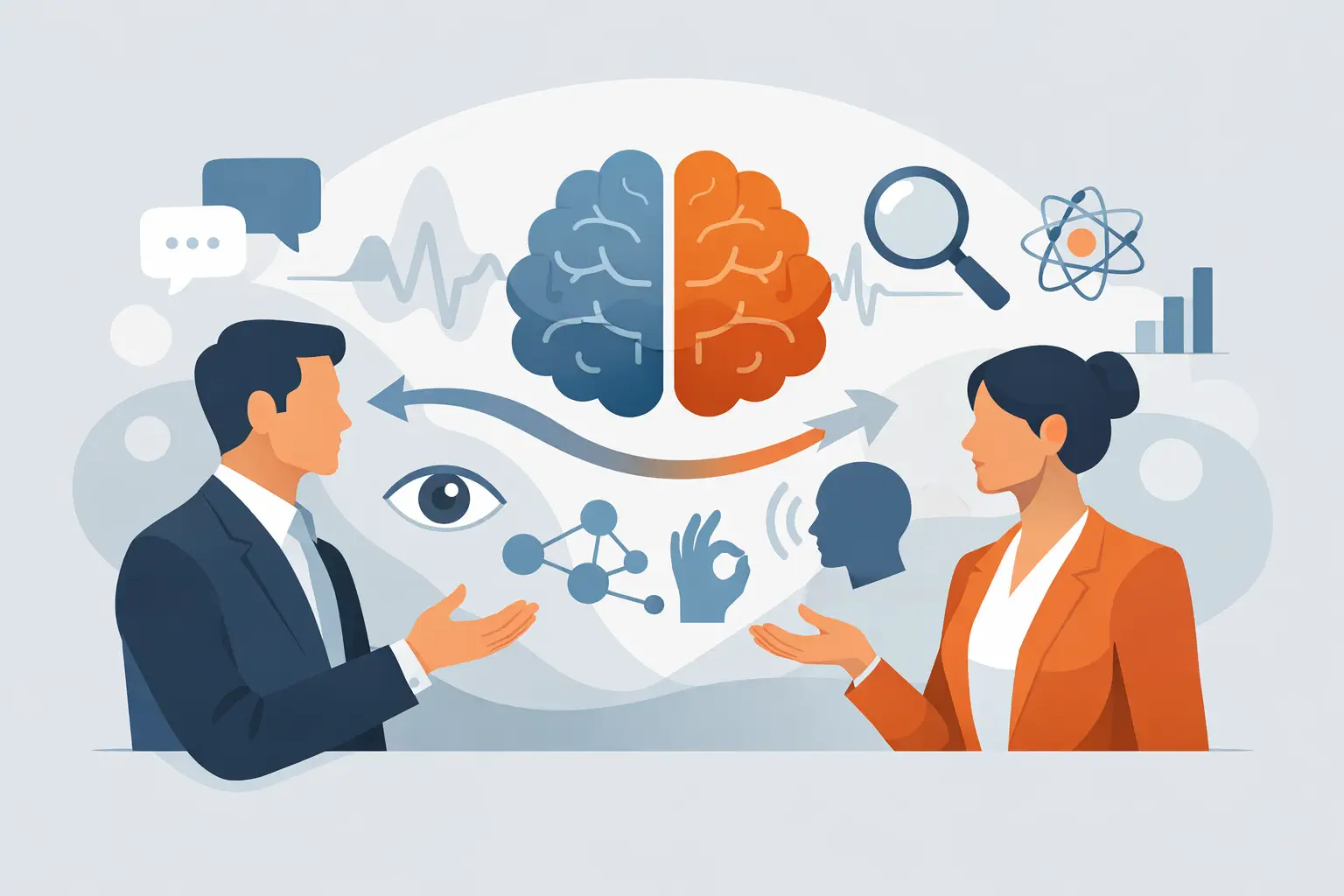
A witness folds their arms during an interview. A job candidate avoids eye contact. A colleague’s smile appears briefly and then disappears. These observations can feel revealing, especially in high-stakes settings. But is nonverbal communication scientifically reliable? The answer is more demanding than popular body-language advice suggests: nonverbal behavior can provide useful information, but rarely a definitive conclusion on its own.
For professionals in investigation, security, leadership, human resources, negotiation, and behavioral research, that distinction matters. Sound practice does not ask whether one gesture exposes a hidden truth. It asks what a behavior may mean in context, what alternative explanations exist, and what additional evidence is needed before acting.
What scientific reliability actually means
When researchers assess whether nonverbal communication is scientifically reliable, they are not simply asking whether facial expressions, posture, voice, and gesture matter. They clearly do matter. Humans routinely communicate attitudes, emotions, intentions, affiliation, status, and discomfort without words.
The scientific question is whether observers can identify those meanings accurately and consistently. Reliability concerns whether an observation or measurement produces similar results across observers and occasions. Validity concerns whether it measures what it claims to measure. A behavior may be reliably noticed, such as a person speaking more quickly, without being a valid indicator of deception, guilt, hostility, or any other specific psychological state.
This distinction is essential because many widely repeated claims collapse it. An investigator may reliably observe fidgeting. That does not establish that fidgeting reliably indicates lying. A manager may accurately notice that an employee is quiet in a meeting. That does not reveal why the employee is quiet.
Nonverbal cues are meaningful, but not a secret code
Nonverbal communication includes facial movement, gaze, gesture, posture, interpersonal distance, touch, vocal tone, speech rate, pauses, and physiological signs such as visible flushing or tremor. These signals often work together with language and situational context. They help people coordinate conversation, convey warmth or dominance, display engagement, and regulate social distance.
Research supports the idea that certain nonverbal patterns can be associated with emotional experience. Facial expressions, vocal qualities, and body movement can communicate affective states, particularly when interpreted alongside circumstances and verbal content. Yet associations are not fixed translations. The same lowered gaze may reflect sadness, respect, fatigue, concentration, anxiety, cultural convention, or an effort to read notes.
A cue becomes more informative when it is part of a pattern that fits the known facts of a situation. A sudden change in a person’s speech rhythm after a specific question may justify further inquiry. It does not justify declaring that the person has been deceptive. Professional interpretation requires hypotheses, not verdicts.
Why one-cue judgments fail
Single-cue judgments fail because human behavior is multiply determined. Stress, trauma, medication, pain, language differences, social anxiety, neurodivergence, power dynamics, sleep deprivation, and unfamiliar settings can all affect expression and behavior. A person being questioned by an authority figure may appear tense because the setting is intimidating, not because they are concealing information.
The popular idea that a skilled observer can establish a person’s normal behavioral “baseline” and spot deception when it changes is also limited. People do not have one stable baseline that applies across settings. Their behavior shifts with topic, audience, perceived consequences, culture, and physical condition. Comparing behavior within the same interaction can sometimes identify a change worth exploring, but it cannot explain that change by itself.
Deception detection is the clearest cautionary example
The strongest claims about body language often concern lie detection. They promise that crossed arms, gaze aversion, nervous movements, or facial “leakage” can expose dishonesty. Scientific evidence does not support treating such behaviors as dependable signs of lying.
Deception is cognitively and emotionally variable. Some people become visibly anxious when lying; others do not. Truthful people may be anxious because they fear disbelief, consequences, or misunderstanding. Some deceptive individuals may appear composed because they have rehearsed, feel justified, or do not experience substantial stress. This overlap makes simple behavioral rules particularly risky.
Observers also tend to overestimate their ability to detect deception. Confidence can rise after training or experience without a comparable rise in accuracy. In investigative and organizational contexts, this creates a serious professional hazard: an initial impression can shape questioning, documentation, and later interpretation of evidence.
A more defensible approach focuses on the quality and verifiability of information. Interviewers should seek detailed accounts, clarify chronology, test information against independently known facts, explore inconsistencies fairly, and document both confirming and disconfirming evidence. Nonverbal observations may guide the next question, but they should not determine the answer.
Context, culture, and individual difference change the meaning
A scientifically responsible approach to nonverbal behavior recognizes that communication norms are not universal. Eye contact, interpersonal distance, vocal expressiveness, gesture, and emotional display can vary across cultures, communities, professions, and families. An observer who interprets behavior only through their own norms can mistake difference for evasiveness, disrespect, lack of confidence, or lack of credibility.
Individual differences deserve equal attention. Autistic people, people with attention-related conditions, people who have experienced trauma, and people communicating in a second language may use or process nonverbal signals differently. A person may avoid eye contact to concentrate, regulate sensory input, show respect, or manage anxiety. Treating that behavior as proof of untrustworthiness is not only scientifically weak but may also produce unfair outcomes.
For internationally minded professionals, cultural humility is therefore a practical competence. It means resisting instant interpretations, asking neutral questions, and recognizing when one’s own expectations may be shaping the assessment.
How to use nonverbal information responsibly
Nonverbal behavior should be treated as observational data with limited diagnostic power. In practice, this means recording what occurred rather than assigning an unsupported meaning. “The interviewee paused for 12 seconds before answering” is an observation. “The interviewee paused because they were lying” is an inference that requires evidence.
Professionals can strengthen their judgment by using a structured process:
- Describe the behavior precisely, including timing and context.
- Consider multiple plausible explanations before selecting one.
- Compare the behavior with verbal content, situational demands, and independently verifiable facts.
- Use open-ended questions that allow clarification rather than accusatory questions that invite defensiveness.
- Make consequential decisions only when evidence extends beyond behavioral impression.
This approach is especially valuable in interviews and negotiations. A change in posture, tone, or response length can signal that a topic is sensitive, confusing, emotionally charged, or strategically important. The appropriate response is curiosity. A well-framed follow-up question may reveal new information; a premature accusation may close off communication and contaminate the interaction.
The problem with simplified communication formulas
Many professionals encounter the claim that most communication is nonverbal, often presented as a precise percentage. Such formulas are commonly misapplied. Research on the relative influence of words, voice, and facial expression addressed particular situations involving inconsistent emotional messages. It was not a universal finding that words barely matter in every conversation.
In operational settings, verbal content can be decisive. A detailed account, a timeline, a documented statement, a contradiction, or a verifiable fact may carry far more evidentiary weight than posture or eye contact. Nonverbal behavior remains relevant because it shapes rapport, delivery, perceived confidence, and the flow of interaction. Its relevance does not make it a substitute for evidence.
The most capable practitioners avoid two opposite errors. The first is dismissing nonverbal communication as meaningless. The second is treating it as an infallible window into the mind. Scientific literacy occupies the more difficult and more useful middle ground.
Building advanced competence in behavioral assessment
Competence in nonverbal communication requires more than memorizing gestures. It calls for grounding in research methods, psychology, interviewing, cognition, bias, ethics, and cross-cultural communication. Professionals must learn to distinguish observation from interpretation, correlation from causation, and useful leads from defensible conclusions.
This is where advanced study becomes career-relevant. Whether the setting is a forensic interview, a workplace investigation, a security assessment, a negotiation, or a research project, the central skill is disciplined reasoning under uncertainty. The goal is not to appear intuitive. It is to make better decisions, explain them clearly, and protect people from the consequences of unjustified inference.
At Evidentia University, the study of human behavior is most valuable when it remains connected to real-world professional responsibility. The strongest behavioral analysts do not claim to read minds. They ask better questions, recognize the limits of their tools, and let evidence lead.
When a gesture catches your attention, treat it as the beginning of an inquiry rather than the end of one. That habit can improve both the quality of your decisions and the fairness of the people affected by them.