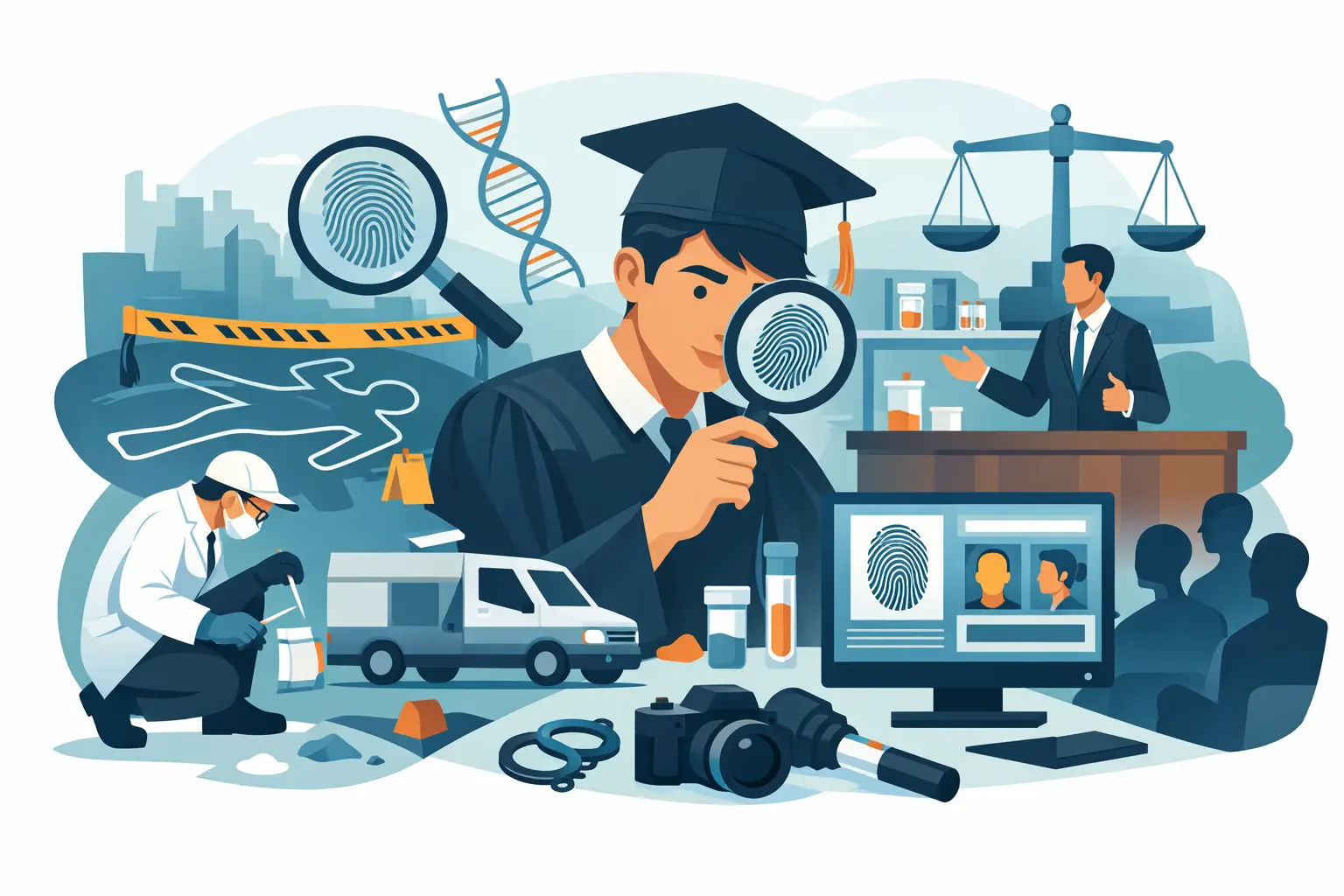
A forensic degree rarely leads to just one job title. That is where many prospective students get stuck. They ask what can forensic graduates do, assuming the answer must point to a single profession, when in reality forensic education prepares people for a spectrum of roles across investigation, analysis, public safety, intelligence, compliance, and behavioral research.
That breadth is not a weakness. It is one of the field’s strongest advantages. Forensic training develops a way of thinking – evidence-centered, methodical, and professionally skeptical. Employers value that mindset in places far beyond the traditional crime lab.
What can forensic graduates do in today’s job market?
The short answer is that it depends on the graduate’s specialization, prior experience, and career goals. A student with a laboratory background may move toward forensic biology or trace evidence work. A professional already working in law enforcement may use graduate study to advance into investigations, behavioral analysis, or intelligence functions. Another learner may apply forensic thinking in anti-fraud, cybersecurity, or risk management.
What connects these paths is the ability to evaluate evidence, identify patterns, document findings, and communicate conclusions under scrutiny. Those skills matter in criminal justice settings, but they also matter in corporate, regulatory, and private-sector environments where facts must be established carefully and defensibly.
Traditional forensic career paths
When people think about forensic graduates, they often picture a lab, a courtroom, or a crime scene. Those are still real and meaningful career routes.
Crime scene investigation remains one of the most visible options. These professionals collect, preserve, and document physical evidence. The work requires technical discipline, attention to chain of custody, and comfort with procedures that leave little room for error. For some graduates, this is an ideal fit. For others, the on-call nature and exposure to traumatic scenes can be a serious consideration.
Forensic laboratory roles are another established path. Depending on training, graduates may work in toxicology, DNA analysis, trace evidence, digital evidence, firearms examination, or questioned documents. These positions often appeal to those who prefer analytical precision over field response. The trade-off is that lab careers can be highly specialized, and some roles require very specific scientific coursework or advanced credentials.
Court-related work is also significant. Some forensic graduates support prosecutors, defense teams, or expert witnesses by organizing evidence, preparing reports, or assisting with case strategy. Others move into legal-adjacent roles where their value lies in translating technical findings into language that judges, attorneys, or juries can understand.
Behavioral and investigative roles beyond the lab
A growing number of graduates are drawn to the human side of forensic work. This is especially true for those interested in behavior, interviewing, threat assessment, deception, victimology, or offender analysis.
Investigative positions in law enforcement, corrections, probation, intelligence, and protective services often reward graduates who can connect facts with human behavior. A forensic background can strengthen case analysis, interviewing practices, and decision-making under uncertainty. In these settings, success depends not only on technical knowledge but also on judgment, ethics, and communication.
Behavioral analysis is another area of opportunity, though it is often misunderstood. It is not a cinematic shortcut to solving cases. In practice, it involves careful interpretation of behavior, context, and patterns, often as part of a broader investigative process. Graduates with advanced study in behavioral science, criminal profiling, or nonverbal communication may contribute meaningfully here, especially when their education is grounded in research rather than mythology.
Threat assessment and violence prevention are also relevant fields. Schools, corporations, public institutions, and security organizations increasingly need professionals who can assess concerning behavior, evaluate risk indicators, and support preventive intervention. Forensic graduates with strong behavioral training may be well positioned for this work.
What can forensic graduates do outside criminal justice?
Quite a lot, especially if they understand how to translate their skills. Forensic education is valuable anywhere evidence, risk, and human conduct intersect.
Fraud investigation is one of the clearest examples. Financial institutions, insurers, corporations, and public agencies all need professionals who can identify anomalies, follow documentation, assess intent, and support internal or external investigations. Graduates with strengths in interviewing, analysis, and report writing can do well in this space, particularly if they add domain knowledge in finance, compliance, or anti-fraud systems.
Cybersecurity is another expanding area, particularly for those focused on digital forensics, cyber investigations, or online threat environments. Digital evidence now plays a role in a wide range of cases, from corporate misconduct to organized fraud. The field moves quickly, so graduates need both foundational knowledge and a commitment to ongoing learning.
Compliance and corporate investigations offer a different kind of pathway. Organizations must respond to misconduct allegations, policy breaches, insider threats, and regulatory concerns. Forensic graduates can contribute to fact-finding, case documentation, interview support, and investigative review. This work is often less visible than criminal justice roles, but it can be intellectually demanding and professionally significant.
Human resources and workplace risk teams also increasingly benefit from forensic and behavioral expertise. Cases involving harassment, deception, retaliation, or internal misconduct require careful interviewing and evidence assessment. Not every forensic graduate will want to work in organizational settings, but for some professionals, this route offers a meaningful blend of behavioral insight and applied investigation.
The role of graduate education and specialization
A forensic degree opens doors, but specialization often determines which doors open first. That matters for students who want more than broad interest. They want a sharper professional identity.
Graduate study can help forensic graduates build that specialization with purpose. Some deepen their scientific expertise. Others move toward behavioral science, intelligence, cybersecurity, anti-fraud, negotiation, or research. The right choice depends on where a person wants to create impact.
This is particularly important in a competitive market. Employers may be impressed by general forensic knowledge, but they often hire based on applied relevance. A candidate who understands behavioral threat assessment, digital evidence handling, fraud detection, or investigative interviewing may stand out more clearly than one who presents only broad forensic interest.
Institutions such as Evidentia University reflect this shift by focusing on advanced, professionally relevant areas where forensic and behavioral sciences intersect. For adult learners and working professionals, that kind of targeted study can be career-defining because it aligns academic depth with real-world application.
Skills that make forensic graduates valuable
What employers often notice first is not the degree title alone but the thinking style behind it. Strong forensic graduates learn to separate assumption from evidence. They know how to document findings carefully, recognize inconsistencies, and ask better questions before reaching conclusions.
Communication is central. A brilliant analysis loses value if it cannot be explained clearly to a supervisor, investigator, attorney, or executive team. That is why writing, interviewing, testimony preparation, and presentation skills matter so much in forensic careers.
Ethics matter just as much. Forensic work operates in high-stakes environments where mistakes can affect liberty, reputation, safety, or institutional trust. Graduates who understand professional boundaries, evidentiary standards, and the consequences of bias bring real value to any organization.
Adaptability is another differentiator. The field continues to evolve through technology, regulation, and new forms of crime and misconduct. Graduates who stay current and can apply their training across contexts often build the most resilient careers.
How to think about your next step
If you are asking what can forensic graduates do, the better question may be where your interests meet evidence-based work. Some people are energized by field investigations. Others want the structure of laboratory analysis, the strategic environment of intelligence, the prevention focus of threat assessment, or the private-sector relevance of fraud and compliance.
It is worth being honest about trade-offs. Public sector roles may offer purpose and clear mission, but advancement can be slower. Private-sector roles may offer broader mobility and compensation, but they can demand faster adaptation and business awareness. Laboratory work may suit detail-oriented professionals, while behavioral or investigative roles often require stronger interpersonal stamina.
The most effective career decisions usually come from alignment, not prestige alone. Choose the path that fits your strengths, your tolerance for pressure, and the kind of problems you want to solve.
Forensic graduates are not limited to one destination. They are trained to work where facts matter, where human behavior must be understood, and where careful analysis can change outcomes. That is a powerful place to build a career.