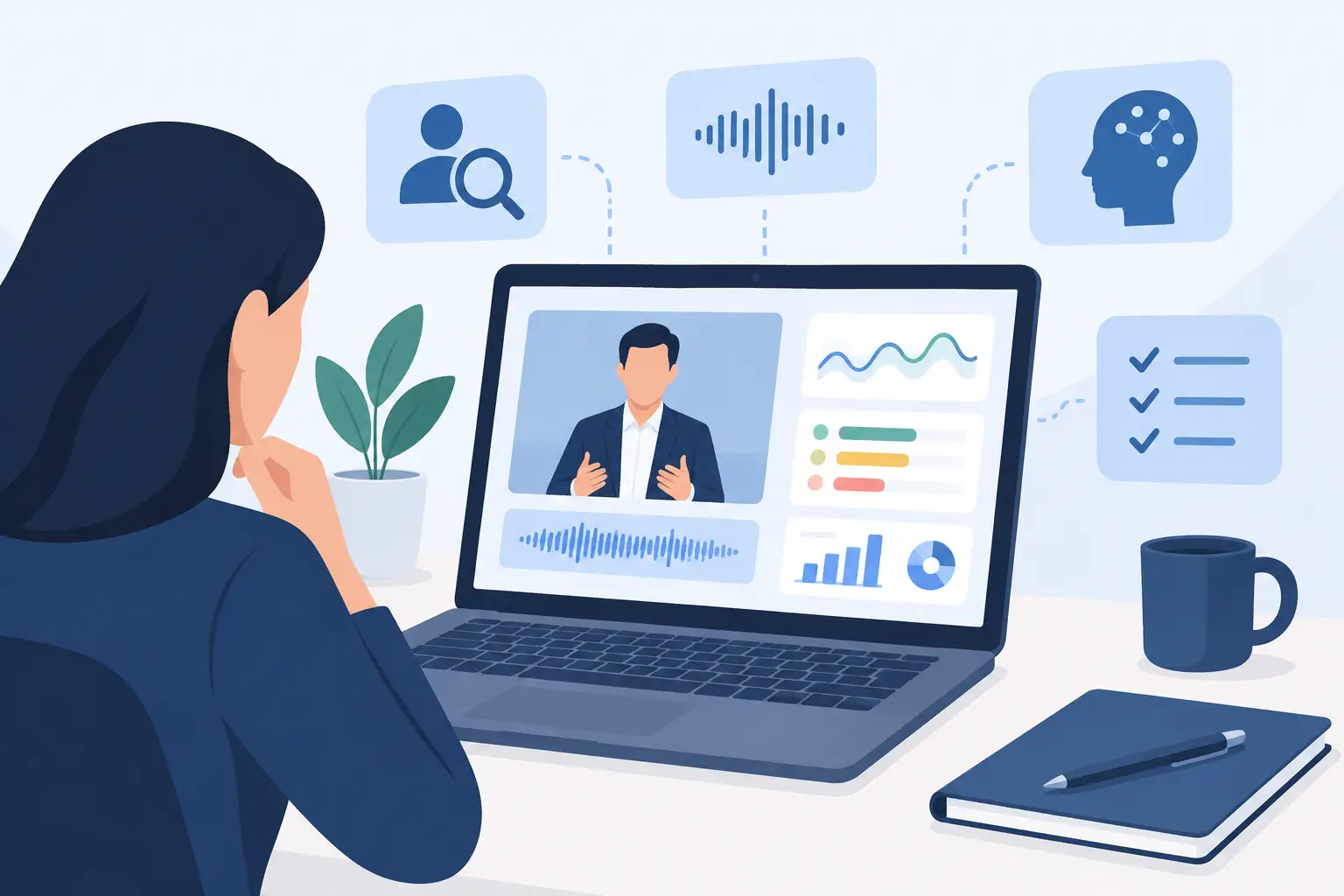
An interview can contain the detail that changes a hiring decision, advances an investigation, or reframes a research question. Yet the value of that detail depends on more than recording the conversation. The best interview analysis tools help professionals preserve what was said, identify meaningful patterns, test interpretations against the record, and explain their reasoning with discipline.
For professionals in behavioral science, law enforcement, security, human resources, compliance, and research, the central question is not which platform has the longest feature list. It is which tool supports a method that is accurate, ethical, and appropriate to the consequences of the decision being made.
What interview analysis software should actually do
Interview analysis is often treated as a technical task: transcribe the recording, search for terms, produce a report. In serious professional settings, it is an evidentiary and interpretive task. A useful platform should reduce administrative burden while preserving the analyst’s ability to revisit source material, compare accounts, document coding decisions, and distinguish observation from inference.
The right solution depends on the interview type. A recruitment team may need consistent scorecards and structured feedback across candidates. An investigative team may need time-stamped transcripts, secure storage, case-level access controls, and an audit trail. A researcher may need rigorous qualitative coding, memoing, intercoder comparison, and the ability to trace a finding back to a specific passage.
No software can determine whether a person is truthful, dangerous, or suitable for a role. Systems that claim to infer deception, personality, or credibility from facial movements, vocal features, or language patterns alone require exceptional skepticism. Human behavior is contextual. Accent, culture, stress, disability, trauma, recording quality, and interview conditions can all affect observable behavior. Technology can organize evidence; it should not replace professional judgment.
Best interview analysis tools by professional use
Rather than naming a single winner, it is more useful to compare the strongest tool categories and the platforms that commonly serve them well.
| Tool type | Strong options | Best fit | Key consideration | | — | — | — | — | | Qualitative analysis software | NVivo, MAXQDA, ATLAS.ti | Research, investigative review, complex case interviews | Requires a clear coding framework and analyst training | | Research repository and synthesis platforms | Dovetail, Condens | User research, product research, collaborative thematic analysis | Better for team synthesis than highly sensitive case management | | Transcription and media review | Trint, Descript, Otter | Fast first-pass transcripts and searchable recordings | Automated transcripts must be checked against the audio | | Structured hiring intelligence platforms | Metaview, BrightHire, HireVue | Recruitment interviews and calibrated interviewer feedback | Assess bias, privacy, and local employment-law implications | | Secure case and evidence management systems | Purpose-built enterprise case platforms | Regulated investigations, law enforcement, compliance | Confirm retention, access, export, and chain-of-custody controls |
NVivo, MAXQDA, and ATLAS.ti for rigorous qualitative work
For analysts conducting detailed interviews, these three platforms remain leading choices because they are designed around traceable qualitative analysis. Each allows users to import transcripts, recordings, notes, documents, and in some cases visual material; apply codes; write analytic memos; compare themes; and retrieve every excerpt associated with an idea or category.
NVivo is often favored by teams working with large, varied datasets and formal research workflows. MAXQDA is widely appreciated for an accessible interface and strong mixed-methods capabilities. ATLAS.ti offers flexible network views that can help analysts visualize relationships among codes, actors, events, and concepts.
The trade-off is meaningful. These platforms are not shortcuts to insight. They reward methodological clarity. Before coding begins, a team should define its research or investigative question, determine whether codes are deductive, inductive, or both, and establish how disagreements will be handled. Without that discipline, sophisticated software can produce an impressive but weakly supported theme map.
Dovetail and Condens for collaborative insight work
When teams need to synthesize interviews quickly across product, service, policy, or organizational research, repository platforms can be highly effective. Dovetail and Condens make it easier to centralize recordings, transcripts, tags, highlights, and insight reports so that multiple stakeholders can engage with the underlying evidence.
They are particularly useful when the goal is to move from interview excerpts to defensible recommendations without losing the path between the two. A policy team, for example, might tag participant accounts by perceived barriers, decision points, and service failures, then compare patterns across demographic or professional groups.
These tools may be less appropriate for highly sensitive investigative material. Before adoption, organizations should examine data residency, permissions, contractual safeguards, deletion practices, and whether the platform’s collaboration features expose information more broadly than a case requires.
Transcription tools for speed, not final accuracy
Automated transcription is now a practical starting point for nearly every recorded interview. Trint, Descript, and Otter can make hours of audio searchable within minutes, helping analysts locate names, dates, recurring phrases, and critical passages.
But a transcript is not a neutral artifact. Automated systems can mishear technical vocabulary, names, overlapping speech, low-volume statements, accents, or emotionally charged exchanges. In an investigative, compliance, or research setting, the recording remains the primary source. Review the transcript against the audio, clearly mark unintelligible passages, and preserve time stamps so that others can independently verify important quotations.
For interviews involving allegations, consent disputes, threats, or other high-stakes claims, human quality assurance is not optional. It is part of the analytical method.
Hiring platforms require a fairness-first approach
Recruitment tools can help organizations standardize interview questions, capture interviewer feedback promptly, and reduce reliance on memory or informal impressions. Platforms such as Metaview and BrightHire are often used to record interviews, generate notes, and support coaching or calibration. HireVue and similar systems may be used for structured digital interviewing, depending on the organization’s hiring model and jurisdiction.
The benefit is consistency. The risk is false objectivity. If a structured interview is built around poorly defined competencies, biased criteria, or uneven interviewer behavior, technology can scale the problem rather than solve it. Organizations should connect every evaluation criterion to genuine job requirements, train interviewers to use behavioral evidence, and periodically test whether outcomes differ unfairly across protected groups.
Automated scoring deserves particular scrutiny. Candidates should understand what data is collected, how it is used, and who can access it. Human review, transparent governance, and documented accommodations are essential.
How to choose among the best interview analysis tools
Begin with the decision the analysis must support. If the result may influence a disciplinary action, legal referral, employment decision, or published research claim, prioritize source preservation, permissions, exportability, and auditability over convenience. If the goal is early-stage user research, collaboration and speed may matter more.
Then examine the workflow from beginning to end. Can the tool securely capture consent? Does it preserve original media? Can analysts correct transcripts without obscuring the original record? Can you export coded passages, reports, and metadata in a usable format? A platform that is easy to use but difficult to exit can create long-term institutional risk.
Data governance should be a deciding factor, not a procurement afterthought. Ask where recordings and transcripts are stored, whether encryption is applied in transit and at rest, how role-based access works, what audit logs are available, and how long data is retained. International teams must also consider cross-border privacy obligations and the expectations of participants whose accounts may be sensitive.
Finally, assess the team, not just the tool. A well-trained analyst using a simple coded spreadsheet and verified transcript may produce stronger work than an untrained team using advanced artificial intelligence. Software should reinforce a defined protocol that includes informed consent where appropriate, neutral questioning, careful documentation, corroboration, and review.
A defensible workflow for interview analysis
A practical workflow begins before the interview. Define the purpose, create a structured or semi-structured guide, and identify what information must be captured. During the interview, preserve the conditions of the conversation: date, participants, setting, interruptions, relevant documents, and any limitations affecting the exchange.
Afterward, retain the original recording and create a reviewed transcript. Apply a coding framework that separates descriptive facts from interpretations. For example, an investigator might code references to dates, actions, witnesses, and documents separately from credibility considerations or hypotheses. A researcher might distinguish stated experiences, observed patterns, and emerging explanatory themes.
The final report should make the reasoning visible. It should identify what the interviewee said, what other evidence supports or conflicts with the account, and what conclusions remain tentative. This is where the best tools earn their place: not by generating a definitive answer, but by helping professionals show how they arrived at a careful one.
At Evidentia University, advanced study of human behavior and investigative practice begins with that same standard: observe closely, reason ethically, and treat every conclusion as accountable to evidence. The most valuable interview analysis platform is the one that strengthens those habits in your real-world work.