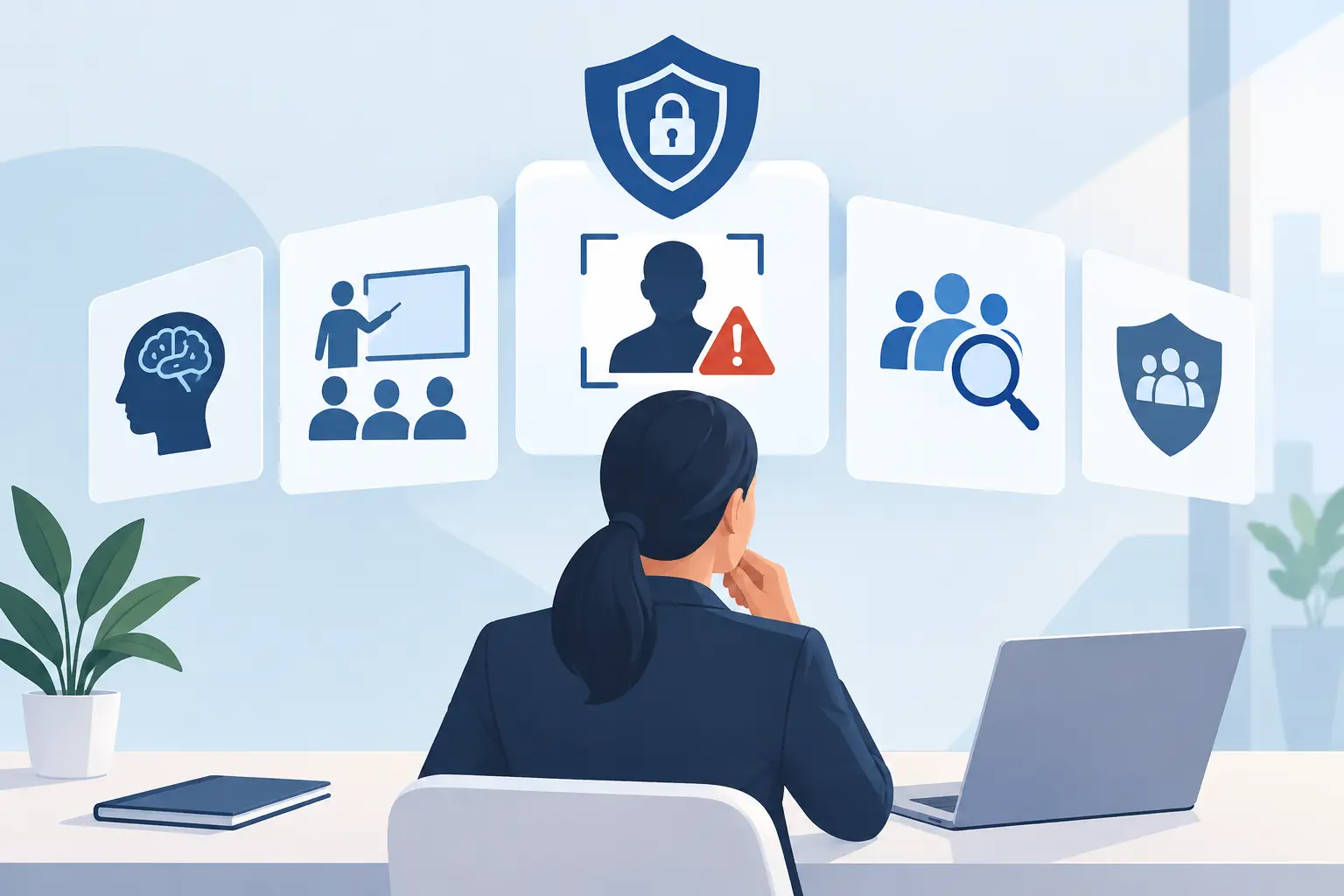
A concerning email, a pattern of unwanted contact, an employee in acute distress, or an escalating grievance can each demand a response long before anyone can predict an outcome. That is why the best threat assessment training programs do not promise certainty. They prepare professionals to identify concerning behavior, assess context, coordinate proportionate interventions, and document decisions that can withstand scrutiny.
For professionals in security, law enforcement, human resources, higher education, behavioral health, and corporate risk, the right program is not simply the one with the strongest name recognition. It is the one that develops disciplined judgment under pressure. Threat assessment sits at the intersection of behavioral science, investigative practice, legal responsibility, and human care. Training must reflect that complexity.
What Strong Threat Assessment Training Should Teach
A credible program begins with the distinction between a threat and risk. A threat assessment is not a search for a profile or a checklist that labels people as dangerous. It is a structured, evidence-informed process for evaluating behaviors, communications, circumstances, stressors, access, and protective factors. The goal is to understand whether a person may be moving toward violence or another harmful act, and what interventions may reduce that risk.
The strongest curricula teach behavioral threat assessment as a multidisciplinary practice. Participants should learn how to gather information without turning reasonable concern into unsupported suspicion. They should examine fixation, grievance, leakage, escalation, stalking behaviors, targeted violence pathways, and changes in capability or access. Just as importantly, they should learn to recognize stabilizing influences, support systems, treatment engagement, and opportunities for off-ramps.
Training should also make room for uncertainty. Threat assessment teams often make consequential decisions with incomplete information. A useful program teaches how to state what is known, what remains unknown, and what additional information could change the assessment. This is more valuable than a course that presents a rigid scoring system as a substitute for professional judgment.
The Best Threat Assessment Training Programs by Professional Need
There is no single best option for every learner. The most appropriate pathway depends on the setting in which you work, the authority you hold, and whether your role centers on prevention, investigation, clinical evaluation, or organizational leadership.
Foundational programs for cross-functional teams
Introductory and intermediate training is often the right starting point for workplace violence prevention teams, campus behavioral intervention teams, school administrators, security managers, and HR leaders. These programs should establish a common language across disciplines. Participants need to understand warning behaviors, reporting pathways, case triage, confidentiality boundaries, and the roles of law enforcement, mental health professionals, and organizational leaders.
Look for instruction built around realistic case scenarios rather than abstract definitions alone. A cross-functional team must practice how it will respond when one department holds critical information, another has a duty of care, and no individual has the full picture. Good foundational programs make coordination more deliberate before a crisis tests it.
Advanced training for investigators and security professionals
Investigators, executive protection professionals, corporate security leaders, and law enforcement personnel generally need more depth in fact development and case management. Advanced programs should address interview strategy, open-source information, documentation standards, stalking and harassment investigations, threat communications, and the assessment of planning and preparation behaviors.
For these practitioners, faculty experience matters greatly. A course led by people who have managed complex cases can show how investigative details alter an assessment over time. Yet practical experience alone is not enough. The program should connect casework to established behavioral research and clearly distinguish evidence-based practice from anecdote.
Specialized programs for campuses, schools, and behavioral health settings
Threat assessment changes meaningfully across environments. Higher education and K-12 settings must balance safety, student success, disability considerations, privacy rules, and developmental factors. Behavioral health professionals need training that respects clinical ethics while clarifying when and how they can participate in a broader safety response.
Specialized programs should address the policies, reporting culture, and population-specific challenges of the setting. A campus team, for example, may need to manage concerning behavior over an extended period while helping a student remain connected to academic and mental health support. A short course focused only on imminent violence may be too narrow for that work.
Graduate-level study for strategic leadership
Professionals who want to lead prevention programs, develop policy, conduct research, or move into senior investigative roles may benefit from graduate-level education in behavioral, forensic, or security-related disciplines. This path is more demanding than a certificate course, but it can provide stronger grounding in research methods, ethics, behavioral analysis, decision-making, and organizational systems.
For learners seeking this level of depth, an institution such as Evidentia University can be especially relevant when its curriculum connects behavioral science with applied investigation and practitioner insight. The essential question is not whether a program uses the phrase “threat assessment,” but whether it cultivates the analytical habits required to lead complex cases responsibly.
How to Compare Programs Before You Enroll
Marketing language can make many courses appear similar. A more discerning comparison looks at what the program asks learners to do. Does it require them to analyze evidence, make defensible recommendations, and reconsider an assessment when new facts emerge? Or does it primarily ask them to memorize warning signs?
Use this five-part scorecard when evaluating potential training:
- Faculty credibility: Instructors should bring relevant field experience, academic grounding, or ideally both. Review whether their expertise matches the environment in which you work.
- Curriculum depth: Look for behavioral analysis, case management, intervention planning, documentation, and legal or ethical considerations rather than awareness content alone.
- Applied learning: Strong programs use case studies, simulations, structured exercises, and feedback that reveal how decisions are made.
- Audience fit: A course designed for higher education may not meet the needs of corporate security, and a law enforcement-focused course may not address HR responsibilities adequately.
- Continuing value: Consider whether the program offers current research, peer exchange, advanced modules, or a learning community that supports ongoing development.
Delivery format also deserves attention. Online programs can provide global access and allow working professionals to study without leaving their roles. However, flexibility should not mean isolation. The best online experiences create meaningful interaction through live discussion, faculty feedback, case-based assignments, and opportunities to test reasoning with peers.
Credentials Matter, but Competence Matters More
Certificates and professional designations can signal commitment, especially when an employer needs a clear way to identify trained personnel. Still, a credential should not be mistaken for operational readiness. Threat assessment is a practice developed over time through supervised judgment, interdisciplinary consultation, policy alignment, and careful review of outcomes.
Before choosing a credentialing course, ask what the assessment process actually measures. A multiple-choice examination may confirm familiarity with terminology. It does not necessarily demonstrate that a participant can evaluate a complex case, avoid confirmation bias, or communicate recommendations to legal counsel and senior leadership.
The most valuable programs build reflective practice. They teach professionals to challenge their first interpretation, seek disconfirming information, consider bias, and reassess risk as circumstances change. This approach is particularly important because both overreaction and underreaction can cause harm. An unnecessary punitive response can isolate someone who needs support, while a delayed response can leave others exposed to preventable danger.
Questions to Ask Admissions Teams or Training Providers
Before enrolling, ask whether the curriculum addresses intervention as seriously as identification. Ask how often content is updated, whether faculty discuss failed assumptions as well as successful cases, and how the program handles legal, cultural, and ethical complexity. If the course serves an international audience, ask whether it recognizes that reporting obligations, privacy standards, and institutional authority vary across jurisdictions.
Also ask what kind of learner support is available. Adult professionals often need clear expectations, accessible faculty, and a realistic workload. A demanding program can be career-defining, but only when its structure allows students to engage deeply enough to apply the material with confidence.
A strong threat assessment education should leave you with more than a framework or certificate. It should leave you better able to ask the next careful question, bring the right people into the room, and choose an intervention that protects both safety and dignity.