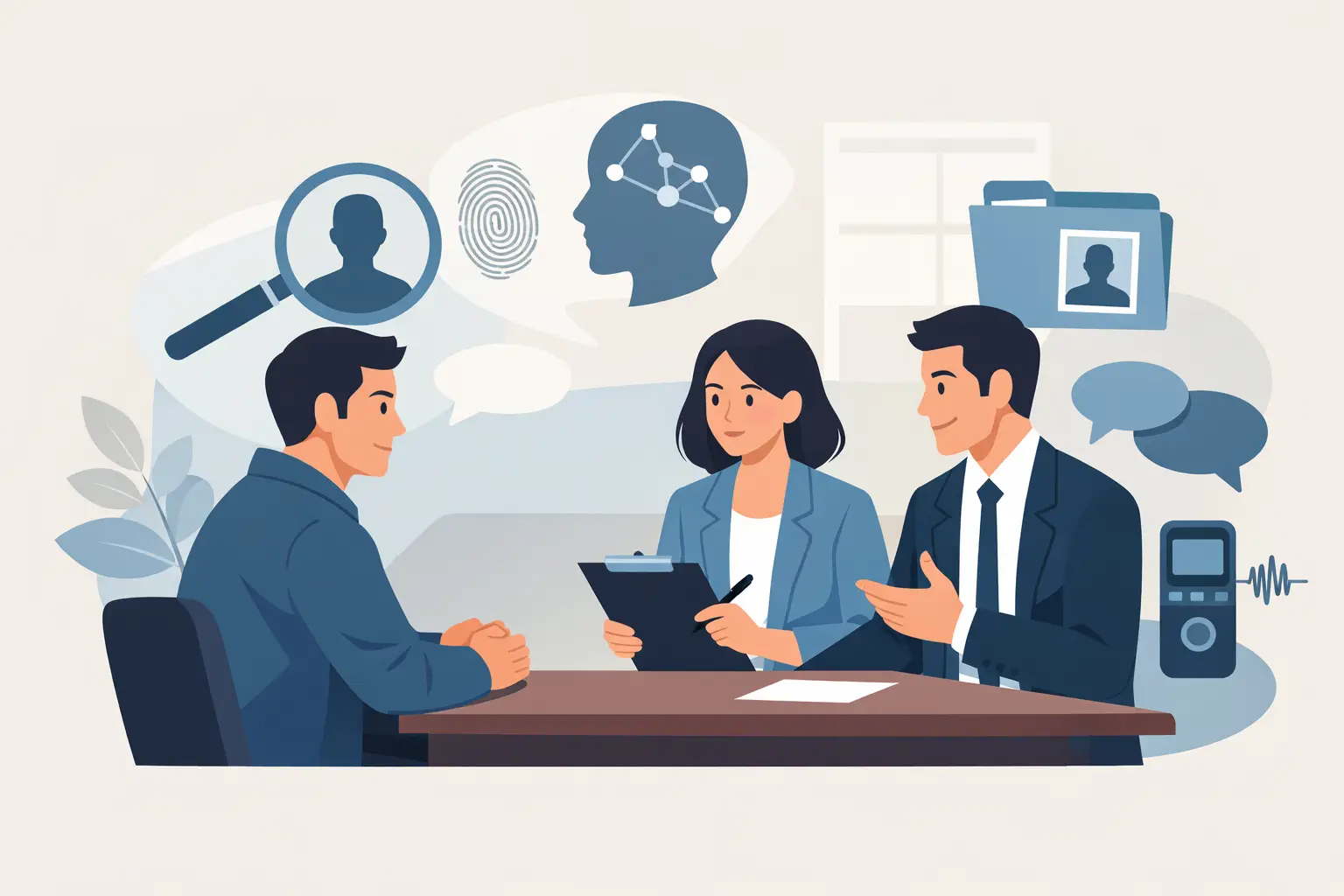
A single poorly framed question can contaminate an account before an investigator has heard the witness’s actual memory. A rushed assumption can close off disclosure, damage rapport, and create avoidable risk for an organization or case. That is why learning how to learn investigative interviewing is not simply about becoming more persuasive. It is about developing a disciplined method for gathering accurate, ethical, and defensible information.
Investigative interviewing sits at the intersection of psychology, communication, law, and decision-making. Professionals may use it in criminal investigations, workplace misconduct inquiries, fraud examinations, compliance reviews, intelligence work, safeguarding matters, and security operations. The setting changes, but the standard remains demanding: obtain the best available account without coercion, contamination, or confirmation bias.
Start With the Purpose of an Investigative Interview
An investigative interview is not an interrogation by another name. Its primary purpose is information gathering. The interviewer seeks to understand what a person knows, observed, experienced, did, or can reliably clarify. That distinction matters because an approach built around forcing admissions can produce poor information, false confidence, and serious ethical consequences.
Before studying techniques, learn to define the interview’s purpose. Are you establishing a timeline? Testing an allegation? Identifying witnesses, documents, transactions, or digital evidence? Understanding a subject’s role in an event? A clear purpose helps you prepare relevant topics while avoiding the trap of treating every interview as a search for confirmation.
This mindset also requires intellectual humility. An interviewee may be mistaken, deceptive, frightened, ashamed, traumatized, protective of others, or simply unable to recall a detail. The skilled interviewer does not assume which explanation is true at the outset. They create conditions in which information can be evaluated against corroborating evidence.
Build the Foundations Before Practicing Techniques
Those who learn quickly usually begin with the disciplines that make techniques effective: ethics, law, human memory, communication, and case analysis. A polished question sequence has little value if the interviewer does not understand how suggestion affects recall or how disclosure rules shape what can be asked and recorded.
Study memory and suggestibility
Human memory is reconstructive, not a video recording. Recall can be influenced by stress, time, repeated questioning, exposure to other accounts, and the wording of questions. Learning this principle changes the way you listen.
Open prompts such as, “Tell me everything you remember about that conversation,” give an interviewee space to provide an unprompted account. More focused questions can follow, but only after the person has had an opportunity to describe events in their own words. By contrast, leading questions can introduce information the interviewer wants confirmed: “He threatened you before he left, correct?”
The practical lesson is not that every closed question is improper. Dates, names, locations, and procedural details often require focused clarification. The lesson is to use specificity carefully and in sequence: invite free recall, clarify what was said, then test important details against other evidence.
Learn the legal and ethical boundaries
Legal requirements differ across jurisdictions and professional contexts. Police interviews, internal workplace investigations, regulatory inquiries, and private-sector fraud examinations each carry distinct rules on representation, privacy, recording, warnings, disclosure, and documentation. Learn the standards that govern your field rather than relying on popular media portrayals of interviewing.
Ethics extends beyond compliance. Avoid deception where it is prohibited or inappropriate. Do not exploit a person’s vulnerability. Protect confidential information. Keep an accurate record. Most critically, recognize that the pressure to resolve a case can distort judgment. Ethical interviewing protects the interviewee, the investigation, and the credibility of the professional conducting it.
Learn Investigative Interviewing Through a Structured Model
A structured framework gives new interviewers a reliable way to prepare, conduct, and evaluate interviews. One widely respected example is the PEACE model: Planning and Preparation, Engage and Explain, Account, Closure, and Evaluation. Its value is not a rigid script. Its value is that it prevents essential work from being skipped.
In planning, review available evidence, identify knowledge gaps, determine the interviewee’s likely perspective, and organize topics in a logical order. Prepare open questions and possible follow-ups, but remain ready to depart from the plan when new information emerges. Planning should also include practical conditions: a private setting, adequate time, appropriate support measures, interpreters when needed, and reliable recording procedures.
Engagement is often misunderstood as friendliness. Professional rapport is better defined as a working relationship in which the interviewee understands the process, feels heard, and can participate without unnecessary confusion or intimidation. Be clear about your role, the purpose of the meeting, the expected duration, and any applicable boundaries around confidentiality.
The account stage requires active listening. Start broad, allow pauses, and resist the urge to fill silence. People frequently retrieve additional detail after a pause. Use their own language when seeking clarification, and distinguish between what they personally saw, what they inferred, and what someone else told them.
Closure should not be rushed. Give the interviewee an opportunity to add or correct information. Explain what will happen next within the limits of the process. The evaluation stage happens after the conversation: compare the account with evidence, identify unresolved points, assess your own performance, and decide whether another interview is necessary.
Practice the Questions That Produce Better Information
Question design is a central interviewing skill, but strong questions depend on attentive listening. Practice moving from broad to narrow without making the conversation feel like a checklist.
Begin with open invitations: “Please walk me through what happened from the beginning.” Use probing questions to develop detail: “What do you remember seeing at that point?” Use clarification questions when language is vague: “When you say you felt pressured, what was said or done?” Finally, use focused questions to establish a precise fact when needed: “Was that meeting on Tuesday or Wednesday?”
Avoid stacking questions. “Who was there, what did they say, and why did you leave?” asks the interviewee to manage several cognitive tasks at once. Ask one question, listen fully, and follow the answer. This discipline reveals inconsistencies or uncertainty more effectively than rapid-fire questioning.
It also helps to separate evidence from interpretation. Rather than asking, “Why did you falsify the report?” ask, “Please explain how the figures in this report were entered.” The first question assumes misconduct. The second allows for an account that can later be tested against the records.
Use Feedback, Recording, and Deliberate Practice
Interviewing improves through observation and review, not intuition alone. Whenever policy and law permit, recordings provide a more reliable basis for evaluation than memory or notes. Review a recording with a supervisor, mentor, or trained peer. Look for moments where you interrupted, used a leading phrase, overlooked a promising detail, or signaled your own assumptions.
Role-play is valuable when it is designed seriously. Practice with scenarios that involve incomplete evidence, conflicting accounts, anxious witnesses, reluctant employees, and subjects who deny responsibility. The goal is not to “win” the scenario. It is to maintain structure, build rapport, and gather information that can be independently assessed.
A useful practice routine includes four distinct habits:
- Write an interview plan from a short case file and identify both evidence gaps and alternative explanations.
- Conduct a timed role-play using primarily open prompts before moving to focused questions.
- Review the recording and mark every interruption, assumption, and missed follow-up.
- Rewrite three questions that were weak, leading, unclear, or unnecessarily accusatory.
This form of deliberate practice may feel slower than consuming tips or watching dramatic interviews. It builds the judgment that complex real-world interviews demand.
Develop Behavioral Insight Without Overreading Cues
Behavioral knowledge can strengthen interviewing, but it must be used responsibly. Nervousness, reduced eye contact, fidgeting, delayed responses, or changes in tone do not reliably prove deception. People display stress for many reasons, including fear, trauma, cultural differences, neurodiversity, authority dynamics, and concern about being misunderstood.
Instead of treating body language as a lie detector, use behavioral observations as prompts for inquiry. If a person becomes noticeably hesitant around one part of a timeline, do not conclude they are lying. Slow down and ask for context: “I notice this part seems difficult to discuss. Take your time. What do you recall happening next?”
The strongest assessments come from evidence-based interviewing, internal consistency, external corroboration, and careful analysis of statements over time. Behavioral cues may help you decide where to explore further, but they should never substitute for proof.
Pursue Advanced Study and Supervised Experience
For professionals working in high-stakes environments, short courses can offer an introduction, but they are rarely sufficient on their own. Advanced development should combine research literacy, interviewing frameworks, behavioral science, ethics, case-based learning, and supervised practice.
Choose education that treats interviewing as an applied discipline rather than a collection of persuasion tactics. Faculty experience matters, especially when instructors can connect empirical research with investigative realities. At Evidentia University, this kind of interdisciplinary perspective reflects the wider relationship between human behavior, forensic inquiry, and professional decision-making.
Your best next step is to select one upcoming conversation in your professional setting and prepare for it differently: define the information objective, write open prompts, identify assumptions to test, and plan how you will review your own performance afterward. That habit, repeated with rigor, is where capable interviewers become trusted ones.