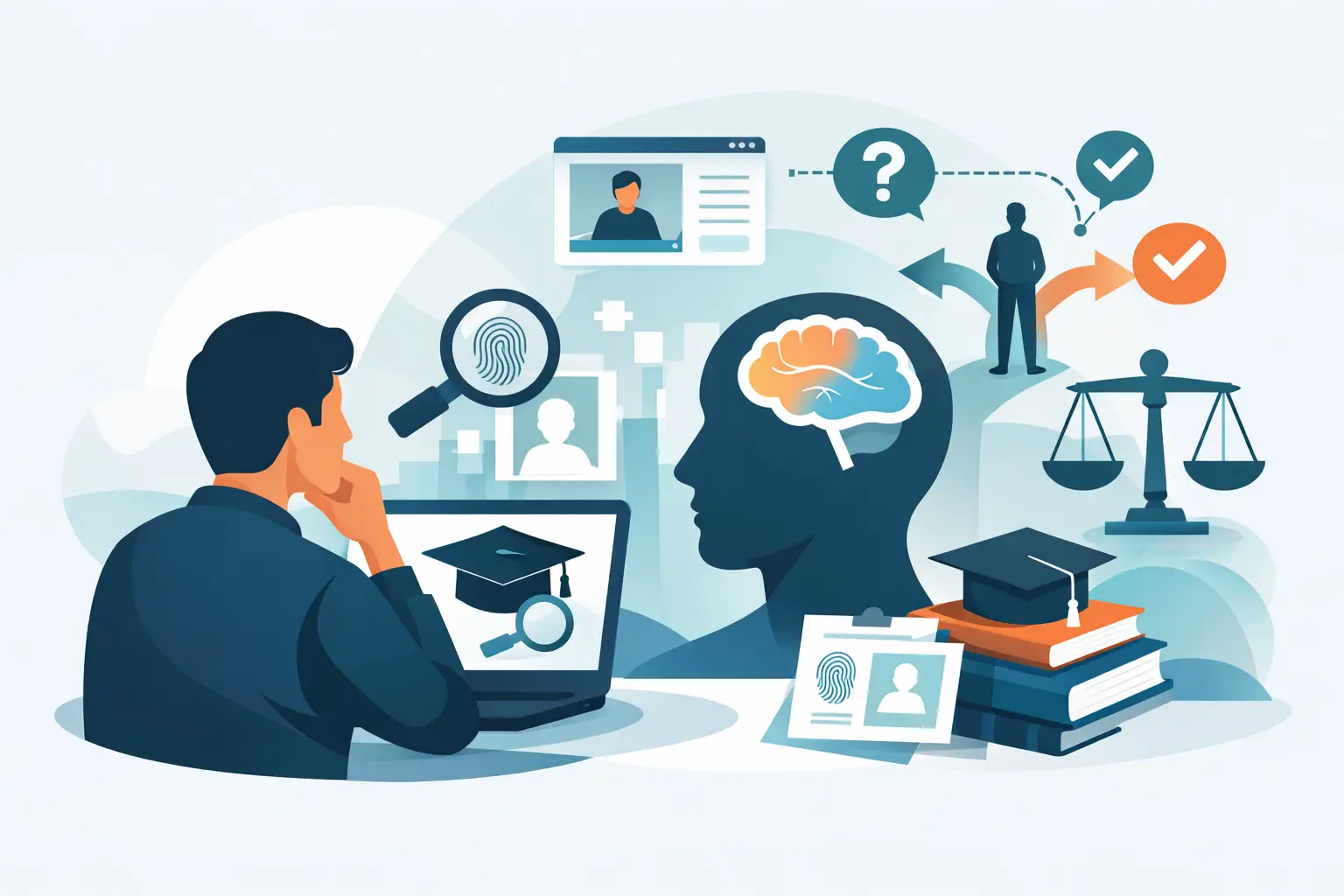
A strong investigative psychology degree online sits at the intersection of behavior, evidence, and decision-making. For professionals who want to understand why people offend, deceive, cooperate, confess, or escalate risk, this field offers more than academic interest. It offers a practical framework for analyzing human behavior in investigative, security, forensic, and justice settings.
That practical value matters because interest in investigative psychology is often driven by real career questions, not abstract curiosity. Mid-career law enforcement professionals may want sharper behavioral analysis skills. Security and compliance specialists may need a better grasp of threat indicators and deception. Psychology and criminal justice graduates may be looking for a graduate path that is more specialized, more applied, and more relevant to modern investigative work than a broad generalist degree.
What an investigative psychology degree online actually studies
Investigative psychology is not a catchall term for crime shows, profiling myths, or intuition dressed up as expertise. At its best, it is a disciplined study of human behavior in investigative contexts. That includes how offenders make choices, how victims and witnesses remember and report events, how investigators form judgments, and how social, cognitive, and environmental factors shape criminal behavior.
In an online graduate program, students typically engage with topics such as behavioral analysis, forensic psychology, criminal behavior patterns, interviewing, deception, victimology, decision-making under pressure, and research methods. Depending on the institution, the curriculum may also touch adjacent specialties such as nonverbal communication, negotiation psychology, threat assessment, fraud analysis, and digital-era investigative challenges.
The strongest programs do not treat these subjects as disconnected modules. They show how they work together. A behavioral pattern means little without methodology. Interviewing techniques mean less without an understanding of memory, bias, and suggestibility. Criminal behavior analysis becomes more credible when it is grounded in evidence rather than dramatic speculation.
Why professionals choose to study online
For the audience most drawn to this field, online learning is not a fallback. It is often the only realistic path to advanced specialization. Working adults rarely have the option to relocate, pause a career, or rearrange family responsibilities for campus attendance. An online format makes graduate study possible without forcing unnecessary trade-offs.
That said, flexibility alone is not enough. A serious investigative psychology degree online should preserve academic depth while accommodating professional life. That means clear course design, meaningful faculty engagement, rigorous assessment, and a structure that respects the reality of adult learners. Convenience is valuable, but credibility matters more.
There is also a broader advantage to online delivery when it is done well. Students often come from multiple countries, industries, and investigative environments. That creates a richer academic exchange. A law enforcement officer, a behavioral analyst, a compliance professional, and a psychology graduate may approach the same case material from very different angles. In a specialized field, that diversity strengthens learning rather than diluting it.
Who benefits most from this degree
This degree is especially relevant for people whose work depends on interpreting behavior with precision. That includes professionals in law enforcement, intelligence, corrections, private investigations, corporate security, fraud prevention, human resources, and behavioral research. It can also appeal to students preparing for doctoral study or seeking a more focused alternative to traditional psychology or criminal justice pathways.
Still, fit matters. An investigative psychology degree online is not automatically the right choice for every student interested in psychology. If your primary goal is clinical licensure, this is usually not the direct route. If you want a broad undergraduate-style survey of human behavior, this field may feel too specialized. It is best suited to learners who want to understand behavior in applied, high-stakes, evidence-based contexts.
That distinction is worth taking seriously. Specialized education tends to create stronger professional identity, but it also narrows the lane. For many students, that is a strength. For others, it may feel limiting. The right program should help you build both subject-matter expertise and transferable analytical skills.
What to look for in an investigative psychology degree online
Program quality is not defined by marketing language. It is defined by intellectual seriousness and professional relevance. The first question to ask is whether the curriculum is genuinely investigative in orientation or simply a general psychology degree with forensic terminology added on top.
Faculty quality is equally important. In a field like this, practitioner-led instruction can make a substantial difference, especially when faculty bring experience from policing, behavioral science, federal investigations, criminology, interviewing, or applied research. Theory matters, but students in this space also need to understand how knowledge performs under operational pressure.
You should also look closely at how the program handles research and case application. Does it train students to evaluate evidence critically? Does it address bias, ethics, and methodological limits? Does it move beyond profiling stereotypes and toward empirically grounded analysis? These are not secondary details. They are central to the legitimacy of the discipline.
A strong specialist institution may also offer an academic ecosystem around the degree, including talks, publications, research initiatives, and peer community. That matters more than many prospective students realize. Graduate education is not only about course completion. It is also about entering a professional and intellectual network shaped by serious inquiry.
Career outcomes and realistic expectations
One reason this field attracts attention is that it sounds highly specialized and operationally relevant. That is true, but expectations should stay grounded. An investigative psychology degree online does not by itself make someone a profiler, lead investigator, or forensic psychologist. Titles and roles depend on jurisdiction, prior training, licensure requirements, agency structures, and professional background.
What the degree can do is sharpen your expertise in behavioral interpretation, investigative reasoning, research literacy, and high-level communication. Those competencies can strengthen advancement in current roles and open new opportunities in analytical, investigative, advisory, and interdisciplinary settings.
For some professionals, the return on investment is immediate. A security leader may apply behavioral insights to threat assessment. A fraud investigator may improve interviewing strategy. A law enforcement professional may become more sophisticated in understanding offender patterns or investigative bias. For others, the value is more strategic. The degree builds credibility for future leadership, teaching, consulting, or doctoral work.
The best way to judge outcomes is not to ask whether the degree guarantees a single job title. It is to ask whether it advances your professional direction in a meaningful way.
The role of academic rigor in a practice-driven field
Specialized applied disciplines can sometimes attract simplistic thinking. Investigative psychology should resist that tendency. Human behavior is complex, context-dependent, and difficult to reduce to neat formulas. Good programs teach students to think carefully, tolerate ambiguity, and test claims against evidence.
That may feel less dramatic than popular portrayals of investigative work, but it is far more valuable. Real expertise often looks like disciplined restraint. It means knowing what the evidence supports, what it suggests, and what remains uncertain. In professional settings, that distinction protects investigations, organizations, and public trust.
This is where a specialist graduate institution can stand apart. When a university is built around forensic and behavioral sciences rather than treating them as side offerings, students often gain a more coherent educational experience. At Evidentia University, for example, that specialist focus aligns with the expectations of adult learners who want advanced, career-relevant study shaped by both academic rigor and practitioner insight.
Is this degree worth it for you?
That depends on what you want the next stage of your education to do. If you are looking for a generic credential, a highly specialized degree may not be the obvious choice. If you want intellectual depth in the behavioral dimensions of investigation, risk, and decision-making, it can be a powerful investment.
The strongest candidates are usually motivated by a clear professional question. They want to investigate better, assess behavior more accurately, communicate findings more credibly, or move into a more advanced niche within their field. For those learners, an investigative psychology degree online is not just a flexible academic option. It is a way to develop expertise that is both rare and increasingly relevant.
Choose a program that treats the subject with seriousness, respects the complexity of human behavior, and connects scholarship to real-world application. The right degree should not simply add knowledge. It should change how you think when the stakes are high.