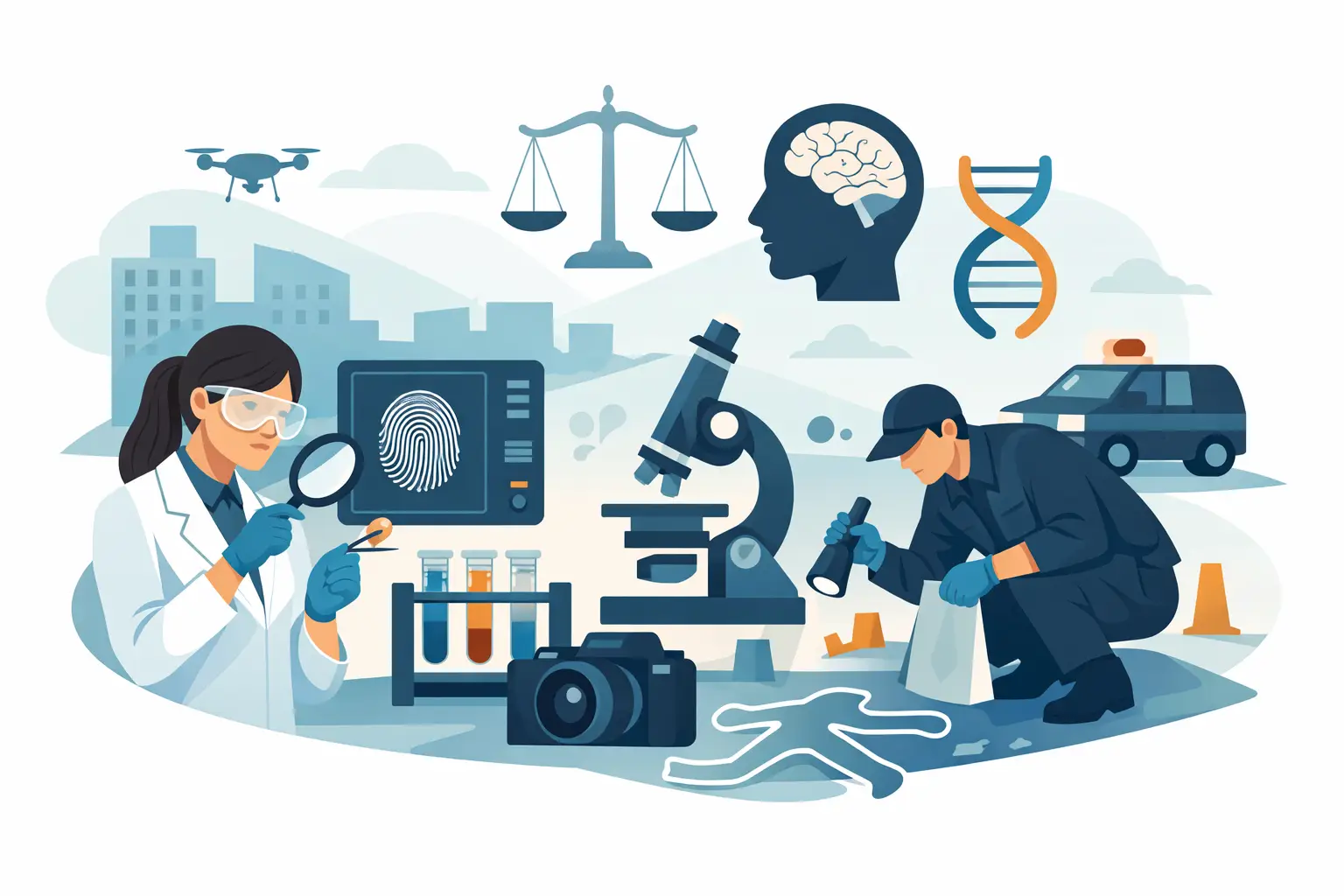
A forensic science degree can take you far beyond the TV version of crime labs. If you are asking what can you do with forensic science degree training, the real answer is broader, more specialized, and more professionally adaptable than most people expect. The field sits at the intersection of science, investigation, law, and human behavior, which means your career path depends as much on your specialization as on the degree itself.
For adult learners and working professionals, that distinction matters. A forensic science background can support direct entry into laboratory and investigative roles, but it can also serve as a platform for advancement into leadership, behavioral analysis, fraud examination, cybersecurity, compliance, and expert consulting. The strongest outcomes usually come from aligning your academic focus with the kind of evidence, cases, and institutions you want to work with.
What can you do with forensic science degree training?
The most direct answer is that you can work anywhere evidence must be collected, analyzed, interpreted, and defended. That includes public crime laboratories, medical examiner systems, law enforcement agencies, federal institutions, private forensic firms, insurance investigations, corporate risk units, and research environments.
Still, job titles vary widely. One graduate may move into DNA or toxicology work. Another may specialize in digital evidence. Someone else may use the degree as a springboard into criminal profiling, investigative interviewing, anti-fraud analysis, or forensic consulting. The degree is not a single-lane credential. It is a technical foundation that opens several lanes, each with different educational expectations and hiring standards.
That is the trade-off prospective students should understand early. A forensic science degree offers range, but your employability improves when your studies reflect a clear professional direction.
Laboratory careers remain a core path
For many students, forensic science still means laboratory work, and that remains one of the clearest career routes. Crime labs employ professionals who process biological samples, analyze trace evidence, examine controlled substances, compare firearms evidence, and support toxicology testing. These roles demand scientific precision, chain-of-custody discipline, and the ability to write defensible reports.
The advantage of this path is its technical clarity. Employers often know exactly what competencies they need, and candidates who can demonstrate methodical training in evidence handling and analytical procedures stand out. The challenge is that some lab roles are highly competitive and may require specific undergraduate science coursework, professional certifications, or advanced specialization.
If your interest is strongest in chemistry, biology, microscopy, or instrumental analysis, this route can be deeply rewarding. It is especially well suited for students who prefer structured analytical work over field-based investigation.
Common lab-focused roles
Graduates may pursue positions such as forensic laboratory technician, forensic scientist, DNA analyst, toxicology analyst, trace evidence examiner, firearms examiner, or quality assurance specialist in a forensic setting. Exact titles depend on the agency and the branch of forensic science involved.
Investigation and fieldwork offer a different kind of impact
Not every forensic professional spends the day behind a microscope. Some work much closer to the scene itself, supporting evidence recovery, case development, and investigative decision-making. Crime scene investigators, evidence technicians, medico-legal death investigators, and related professionals operate where scientific judgment meets real-world uncertainty.
This path tends to appeal to individuals who are comfortable under pressure and interested in operational work. It often requires careful documentation, photography, scene preservation, and coordination with law enforcement, attorneys, and laboratory personnel. A mistake at this stage can affect an entire case, so attention to detail is not simply a desirable skill. It is central to professional credibility.
There is also an emotional reality here. Field-based forensic roles can involve exposure to traumatic scenes, irregular schedules, and high-stakes testimony. For some people, that sense of mission is exactly what makes the work meaningful. For others, laboratory or analytical roles may be a better fit.
Digital forensics and cyber investigations are growing fast
One of the most compelling answers to what can you do with forensic science degree preparation today is digital evidence work. As more crimes, disputes, and compliance failures leave electronic trails, the demand for professionals who can recover, preserve, and interpret digital data continues to expand.
Digital forensics professionals may analyze computers, mobile devices, cloud environments, metadata, deleted files, network activity, and user behavior. Their work supports criminal cases, internal investigations, civil litigation, and corporate security operations. In many settings, digital evidence now matters as much as physical evidence.
This path rewards students who are both technically curious and procedurally disciplined. Employers need people who understand not only where data lives, but how to collect it in a way that withstands legal scrutiny. Depending on the role, additional training in cybersecurity, incident response, or forensic tools may be essential.
For professionals already working in security, IT, law enforcement, or compliance, forensic science can be a powerful specialization rather than a career reset.
Fraud, compliance, and corporate investigations are strong alternatives
A forensic science degree is also relevant outside traditional criminal justice settings. Financial misconduct, internal theft, document fraud, insurance claims, workplace investigations, and regulatory breaches all require evidence-based reasoning. That creates opportunities in the private sector for graduates who can think analytically, document findings carefully, and operate within legal and ethical frameworks.
In these environments, the work may involve detecting patterns of deception, reviewing records, interviewing subjects, analyzing digital trails, and preparing reports for legal or executive stakeholders. The setting changes, but the underlying forensic mindset remains the same: gather facts, test assumptions, preserve integrity, and communicate conclusions clearly.
This is where interdisciplinary education becomes especially valuable. A professional who understands forensic methods and human behavior may be well positioned for anti-fraud analysis, investigative interviewing, compliance review, or corporate risk assessment. For many adult learners, these roles offer a practical blend of advancement potential and transferable expertise.
Behavioral and analytical specialization can widen your options
Forensic science is increasingly connected with behavioral insight. Cases are not solved by evidence alone. They are solved through interpretation, context, interviewing, decision-making, and understanding how people act under pressure, concealment, conflict, or stress.
That is why some graduates build on forensic science with advanced study in behavioral analysis, criminal psychology, nonverbal communication, negotiation, or profiling. This does not replace scientific training. It sharpens how professionals assess statements, detect inconsistencies, support investigations, and contribute to multidisciplinary casework.
For students with leadership ambitions, this combination can be especially powerful. Agencies and organizations need professionals who can bridge technical evidence and human behavior, particularly in complex environments involving fraud, insider threat, cyber misconduct, or investigative strategy. Institutions such as Evidentia University are part of this shift, offering advanced education that reflects the growing convergence of forensic science and applied behavioral expertise.
Research, teaching, and expert consulting are long-term pathways
Some careers become available later, after years of practice and further education. Experienced forensic professionals often move into training, academic instruction, quality management, policy development, or expert witness consulting. These roles depend on deep credibility and a track record of rigorous work.
If you are academically inclined, research can be another meaningful direction. Forensic science continues to evolve through advances in methods, standards, validation, cognitive bias mitigation, and interdisciplinary collaboration. Professionals who contribute to this work help shape the field itself, not just individual cases.
This path usually requires graduate study and patience. It is less about immediate job placement and more about long-term authority.
What employers usually want beyond the degree
A degree matters, but employers rarely hire on degree title alone. They look for technical competence, courtroom awareness, communication skills, and evidence of professional judgment. In practical terms, that means internships, laboratory exposure, software familiarity, report writing, and a clear understanding of legal procedure can all strengthen your profile.
Specialization matters here too. A general forensic science degree may open the door, but targeted expertise often determines which door opens. Someone pursuing DNA analysis will need a different academic background than someone aiming for cyber forensics or fraud investigations.
For working professionals, that can actually be an advantage. Continuing education, graduate certificates, and focused master’s-level study allow you to shape your qualifications around the sector you want to enter or advance within.
Is a forensic science degree worth it?
It can be, but only if it matches your intended role. If you want a career grounded in evidence, investigative reasoning, and applied science, forensic science offers substantial professional value. If you are hoping the degree alone will qualify you for every role associated with criminal investigation, the picture is more complicated.
The strongest candidates tend to be those who understand the field as a system rather than a single job. They know whether they want laboratory science, scene work, behavioral analysis, digital evidence, fraud examination, or research. Then they build their education accordingly.
That is the real opportunity in forensic science. It is not simply a degree for people who want to work on cases. It is a discipline for people who want to think clearly where facts are contested, evidence matters, and outcomes carry real human consequence.
Choose your path with that level of seriousness, and the degree becomes more than a credential. It becomes the foundation for work that is intellectually demanding, publicly relevant, and capable of leaving a lasting professional mark.