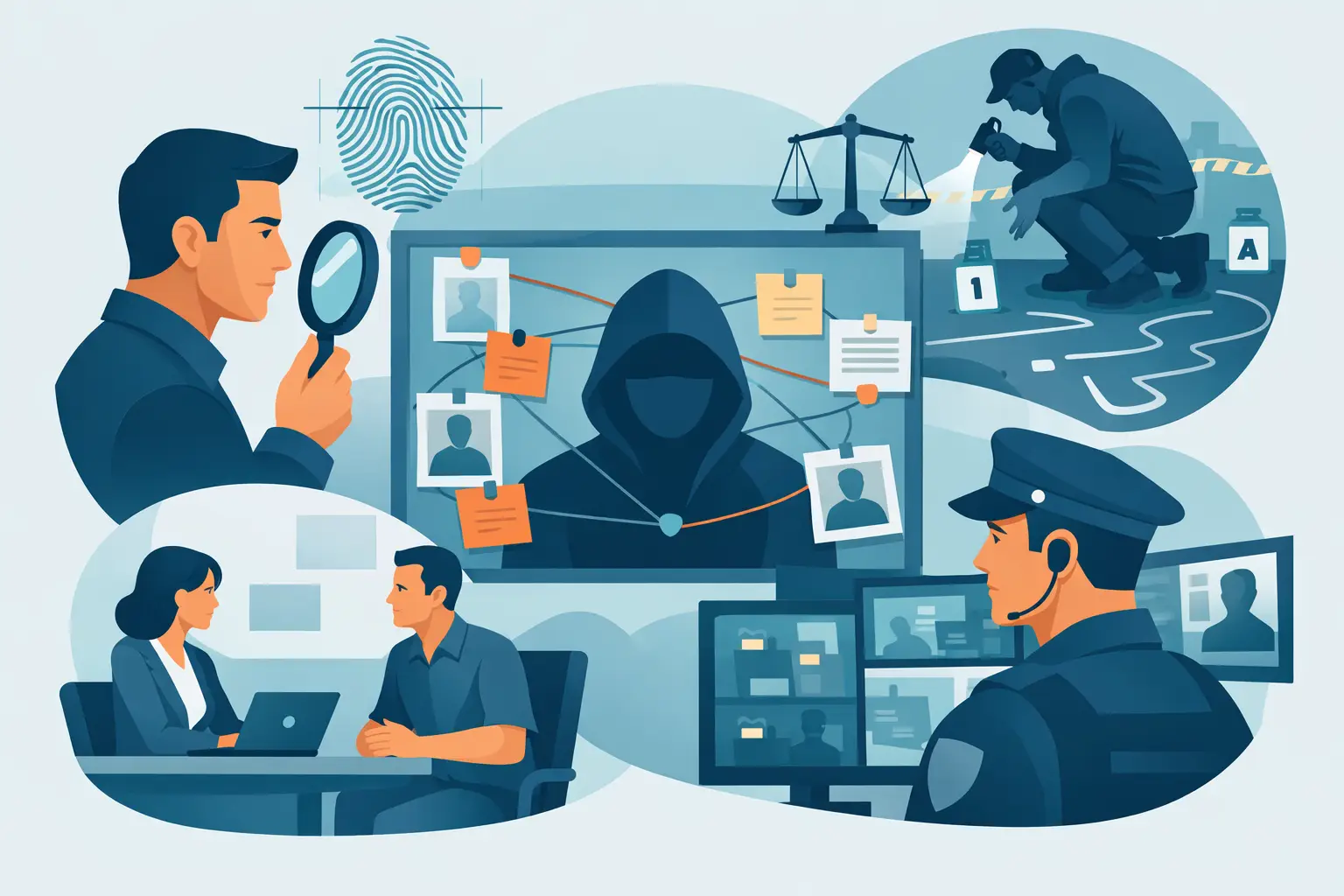
A behavioral profile is not a television-style revelation that identifies a suspect from a single clue. In professional settings, it is a disciplined way to interpret conduct, victimology, decision-making, risk, and patterns of escalation. For people asking what jobs use criminal profiling, the more useful question is: where do behavioral insights improve an investigation, prevent harm, or support a defensible decision?
The answer reaches beyond the narrow title of “criminal profiler.” Behavioral analysis is used across public safety, intelligence, security, fraud prevention, corrections, research, and selected clinical or legal contexts. The work varies substantially by role, jurisdiction, training, and organizational mission. In most careers, profiling is one capability within a larger professional toolkit – not a standalone occupation.
What Jobs Use Criminal Profiling and Behavioral Analysis?
Criminal investigative analyst
Criminal investigative analysts support complex investigations by organizing case information and developing evidence-informed behavioral interpretations. They may examine offender actions, crime-scene dynamics, victim selection, communication, timelines, geographic patterns, and links among incidents. Their findings can help investigators prioritize leads, shape interview strategies, identify investigative gaps, and assess whether cases may be connected.
This role is often associated with law enforcement agencies, specialized investigative units, or national and international policing organizations. It generally demands more than an interest in true crime. Analysts need strong research habits, knowledge of investigative procedure, careful report writing, and the humility to distinguish an informed hypothesis from a proven fact. A profile should guide inquiry, not replace evidence.
Detectives and major-crimes investigators
Detectives may use behavioral profiling principles even when their job title does not include the word “analyst.” In homicide, sexual assault, arson, child exploitation, stalking, missing-person, and serial-offense investigations, investigators constantly assess behavior. Why was a victim targeted? What does the sequence of actions suggest about planning or control? Which witnesses may be most vulnerable to pressure or manipulation?
For detectives, behavioral knowledge is especially valuable when it strengthens interviewing, victim-centered practice, threat assessment, and case prioritization. The trade-off is that detectives operate under operational pressure and legal constraints. They must prevent cognitive bias, preserve due process, and ensure that every conclusion remains anchored to corroborated facts.
Intelligence analyst
Intelligence professionals examine threats before or alongside criminal events. Their work may involve organized crime, terrorism, extremist violence, transnational networks, cyber-enabled harm, or public-safety threats. Behavioral analysis can help them understand recruitment methods, group dynamics, grievance narratives, operational security, escalation indicators, and likely targets.
Unlike a traditional case investigator, an intelligence analyst may be focused on patterns across many subjects, locations, or information streams. The central question is often not “who committed this offense?” but “what does this pattern indicate, and what risk may develop next?” This calls for analytic rigor, awareness of uncertainty, and the ability to communicate assessments clearly to decision-makers.
Threat assessment specialist
Threat assessment specialists evaluate concerning behavior in workplaces, schools, universities, healthcare organizations, government settings, and public venues. They do not predict violence with certainty. Instead, they assess the nature, context, and trajectory of a threat so organizations can make proportionate decisions about safety, support, monitoring, and intervention.
A threat assessment professional may review threatening communications, fixation on a target, grievance language, access to means, prior incidents, and signs of escalating stress or intent. The best practice is multidisciplinary: behavioral insight is considered alongside legal, security, human resources, clinical, and operational information. This is a field where careful documentation and ethical judgment matter as much as behavioral expertise.
Fraud and financial-crime analyst
Criminal profiling also has a meaningful place in financial investigations. Fraud analysts investigate the behavioral patterns behind embezzlement, identity theft, insider misconduct, romance scams, social engineering, procurement fraud, and money-laundering schemes. Their work may involve identifying how offenders establish trust, exploit controls, rationalize conduct, and adapt when detected.
In corporate, banking, insurance, and regulatory environments, the term “profiling” is often used less frequently than behavioral risk analysis or fraud typology. The underlying skill remains similar: interpreting patterns without making unsupported claims about an individual. Analysts combine transaction data, investigative interviews, digital evidence, and behavioral indicators to detect anomalies and recommend controls.
Cybersecurity and digital forensics professionals
Cybercrime has made behavioral analysis increasingly relevant to technical roles. Digital forensic examiners and cybersecurity analysts may study attacker behavior through tactics, techniques, infrastructure choices, communication styles, target selection, and timing. This can help distinguish opportunistic activity from targeted intrusion, identify recurring campaigns, and improve incident response.
Cyber behavioral analysis is not a substitute for technical expertise. A professional still needs competence in networks, systems, evidence preservation, malware, logs, and relevant legal standards. Yet understanding human motives and decision patterns can improve how teams anticipate phishing, insider threats, online harassment, extortion, and social-engineering attacks.
Correctional and rehabilitation professionals
Within correctional systems, behavioral assessment supports classification, risk management, institutional safety, case planning, and rehabilitation. Professionals may evaluate patterns of violence, coercive control, sexual offending, gang involvement, manipulation, or institutional misconduct. Their purpose is not simply to label individuals. It is to make responsible decisions about placement, supervision, treatment needs, and reintegration planning.
This work requires particular care. Risk assessment can have serious consequences for liberty and opportunity, so professionals must rely on validated approaches, relevant records, and transparent reasoning. Criminal profiling concepts may offer context, but they should never become a shortcut that reduces a person to a stereotype.
Behavioral research, policy, and consulting roles
Some professionals use profiling knowledge outside frontline investigations. Researchers study offending patterns, victimization, deception, decision-making, investigative bias, and the effectiveness of prevention strategies. Policy professionals translate this research into programs and protocols. Consultants may advise organizations on threat management, interview practices, fraud prevention, or behavioral risk.
These careers are well suited to professionals who enjoy methodical inquiry and want to influence systems rather than investigate individual cases. They often require advanced research literacy: the ability to evaluate studies, work with data, recognize limitations, and avoid overstating what behavioral evidence can establish.
The Skills Behind Careers That Use Criminal Profiling
The strongest professionals in this field are not defined by intuition alone. They know how to formulate questions, assess competing explanations, and revise their thinking when evidence changes. They can write precise reports that explain what is known, what is inferred, and what remains uncertain.
Foundational capabilities include criminology, forensic psychology, research methods, interviewing, behavioral analysis, ethics, and legal awareness. Depending on the career, professionals may also need intelligence analysis, statistics, digital forensics, financial investigation, risk assessment, or law enforcement experience. Communication is essential because an excellent analysis has limited value if investigators, executives, attorneys, or safety teams cannot apply it responsibly.
Cultural competence is equally important. Behavior does not occur in a vacuum. Social context, language, trauma, community norms, power dynamics, and access to resources can shape how conduct is expressed and interpreted. Professionals who ignore context risk mistaking difference for danger or constructing profiles that reinforce bias.
Education and Experience: Building a Credible Path
There is no single educational route into criminal profiling-related work. Many practitioners begin in law enforcement, military intelligence, psychology, corrections, cybersecurity, compliance, or fraud investigation, then add specialized graduate study. Others enter through academic research or analytical roles and develop operational knowledge through applied projects and practitioner collaboration.
A graduate-level education can be particularly valuable for professionals seeking to move from general criminal justice knowledge to advanced behavioral analysis. The right program should emphasize research quality, ethical practice, case-based learning, and faculty with meaningful field and scholarly experience. It should also make clear that profiling is a structured analytic discipline, not a collection of dramatic assumptions.
At Evidentia University, learners interested in forensic and behavioral sciences can pursue specialized study designed to connect academic depth with real-world professional relevance. For working adults, online study can make advanced training more accessible while allowing them to apply new frameworks within their current field.
A Career Field Defined by Judgment, Not Labels
Job titles change across agencies and industries, and many employers will not advertise for a “criminal profiler.” Search instead for roles involving behavioral analysis, investigative analysis, threat assessment, intelligence, fraud examination, risk management, or forensic research. Read the responsibilities closely. The meaningful opportunity may be embedded in an analyst, investigator, specialist, or consultant position.
The most promising path is the one that pairs behavioral expertise with a domain where decisions carry real consequences. Whether that domain is public safety, financial integrity, digital security, or rehabilitation, the goal is not to appear certain. It is to help people ask better questions, recognize risk earlier, and act with greater fairness and precision.